Advanced Precision in Oil and Gas Tank Fabrication
The manufacturing of oil and gas storage tanks requires adherence to stringent geometric tolerances and structural integrity standards, such as API 650 or ASME Section VIII. Traditionally, the industry relied on multi-stage processes involving manual layout, mechanical punching, and thermal cutting that often necessitated extensive post-processing. The shift toward Fiber Laser Cutting technology represents a significant leap in industrial efficiency. Unlike older CO2 systems or mechanical methods, fiber lasers utilize a solid-state gain medium, resulting in a beam with a shorter wavelength and higher absorption rates in metallic alloys.
In the context of large-scale tank production, precision is not merely a preference but a safety requirement. Fiber lasers deliver a concentrated energy density that allows for exceptionally narrow kerf widths. This level of control ensures that large-scale plate components—often exceeding 12 meters in length—maintain dimensional stability during the thermal cycle. By utilizing a high-power fiber source, typically ranging from 12kW to 30kW for heavy-walled vessels, engineers can achieve high-speed processing without compromising the edge quality of the carbon steel or stainless steel substrates.
The Role of Laser Seam Tracking in Cutting Accuracy
A primary challenge in cutting large cylindrical tank sections or dished heads is the inherent variation in material flatness and roundness. No industrial plate or pre-formed head is perfectly uniform. This is where Laser Seam Tracking (or advanced height sensing) becomes critical for the cutting head. While the term is often associated with joining processes, in high-end fiber laser cutting, it refers to the real-time triangulation sensors that monitor the topography of the tank surface ahead of the nozzle.
The sensor transmits data to the CNC controller at microsecond intervals, allowing the Z-axis to dynamically adjust the focal point. This constant standoff distance is vital for maintaining a consistent gas pressure and beam diameter at the point of impact. Without this tracking capability, deviations in the tank’s curvature would lead to focal shifts, resulting in dross accumulation, incomplete cuts, or damage to the laser optics. In oil and gas applications, where plate thickness can vary across a single shell transition, the ability of the laser to “track” and adapt to the surface ensures a uniform edge profile across the entire circumference of the vessel.
Integrated Workflow: Punching, Marking, and Cutting
One of the most significant efficiency gains in modern fiber laser systems is the “Single Setup” philosophy. A Fiber Laser Cutting Machine designed for the energy sector is no longer just a cutting tool; it is a multi-functional processing center. The system integrates three distinct operations into one continuous CNC program:
1. Precision Marking
Before the high-power cut begins, the laser operates in a low-frequency pulsing mode to etch part numbers, heat numbers, and assembly guides directly onto the plate. This permanent marking is essential for material traceability required by global oil and gas regulations. It eliminates the risk of human error associated with manual soapstone or paint marking.
2. High-Speed Punching
For bolt holes and nozzle apertures, the fiber laser performs high-speed piercing or “punching.” The rapid acceleration of the linear motors combined with the intensity of the fiber beam allows for clean, perpendicular holes with minimal taper. This is a critical advantage for the subsequent installation of flanges and manways, where alignment must be exact.
3. Final Geometry Cutting
The final phase involves the high-speed contouring of the tank shell or head. Because the laser creates a minimal Heat Affected Zone (HAZ), the metallurgical properties of the tank wall remain intact. This is a crucial factor for vessels intended to store pressurized or corrosive hydrocarbons, where any degradation of the base metal could lead to premature fatigue or stress corrosion cracking.
Eliminating Secondary Grinding Operations
In traditional heavy fabrication, the edge produced by thermal cutting is often oxidized or hardened, requiring mechanical grinding to reach a “bright metal” finish suitable for assembly. Fiber laser technology, particularly when used with high-pressure nitrogen or oxygen assist gases, produces a finish that is virtually free of dross and oxide layers. This no grinding advantage translates directly to reduced labor costs and faster throughput.
By achieving a high-quality surface finish directly from the machine, the components can move straight to the fit-up stage. The elimination of manual grinding also improves the safety of the shop floor by reducing noise levels and the amount of airborne metallic dust. From an industrial engineering perspective, this streamlines the Value Stream Map (VSM) by removing a non-value-added step that traditionally bottlenecked production.
Technical Optimization and Material Utilization
Material costs represent a massive portion of the total expenditure in oil and gas projects. Fiber laser systems utilize sophisticated nesting software that calculates the most efficient layout for tank components. Because the laser has such a small kerf width—often less than 0.3mm—parts can be nested much more tightly than with mechanical or older thermal methods. This high level of material utilization reduces scrap rates significantly.
Furthermore, the high-speed capabilities of fiber lasers (frequently exceeding 60m/min on thinner gauges and maintaining high feed rates on thick plates) ensure that the machine’s duty cycle is maximized. The solid-state nature of the laser source also means lower maintenance requirements compared to CO2 lasers, as there are no internal mirrors to align or turbine blowers to service. This results in higher machine uptime and a more predictable production schedule for large-scale infrastructure projects.
Summary of Engineering Advantages
The implementation of a fiber laser cutting machine with laser tracking for oil and gas tank production offers a clear technical advantage. The synergy between high-precision beam delivery and real-time surface compensation allows for the fabrication of complex vessel components with unprecedented accuracy. By consolidating marking, punching, and cutting, and by eliminating the need for post-cut grinding, manufacturers can achieve a superior level of productivity while meeting the rigorous safety and quality standards of the energy industry. The result is a robust, repeatable process that minimizes waste and maximizes structural performance.
-


Cantilever Welding Robot solution
-


GF laser cutting machine
-

P3015 plasma cutting machine
-

LFP3015 Fiber Laser Cutter
-

pipe plasma cutting machine
-
LFH 4020 Fiber Laser Cutting Machine
-
LFP4020
-

gantry plasma air cutting machine
-

3D robot cutting machine
-

8 axis plasma cutting machine
-

5 axis plasma cutting machine
-

LT360 tube laser cutting machine
-

robot welding workstation
-

SF6060 fiber laser cutting machine
Advanced Fiber Laser Tube Processing Technology
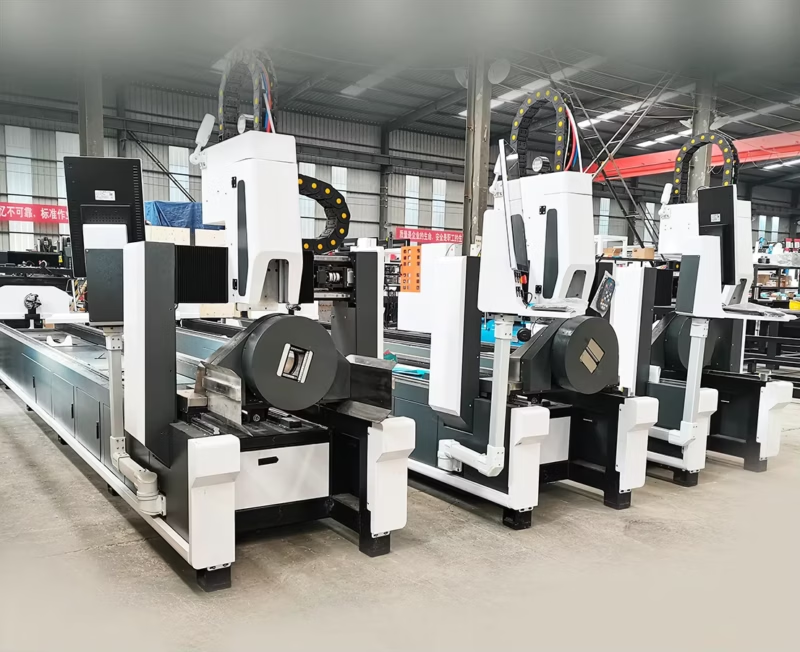
Our CNC Fiber Laser Tube Cutting systems revolutionize metal fabrication by integrating high-precision cutting, punching, and profiling into a single automated workflow. Designed for versatility, this technology handles a wide array of profiles including Round, Square, Rectangular, and Oval tubes, as well as complex L-shaped and U-shaped channels.
- Precision Punching: High-speed hole punching with micron-level accuracy, eliminating the need for mechanical drilling or die-stamping.
- Complex Profiling: Advanced 3D pathing allows for intricate interlocking joints and specialized notch cuts, ideal for structural frames.
- High Material Efficiency: Intelligent nesting software minimizes scrap, reducing raw material costs across large production runs.
- Clean Finish: Delivers oxide-free, burr-free edges that require zero secondary grinding before welding.

Seamlessly processing multiple profiles with consistent precision.
Global Delivery & Logistics



From our high-tech manufacturing facility directly to your global site. PCL WeldCut ensures secure packaging, professional handling, and reliable international logistics to safeguard your equipment throughout the entire journey.