Strategic Implementation of Fiber Laser Systems in Tank Fabrication
In the rigorous landscape of Oil and Gas infrastructure, the engineering requirements for storage tanks and pressure vessels demand uncompromising structural integrity. The transition toward fiber Laser Cutting technology represents a critical shift in how large-scale plate components are processed. Unlike traditional mechanical methods, fiber lasers utilize a solid-state gain medium, resulting in a beam with a significantly smaller footprint and higher energy density. This technical advantage allows for high-speed processing of carbon steel and stainless steel alloys while maintaining a narrow kerf width, which is essential for the tight tolerances required in tank assembly.
Industrial engineers focus on the fiber laser’s ability to deliver consistent beam quality over long durations. This consistency is paramount when cutting large-diameter tank shells where a single continuous cut may span several meters. The integration of high-wattage resonators—often ranging from 12kW to 30kW for industrial tank applications—ensures that the material’s Heat Affected Zone (HAZ) remains minimal. By controlling the thermal input, the metallurgical properties of the tank plates are preserved, preventing the brittleness or edge hardening that complicates downstream processes.
The Role of Laser Seam Tracking in Non-Linear Geometries
One of the primary challenges in fabricating Oil and Gas tanks is the inherent irregularity of large-format plates and the curvature of cylindrical sections. A laser seam tracking system is integrated into the cutting head assembly to compensate for these variances in real-time. This system utilizes a laser displacement sensor to map the surface topography of the workpiece before and during the cutting cycle.
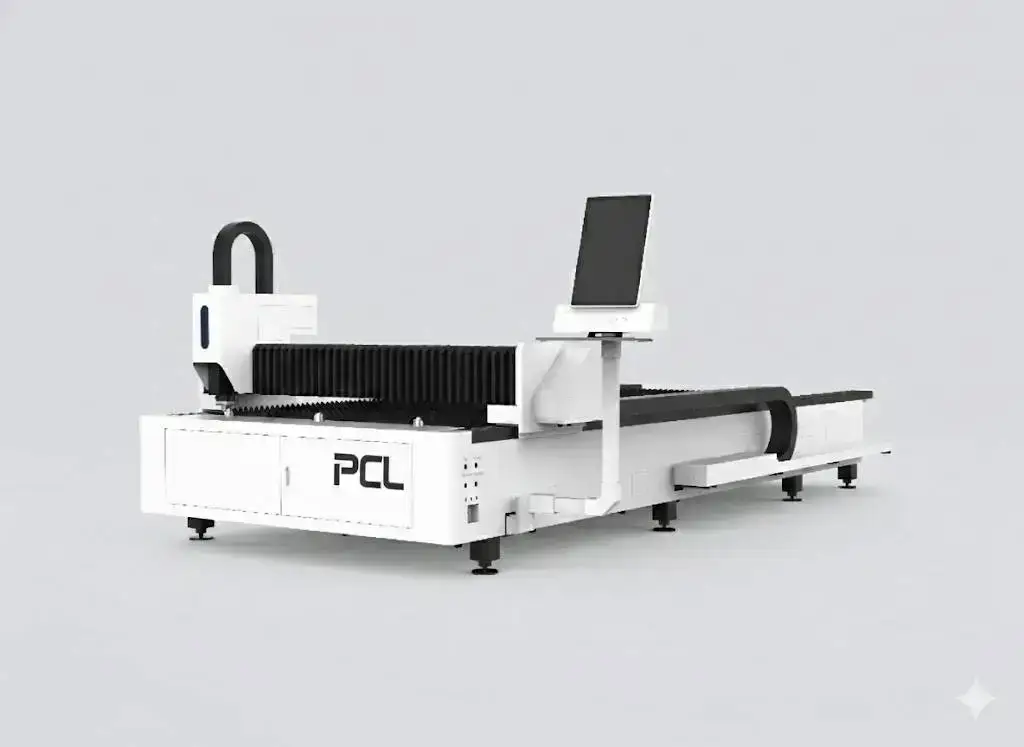
The seam tracking logic operates on a closed-loop feedback mechanism. As the cutting head moves along the programmed path, the sensor detects deviations in plate flatness or the exact position of a pre-rolled edge. This data is fed directly into the CNC controller, which adjusts the Z-axis height and XY coordinates with millisecond responsiveness. This level of automation ensures that the focal point of the laser remains optimal relative to the material surface, regardless of mechanical inconsistencies. In the context of tank fabrication, this translates to perfectly perpendicular edges and uniform bevels, which are foundational for high-quality longitudinal and circumferential joints.
The Efficiency of the Punch, Mark, and Cut Workflow
Efficiency in an industrial setting is measured by the reduction of “touches” per part. Modern fiber laser systems for the Oil and Gas sector utilize a multi-functional approach often described as the “Punch, Mark, and Cut” cycle. This integrated workflow consolidates three distinct manufacturing steps into a single CNC program, executed in one setup.
Precision Punching and Piercing
Before the main contouring begins, the fiber laser performs high-speed piercing or “punching” for nozzle openings and manway bolt holes. Unlike mechanical punching, which induces stress on the plate, laser piercing is non-contact. The CNC controls the ramp-up of laser power and gas pressure to create clean, dross-free entries even in thick-gauge materials. This precision eliminates the need for manual drilling or reaming of holes.
Automated Marking for Assembly
Following the piercing phase, the laser shifts to a low-power marking mode. The system etches part numbers, heat numbers, and, crucially, layout lines for internal baffles, stiffeners, and support structures directly onto the plate. This automated tank fabrication feature removes the human error associated with manual layout and chalk lining. Because the marking is performed by the same gantry and coordinate system as the cutting, the spatial accuracy between the cut edge and the layout mark is absolute.
Final High-Speed Contouring
The final stage is the high-speed cutting of the plate perimeter. Because the fiber laser provides a superior edge finish, the “No Grinding” protocol can be strictly enforced. The oxide-free edges produced using nitrogen or specialized mix-gas cutting mean that the plates are ready for the next stage of production immediately upon leaving the laser bed. This eliminates hundreds of man-hours typically spent on manual edge cleaning and slag removal.
Technical Superiority: Eliminating Secondary Grinding
From a lean manufacturing perspective, grinding is a non-value-added activity that introduces dust, noise, and safety hazards into the facility. Fiber laser systems optimize the cutting parameters—frequency, duty cycle, and gas flow—to achieve a surface roughness (Ra) that meets or exceeds ISO 9013 Grade 2 standards. In tank fabrication, where edge preparation is vital for volumetric integrity, the ability to bypass the grinding station provides a massive throughput advantage.
The high energy density of the fiber laser ensures that the molten material is efficiently ejected from the kerf by the assist gas. This results in a clean underside with no dross attachment. For Oil and Gas tanks that must withstand internal pressures or corrosive contents, the absence of micro-cracks or thermal scarring on the cut edge is a significant quality assurance metric.
Data Integration and Industrial Optimization
The adoption of high-precision thermal cutting through fiber lasers allows for seamless integration into a factory’s ERP and CAD/CAM systems. Engineers can utilize nesting software to maximize material utilization of expensive alloys, reducing scrap rates in tank head and shell production. The real-time data provided by the laser seam tracking system can also be logged for quality control documentation, providing a digital “as-built” record of the plate geometry.
Total Cost of Ownership and ROI
While the initial capital expenditure for a fiber laser system with seam tracking is significant, the return on investment (ROI) is realized through reduced labor costs and increased plate processing speeds. Fiber lasers operate at wall-plug efficiencies of 30% to 40%, significantly higher than CO2 alternatives. Furthermore, the lack of mirrors and bellows reduces maintenance downtime, ensuring the machine remains operational during high-demand production cycles.
Summary of Engineering Benefits
- Precision: Achievement of +/- 0.1mm tolerances on large-format plates.
- Surface Integrity: Elimination of secondary grinding through dross-free cutting.
- Automation: Seam tracking compensates for material warping and rolling inaccuracies.
- Workflow: Multi-process capability (punch, mark, cut) in a single setup.
In conclusion, the integration of fiber laser technology into the fabrication of Oil and Gas tanks provides a robust solution for modernizing production. By leveraging the precision of laser seam tracking and the versatility of the fiber source, manufacturers can ensure higher quality vessels while optimizing operational costs and floor space.
-


LT240S tube laser cutting machine
-
LT120S tube laser cutting machine
-
Sale

Tank Fillet Welding Machine
Original price was: $1,000.00.$900.00Current price is: $900.00. -
Sale

MAK100 tube laser cutting machine
Original price was: $5,500.00.$5,000.00Current price is: $5,000.00. -

portable plasma air cutting machine
$1,200.00 -

2in1 fiber laser cutting machine
-

Air cooling Laser welding machine
-

HF h beam laser cutting machine
-

LT240 laser cutting machine
-

Laser welding machine
-


Cobot Welding Station
-

Gantry welding robot solution
-

Tracked Wheeled AGV Welding robot
-

LFH6020 Fiber laser cutting machine
-
LFP6020
-

robotic welidng machine
Advanced Fiber Laser Tube Processing Technology
Our CNC Fiber Laser Tube Cutting systems revolutionize metal fabrication by integrating high-precision cutting, punching, and profiling into a single automated workflow. Designed for versatility, this technology handles a wide array of profiles including Round, Square, Rectangular, and Oval tubes, as well as complex L-shaped and U-shaped channels.
- Precision Punching: High-speed hole punching with micron-level accuracy, eliminating the need for mechanical drilling or die-stamping.
- Complex Profiling: Advanced 3D pathing allows for intricate interlocking joints and specialized notch cuts, ideal for structural frames.
- High Material Efficiency: Intelligent nesting software minimizes scrap, reducing raw material costs across large production runs.
- Clean Finish: Delivers oxide-free, burr-free edges that require zero secondary grinding before welding.

Seamlessly processing multiple profiles with consistent precision.
Global Delivery & Logistics



From our high-tech manufacturing facility directly to your global site. PCL WeldCut ensures secure packaging, professional handling, and reliable international logistics to safeguard your equipment throughout the entire journey.