Precision Requirements in LNG Fabrication
Liquefied Natural Gas (LNG) projects operate under extreme cryogenic conditions, typically reaching temperatures as low as -162 degrees Celsius. The structural integrity of storage tanks, vaporizers, and piping systems depends entirely on the metallurgical stability of the materials used, primarily 9% nickel steel and 300-series stainless steel. From an industrial engineering perspective, the manufacturing process must prioritize the minimization of thermal stress and the maximization of edge quality.
Traditional thermal cutting methods often leave significant dross and a wide heat-affected zone (HAZ), necessitating labor-intensive secondary grinding. However, the adoption of Fiber Laser Cutting technology has redefined these benchmarks. By utilizing a high-power density beam, these machines achieve a narrow kerf width and a negligible HAZ, ensuring that the mechanical properties of the alloy remain intact throughout the cutting process.
Integrating Laser Seam Tracking for Large-Scale Components
LNG components, particularly tank shells and large-diameter piping, are characterized by their significant dimensions. During the loading of large plates onto a cutting bed, mechanical tolerances and material warping are inevitable. Standard pre-programmed cutting paths often fail to account for these microscopic variations in surface height or plate alignment.
Real-Time Compensation Mechanisms
The integration of Laser Seam Tracking sensors allows the cutting head to dynamically adjust its position in real-time. By utilizing a laser triangulation sensor or a vision-based tracking system, the machine maps the actual topography of the workpiece. This data is fed back into the CNC controller with millisecond latency, adjusting the focal point and the Z-axis height. This ensures that the standoff distance remains constant, which is critical for maintaining consistent beam intensity and edge squareness across a 12-meter plate.
Eliminating Geometric Deviations
For industrial engineers, the primary KPI is the reduction of scrap. Laser seam tracking eliminates the risks associated with “air cutting” or inconsistent penetration caused by plate undulation. In LNG projects where material costs for nickel-alloys are exceptionally high, the ability to maintain a precision of +/- 0.1mm over large spans directly correlates to project profitability.
The Multi-Process Advantage: Punch, Mark, and Cut
Efficiency in an industrial workflow is achieved by reducing the number of “touches” per part. Modern fiber laser systems designed for the energy sector are no longer single-function machines. They serve as integrated fabrication centers that perform three critical functions in a single nesting cycle.
1. High-Precision Punching and Piercing
The fiber laser utilizes ultra-fast pulsing technology to create high-aspect-ratio holes. Unlike mechanical punching, there is no tool wear or mechanical deformation of the surrounding material. This is essential for flange bolt holes and pressure-relief vents in LNG modules where stress concentrations must be avoided.
2. Component Marking and Traceability
Traceability is a non-negotiable requirement for LNG infrastructure. Every plate must be identified by heat number and project code. The laser system can switch parameters to a lower power setting to etch or mark the surface of the metal without compromising its thickness or structural integrity. This replaces manual stamping and ensures that identification persists through the entire assembly process.
3. Final Precision Cutting
The final stage is the high-speed contouring of the part. Because the marking and piercing were done in the same coordinate system without moving the workpiece, the spatial accuracy between the marks, holes, and edges is absolute. This level of synchronization is impossible to achieve with manual layout methods.
Eliminating Secondary Processes: No Grinding Required
One of the most significant cost drivers in heavy fabrication is “man-hours spent grinding.” When cutting thick stainless steel or 9% nickel plates for LNG tanks, the objective is to produce an edge that is ready for immediate fit-up. Fiber Laser Cutting achieves a surface roughness (Ra) that often meets or exceeds the requirements for high-pressure cryogenic vessels.
Maintaining Metallurgical Integrity
The high energy density of the fiber laser allows for extremely high feed rates. This speed results in a very low heat input per unit of length. Consequently, the edge of the cut does not undergo the phase transformation or carbon precipitation that typically occurs with slower thermal processes. For the engineer, this means the part can move directly from the cutting bed to the assembly area without needing a secondary mechanical edge cleaning or dross removal stage.
Optimized Kerf Control
The narrow kerf of the fiber laser (often less than 0.2mm) allows for tighter nesting of parts. In an LNG project requiring thousands of brackets and stiffeners, a 5% increase in Material Utilization can result in six-figure savings. Furthermore, the perpendicularity of the cut edge ensures that during the fit-up phase, the gaps are consistent, which is a prerequisite for automated longitudinal welding of tank sections.
Strategic Implementation in Industrial Workflows
The transition to fiber laser systems with seam tracking requires a shift in shop floor management. The focus moves from “manual skill” to “process parameter optimization.” By utilizing advanced nesting software, engineers can simulate the cutting process to identify potential thermal bottlenecks before the first plate is loaded.
Standardization of Cutting Gases
To achieve the “no grinding” goal in LNG projects, the choice of assist gas is paramount. Using high-pressure Nitrogen (N2) as an assist gas ensures an oxide-free cut edge. This is vital for stainless steel components in LNG environments to maintain corrosion resistance. The fiber laser’s ability to manage gas flow dynamically based on the material thickness further enhances the edge quality and reduces gas consumption costs.
Throughput Metrics and ROI
From a CAPEX perspective, a fiber laser machine is a significant investment. However, when evaluating the Total Cost of Ownership (TCO), the reduction in downstream labor costs (grinding, manual marking, rework) provides a rapid return on investment. In a typical LNG module project, the throughput of a fiber laser system can be 3 to 4 times higher than traditional methods, while simultaneously reducing the reject rate to near zero.
Conclusion: The Future of Cryogenic Fabrication
The demand for LNG as a transition fuel continues to grow globally, putting pressure on fabrication yards to deliver faster and with higher precision. The integration of Fiber Laser Cutting with real-time laser seam tracking represents the pinnacle of current industrial engineering capability. By providing a clean, “no-grind” finish and combining punching, marking, and cutting into a single automated workflow, manufacturers can meet the stringent safety and quality standards of the energy industry while maintaining a competitive edge in production efficiency.
-


LT240S tube laser cutting machine
-
LT120S tube laser cutting machine
-
Sale

Tank Fillet Welding Machine
Original price was: $1,000.00.$900.00Current price is: $900.00. -
Sale

MAK100 tube laser cutting machine
Original price was: $5,500.00.$5,000.00Current price is: $5,000.00. -

portable plasma air cutting machine
$1,200.00 -

2in1 fiber laser cutting machine
-

Air cooling Laser welding machine
-

HF h beam laser cutting machine
-

LT240 laser cutting machine
-

Laser welding machine
-


Cobot Welding Station
-

Gantry welding robot solution
-

Tracked Wheeled AGV Welding robot
-

LFH6020 Fiber laser cutting machine
-
LFP6020
-

robotic welidng machine
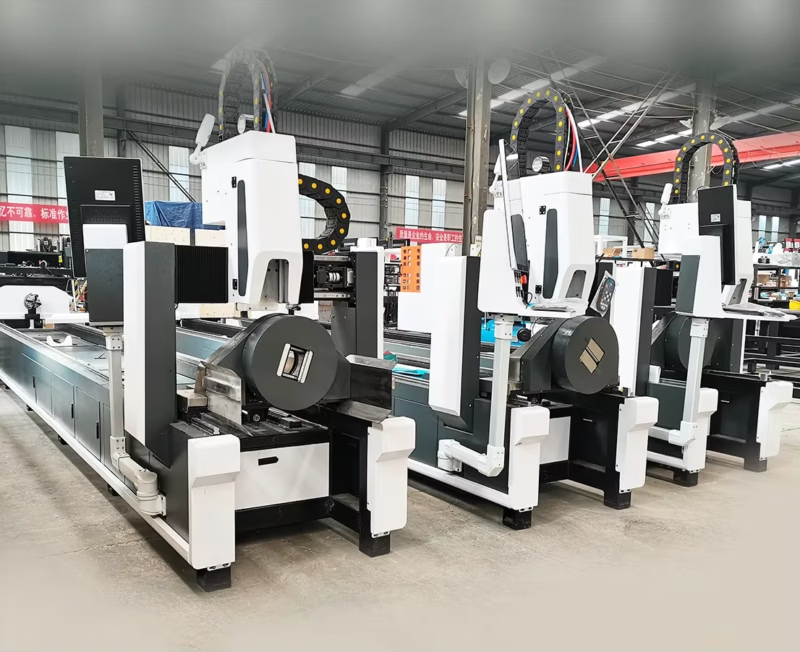
Advanced Fiber Laser Tube Processing Technology
Our CNC Fiber Laser Tube Cutting systems revolutionize metal fabrication by integrating high-precision cutting, punching, and profiling into a single automated workflow. Designed for versatility, this technology handles a wide array of profiles including Round, Square, Rectangular, and Oval tubes, as well as complex L-shaped and U-shaped channels.
- Precision Punching: High-speed hole punching with micron-level accuracy, eliminating the need for mechanical drilling or die-stamping.
- Complex Profiling: Advanced 3D pathing allows for intricate interlocking joints and specialized notch cuts, ideal for structural frames.
- High Material Efficiency: Intelligent nesting software minimizes scrap, reducing raw material costs across large production runs.
- Clean Finish: Delivers oxide-free, burr-free edges that require zero secondary grinding before welding.

Seamlessly processing multiple profiles with consistent precision.
Global Delivery & Logistics



From our high-tech manufacturing facility directly to your global site. PCL WeldCut ensures secure packaging, professional handling, and reliable international logistics to safeguard your equipment throughout the entire journey.