The Shift Toward Fiber Laser Precision in Construction Machinery
In the heavy machinery sector—encompassing excavators, loaders, and cranes—the demand for high-strength structural steel components is constant. Traditionally, these industries relied on multi-stage processes that involved separate marking, mechanical punching, and thermal cutting. However, the modern industrial engineering focus has shifted toward Fiber Laser Cutting to achieve higher throughput and tighter tolerances. This transition is not merely an upgrade in speed; it is a fundamental shift in how structural integrity is maintained from the raw plate to the final assembly.
The core advantage of fiber laser technology lies in its short wavelength (typically around 1.06 microns), which allows for high absorption rates in carbon steel and high-strength alloys. This energy efficiency translates into a narrow kerf width and a minimal heat-affected zone (HAZ), which are critical for components subject to extreme fatigue and stress in the field.
Advanced Seam Tracking: Ensuring Geometric Accuracy
One of the primary challenges in processing large-format plates for Construction Machinery is material variance. Large steel plates often exhibit slight warping, surface irregularities, or positioning shifts during the loading process. Laser Seam Tracking (often referred to in a cutting context as edge detection or vision-based tracking) mitigates these issues by using high-resolution sensors to map the material’s actual position in real-time.
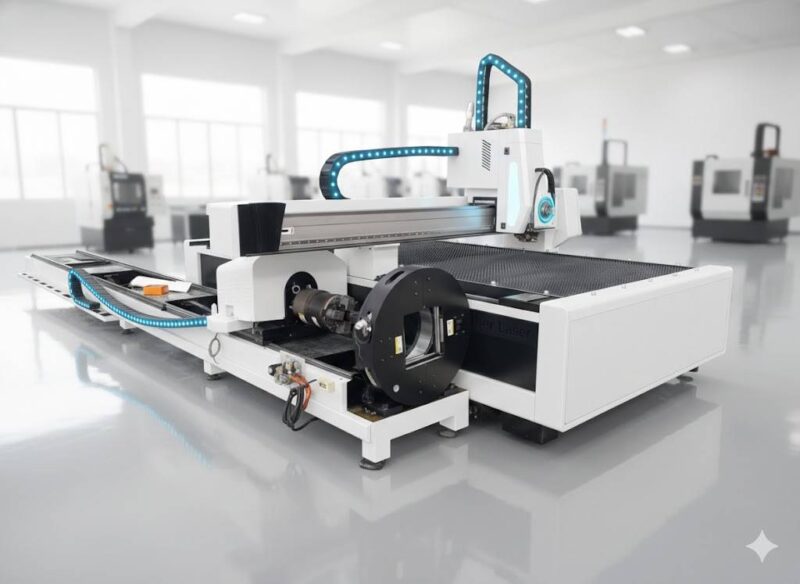
Real-Time Path Correction
The laser seam tracking system utilizes a non-contact sensor to identify the precise boundaries and topographical features of the workpiece. Before the cutting head begins its path, the system performs a high-speed scan to calibrate the CNC coordinates with the physical orientation of the plate. This ensures that the cutting path remains perfectly aligned with the structural design, regardless of any thermal expansion or material deformation that may occur during high-power output operations.
Maintaining Constant Stand-Off Distance
Consistent cut quality requires a precise stand-off distance between the laser nozzle and the material surface. In construction machinery fabrication, where plate thickness can vary significantly across a single batch, the tracking system dynamically adjusts the Z-axis. This prevents collisions and ensures that the focal point of the beam remains optimized for a clean, perpendicular cut, which is essential for the “no grinding” mandate of modern lean manufacturing.
Integrated Punching, Marking, and Cutting Workflows
Modern Construction Machinery fabrication demands high traceability and precise hole alignment for fasteners and hydraulic routing. The integration of marking and punching functions directly into the fiber laser cycle represents a major efficiency gain. Instead of transferring heavy plates between different machine tools, a single fiber laser center executes all three tasks in one setup.
High-Speed Part Marking
Traceability is mandatory in heavy equipment manufacturing for safety and maintenance logs. The fiber laser can be tuned to a lower power density to etch part numbers, QR codes, or alignment notches into the steel surface. Because this occurs in the same coordinate system as the cut, there is zero risk of marking misalignment, facilitating easier downstream sorting and inventory management.
Precision Hole Processing and Slotting
While mechanical punching can cause micro-fractures around hole perimeters, fiber laser cutting produces clean, burr-free apertures. The high power density allows for “punching” or piercing start holes in thick plates in milliseconds. This precision is vital for the assembly of boom arms and chassis components where bolt-hole alignment must be exact to prevent structural stresses during high-load operations.
Eliminating Secondary Operations: The No Grinding Standard
From an industrial engineering perspective, the most significant cost-saving factor of fiber laser integration is the elimination of secondary grinding. Traditional thermal cutting methods often leave dross, slag, or heavily oxidized edges that require manual labor to clean before assembly. Fiber laser systems, particularly when used with high-pressure nitrogen or oxygen assist gases, produce an edge finish that is ready for immediate fit-up.
Edge Quality and Paint Adhesion
The smooth, square edges produced by a fiber laser provide a superior substrate for industrial coatings. In construction environments, where machines are exposed to corrosive elements, the quality of the cut edge directly impacts the longevity of the paint and rust-prevention layers. By removing the grinding stage, manufacturers not only reduce labor costs but also eliminate the variability introduced by manual finishing, leading to a more standardized and reliable final product.
Thermal Deformation Control
High-power fiber lasers concentrate energy so effectively that the surrounding material remains relatively cool. This localized heating prevents the warping and “bowing” often seen in large-format structural components. Maintaining the flatness of the part throughout the cutting process ensures that the finished component fits perfectly into the assembly jig, reducing the need for corrective hydraulic pressing or rework.
Optimizing Throughput in Heavy-Duty Fabrication
The implementation of Precision Metal Fabrication techniques via fiber lasers allows for higher nesting density. Because the laser can maintain stability at extremely close proximity to previous cuts, material utilization is maximized. In the context of expensive high-strength steel used in construction equipment, even a 5% increase in nesting efficiency can result in substantial annual savings.
Automated Material Handling
To match the high-speed output of the fiber laser, many systems are paired with automated shuttle tables and load/unload robots. This creates a continuous production loop where the laser seam tracking system identifies the next plate as soon as it is positioned, maintaining a high Duty Cycle. For the production of excavator buckets, frames, and support beams, this level of automation ensures that the cutting department is never a bottleneck for the assembly line.
Conclusion: The Engineer’s Choice for Reliability
For the construction machinery industry, the Fiber Laser Cutting Machine is more than just a tool; it is a comprehensive solution for precision manufacturing. By leveraging laser seam tracking, engineers can guarantee that every component—from the smallest bracket to the largest structural frame—meets exact specifications without the need for manual intervention or secondary refining. The integration of marking and cutting into a single, high-precision workflow streamlines the supply chain and enhances the overall durability of the machinery delivered to the field.
-


Cantilever Welding Robot solution
-


GF laser cutting machine
-

P3015 plasma cutting machine
-

LFP3015 Fiber Laser Cutter
-

pipe plasma cutting machine
-
LFH 4020 Fiber Laser Cutting Machine
-
LFP4020
-

gantry plasma air cutting machine
-

3D robot cutting machine
-

8 axis plasma cutting machine
-

5 axis plasma cutting machine
-

LT360 tube laser cutting machine
-

robot welding workstation
-

SF6060 fiber laser cutting machine
Advanced Fiber Laser Tube Processing Technology
Our CNC Fiber Laser Tube Cutting systems revolutionize metal fabrication by integrating high-precision cutting, punching, and profiling into a single automated workflow. Designed for versatility, this technology handles a wide array of profiles including Round, Square, Rectangular, and Oval tubes, as well as complex L-shaped and U-shaped channels.
- Precision Punching: High-speed hole punching with micron-level accuracy, eliminating the need for mechanical drilling or die-stamping.
- Complex Profiling: Advanced 3D pathing allows for intricate interlocking joints and specialized notch cuts, ideal for structural frames.
- High Material Efficiency: Intelligent nesting software minimizes scrap, reducing raw material costs across large production runs.
- Clean Finish: Delivers oxide-free, burr-free edges that require zero secondary grinding before welding.

Seamlessly processing multiple profiles with consistent precision.
Global Delivery & Logistics



From our high-tech manufacturing facility directly to your global site. PCL WeldCut ensures secure packaging, professional handling, and reliable international logistics to safeguard your equipment throughout the entire journey.