Optimizing Heavy-Duty Fabrication with Fiber Laser Systems
In the production of construction machinery, structural integrity and dimensional accuracy are the primary metrics for success. The shift from traditional thermal cutting methods to high-wattage Fiber Laser Cutting Machine technology has redefined the tolerances achievable on the shop floor. For components such as excavator frames, loader buckets, and telescopic crane booms, the requirement for high-strength steel plate processing necessitates a system that can handle thicknesses exceeding 20mm while maintaining a narrow kerf width and minimal heat-affected zones (HAZ).
The industrial engineer’s objective is to maximize throughput while minimizing the Total Cost of Ownership (TCO). Fiber lasers facilitate this by offering electrical conversion efficiencies significantly higher than legacy CO2 systems. However, the true value in the construction machinery sector lies in the machine’s ability to produce “weld-ready” parts directly from the cutting bed, eliminating the labor-intensive stages of edge cleaning and manual correction.
The Role of Laser Seam Tracking in Large-Format Cutting
Large-format plates used in construction equipment often exhibit surface irregularities, such as slight warping or material tension release during the cutting process. Standard capacitive height sensing is sometimes insufficient when dealing with massive workpieces that span 12 meters or more. This is where Laser Seam Tracking becomes an essential hardware integration. By utilizing high-speed optical sensors, the system scans the material surface ahead of the cutting head in real-time.
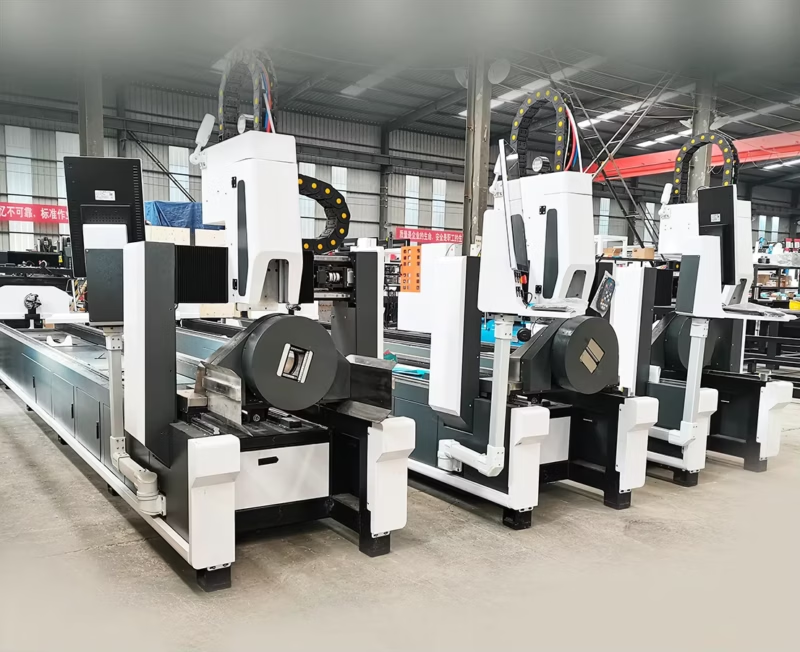
This tracking technology provides a continuous feedback loop to the CNC controller, adjusting the focal position and nozzle height dynamically. In construction machinery fabrication, where parts are often nested across large areas, seam tracking ensures that the beam remains perpendicular and the focus point stays consistent regardless of plate deformation. This level of precision is critical for the subsequent automated assembly of structural box sections, where gap fit-up tolerances are measured in fractions of a millimeter.
Precision Benchmarks: Eliminating the Grinding Phase
One of the most significant bottlenecks in heavy machinery manufacturing is the secondary processing of cut edges. Traditional methods often leave dross, slag, or a hardened carbon layer that interferes with weld penetration. High-precision fiber lasers, configured with optimized assist gas pressures (typically Oxygen for carbon steel or Nitrogen for stainless), produce a surface roughness (Ra) that meets ISO 9013 Grade 1 or 2 standards.
By achieving such high edge quality, the requirement for grinding is entirely removed from the workflow. This “no-grinding” capability directly translates to a reduction in man-hours and consumable costs. Industrial engineers can reallocate labor resources from manual finishing to high-value assembly tasks. Furthermore, the absence of mechanical grinding ensures that the base material’s grain structure remains untainted by the localized heat friction typical of abrasive discs, preserving the mechanical properties of high-yield-strength steels like S700 or S900.
Integrated Functionality: Punching, Marking, and Cutting
Efficiency in Construction Machinery fabrication is gained through process consolidation. Modern fiber laser workstations are no longer just cutting tools; they function as multi-process machining centers. A single programmed routine can execute three distinct operations: marking, punching (piercing), and final profile cutting.
Dynamic Marking for Downstream Logistics
Integrated marking utilizes the laser at a lower power density to etch part numbers, fold lines, and assembly locators directly onto the surface of the component. This eliminates the need for manual layout or inkjet labeling, which often fails during subsequent shot-blasting or painting processes. For complex assemblies with hundreds of unique plate components, permanent laser marking is the backbone of internal traceability and lean inventory management.
Optimized Piercing and Punching
The “punch” phase refers to the laser’s ability to execute high-speed, high-pressure piercings. In thick-plate applications, traditional piercing can take several seconds and create significant splatter. Advanced fiber laser controllers use frequency-modulated piercing cycles to create clean, small-diameter holes that rival mechanical punching in speed and surpass it in flexibility. This allows for the immediate inclusion of bolt holes and drainage ports within the cutting cycle, ensuring perfect concentricity with the outer profile of the part.
Technical Advantages of Integrated Marking and Cutting
When Integrated Marking and Cutting is performed in a single setup, the spatial relationship between the mark and the edge is absolute. There is no risk of misalignment caused by moving the part between different machines. For industrial engineers, this means the “First Time Right” ratio increases significantly. The precision afforded by the fiber laser’s linear drives and optical feedback ensures that even the most complex geometries—such as interlocking tabs for frame alignment—are executed with repeatable accuracy across multiple shifts.
Material Handling and Thermal Management
Processing the thick plates common in construction machinery requires a sophisticated approach to thermal management. Fiber lasers provide a concentrated energy source that minimizes the total heat input into the workpiece. This reduction in thermal load is vital for maintaining the flatness of large parts. Engineers must configure the nesting software to utilize “bridge cutting” or “common line cutting” techniques, which, when combined with the laser’s precision, further reduce material waste and cycle times.
The use of automated shuttle tables and load/unload systems further enhances the fiber laser’s productivity. While one plate is being processed with the laser seam tracking system, the operator can clear the finished parts from the second table. This 100% duty cycle is essential for meeting the high-volume production demands of global construction equipment OEMs.
Conclusion: The Engineering Impact on Throughput
Transitioning to a fiber laser system equipped with seam tracking represents a strategic shift in heavy fabrication. By prioritizing high-precision output that requires no secondary grinding, manufacturers can drastically shorten the lead time from raw plate to finished assembly. The ability to mark and cut in a single pass ensures that the manufacturing flow remains uninterrupted by manual intervention. For the industrial engineer, the result is a streamlined, data-driven production environment where the fiber laser serves as the critical node in a high-efficiency manufacturing ecosystem. The focus remains on geometric perfection, metallurgical integrity, and optimized cycle times—the three pillars of modern construction machinery engineering.
-


LT240S tube laser cutting machine
-
LT120S tube laser cutting machine
-
Sale

Tank Fillet Welding Machine
Original price was: $1,000.00.$900.00Current price is: $900.00. -
Sale

MAK100 tube laser cutting machine
Original price was: $5,500.00.$5,000.00Current price is: $5,000.00. -

portable plasma air cutting machine
$1,200.00 -

2in1 fiber laser cutting machine
-

Air cooling Laser welding machine
-

HF h beam laser cutting machine
-

LT240 laser cutting machine
-

Laser welding machine
-


Cobot Welding Station
-

Gantry welding robot solution
-

Tracked Wheeled AGV Welding robot
-

LFH6020 Fiber laser cutting machine
-
LFP6020
-

robotic welidng machine
Advanced Fiber Laser Tube Processing Technology
Our CNC Fiber Laser Tube Cutting systems revolutionize metal fabrication by integrating high-precision cutting, punching, and profiling into a single automated workflow. Designed for versatility, this technology handles a wide array of profiles including Round, Square, Rectangular, and Oval tubes, as well as complex L-shaped and U-shaped channels.
- Precision Punching: High-speed hole punching with micron-level accuracy, eliminating the need for mechanical drilling or die-stamping.
- Complex Profiling: Advanced 3D pathing allows for intricate interlocking joints and specialized notch cuts, ideal for structural frames.
- High Material Efficiency: Intelligent nesting software minimizes scrap, reducing raw material costs across large production runs.
- Clean Finish: Delivers oxide-free, burr-free edges that require zero secondary grinding before welding.

Seamlessly processing multiple profiles with consistent precision.
Global Delivery & Logistics



From our high-tech manufacturing facility directly to your global site. PCL WeldCut ensures secure packaging, professional handling, and reliable international logistics to safeguard your equipment throughout the entire journey.