Optimizing Bridge Truss Fabrication via Fiber Laser Systems
In the domain of structural civil engineering, the transition from traditional mechanical fabrication to fiber Laser Cutting represents a fundamental shift in production throughput and geometric accuracy. Bridge trusses, characterized by their immense scale and stringent load-bearing requirements, demand a level of precision that conventional methods struggle to maintain over long spans. The implementation of high-power fiber laser resonators, coupled with intelligent seam tracking, allows for the processing of heavy-gauge structural steel with a degree of fidelity that removes the necessity for post-process edge treatment.
The Technical Superiority of Fiber Optics in Heavy Structural Steel
Fiber laser technology operates at a wavelength of approximately 1.06 microns, which is more readily absorbed by structural steels compared to legacy CO2 systems. This absorption efficiency translates into a narrower Kerf width and a significantly reduced Heat Affected Zone (HAZ). For bridge components, where fatigue life is dictated by the microstructural integrity of the cut edge, the fiber laser provides a distinct advantage. The high energy density produces a localized melt that is instantly evacuated by high-pressure assist gases, typically oxygen or nitrogen, resulting in a surface roughness (Rz) that meets or exceeds EN 1090-2 standards for structural execution.
Eliminating Secondary Grinding Operations
A primary bottleneck in bridge truss production is the manual labor required to grind edges to remove dross, slag, or carbonization. The high-frequency modulation of modern fiber lasers ensures that the dross-free interval is maintained even when navigating complex geometries or thick-plate transitions. By achieving a clean, perpendicular cut on the first pass, the fabrication facility eliminates the grinding station entirely. This reduction in material handling not only lowers the cost per part but also enhances the safety profile of the shop floor by reducing airborne particulate matter and noise pollution associated with abrasive tools.
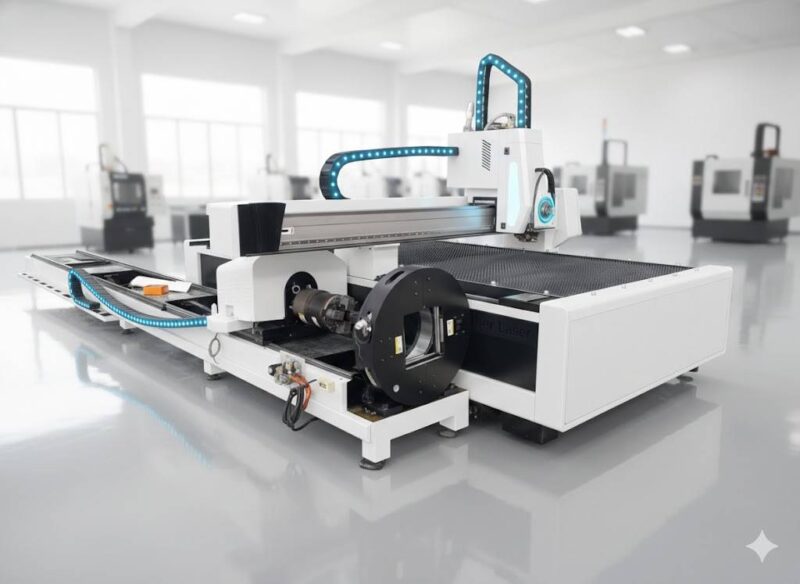
Integration of Laser Seam Tracking for Structural Alignment
Bridge trusses often utilize large-format U-beams, H-beams, or box girders that may possess inherent dimensional variances from the rolling mill. Laser seam tracking technology addresses this challenge by utilizing a triangulation sensor mounted ahead of the cutting head. This sensor scans the physical profile of the workpiece in real-time, feeding positional data back to the CNC controller.
Dynamic Compensation and Path Correction
As the laser head moves along a 12-meter or 18-meter truss section, the seam tracking system detects any bowing, twisting, or lateral deviation in the material. The control software dynamically adjusts the cutting path to ensure that hole patterns, slots, and edge profiles are perfectly concentric to the actual centerline of the beam, rather than the theoretical CAD coordinate. This ensures that when the trusses reach the assembly site, bolt holes align with sub-millimeter precision, eliminating the need for on-site reaming or forced fitments.
The Punch-Mark-Cut Workflow: A Single-Stage Solution
Industrial efficiency is maximized when the number of machine setups is minimized. High-power fiber laser machines for bridge work are designed to perform a multi-functional workflow: punch, mark, and cut. In this context, “punching” refers to the laser’s ability to pierce high-aspect-ratio holes that serve the same function as mechanical drills or punches, but with greater positional accuracy and no tool wear.
Automated Layout Marking
The marking capability utilizes a low-power setting on the same fiber resonator to etch assembly guides, part numbers, and weld preparation lines directly onto the steel surface. Unlike ink-jet or physical stamping, laser marking is permanent and resistant to the elements, ensuring traceability throughout the lifecycle of the bridge. This integrated approach ensures that every feature on a truss member is referenced from a single datum point, virtually eliminating the cumulative errors associated with moving parts between separate punching and cutting machines.
Metallurgical Considerations and Edge Quality
The structural integrity of a bridge truss is heavily dependent on the avoidance of micro-cracking at the cut edge. Fiber laser cutting, through optimized pulse frequency and duty cycle management, minimizes the thermal stress applied to the material. Because the process is non-contact, there is no mechanical deformation of the plate edges. The resulting edge is clean, square, and ready for immediate primer application. From an industrial engineering perspective, the high precision of the laser ensures that the fit-up gap for subsequent assembly stages is consistent, which is critical for maintaining the structural calculations defined by the lead engineer.
Throughput Analysis and OEE Optimization
When calculating Overall Equipment Effectiveness (OEE) for bridge truss fabrication, the fiber laser system outperforms traditional methods in both “Availability” and “Performance” metrics. The lack of consumable tooling (like drill bits or punch dies) reduces downtime for tool changes. Furthermore, the rapid traverse speeds of fiber laser gantries—often exceeding 100 meters per minute—minimize the non-productive time between cuts. The result is a significant increase in tons of steel processed per shift.
Precision Cutting for Complex Truss Geometries
Modern bridge designs frequently incorporate non-linear geometries and variable-depth trusses to optimize weight-to-strength ratios. Fiber laser machines equipped with 3D cutting heads or 5-axis articulation can handle bevel cuts and complex intersections on curved chord members. The laser seam tracking system is particularly vital here, as it maintains the focal point of the laser relative to the curved surface of the material, ensuring a consistent kerf width even as the gantry moves through a multi-axis path.
Environmental and Economic Impact
From a sustainability standpoint, fiber lasers are significantly more energy-efficient than their predecessors, converting up to 40% of electrical input into beam power. In a large-scale bridge project involving thousands of tons of steel, the cumulative energy savings are substantial. Furthermore, the precision of the laser allows for tighter nesting of parts on a single plate, reducing scrap rates and optimizing material utilization—a key KPI for any industrial engineering department.
Conclusion: The Future of Bridge Component Manufacturing
The integration of fiber laser cutting and real-time optical tracking represents the pinnacle of current structural steel fabrication technology. By prioritizing high precision and consolidated workflows, manufacturers can deliver bridge truss components that require no secondary grinding and are ready for immediate assembly. This methodology not only accelerates project timelines but also ensures that the final structure adheres to the highest standards of safety and engineering excellence. As bridge designs continue to push the boundaries of complexity, the versatility and accuracy of the fiber laser will remain the cornerstone of the modern fabrication facility.
-


Cantilever Welding Robot solution
-


GF laser cutting machine
-

P3015 plasma cutting machine
-

LFP3015 Fiber Laser Cutter
-

pipe plasma cutting machine
-
LFH 4020 Fiber Laser Cutting Machine
-
LFP4020
-

gantry plasma air cutting machine
-

3D robot cutting machine
-

8 axis plasma cutting machine
-

5 axis plasma cutting machine
-

LT360 tube laser cutting machine
-

robot welding workstation
-

SF6060 fiber laser cutting machine
Advanced Fiber Laser Tube Processing Technology
Our CNC Fiber Laser Tube Cutting systems revolutionize metal fabrication by integrating high-precision cutting, punching, and profiling into a single automated workflow. Designed for versatility, this technology handles a wide array of profiles including Round, Square, Rectangular, and Oval tubes, as well as complex L-shaped and U-shaped channels.
- Precision Punching: High-speed hole punching with micron-level accuracy, eliminating the need for mechanical drilling or die-stamping.
- Complex Profiling: Advanced 3D pathing allows for intricate interlocking joints and specialized notch cuts, ideal for structural frames.
- High Material Efficiency: Intelligent nesting software minimizes scrap, reducing raw material costs across large production runs.
- Clean Finish: Delivers oxide-free, burr-free edges that require zero secondary grinding before welding.

Seamlessly processing multiple profiles with consistent precision.
Global Delivery & Logistics



From our high-tech manufacturing facility directly to your global site. PCL WeldCut ensures secure packaging, professional handling, and reliable international logistics to safeguard your equipment throughout the entire journey.