Optimizing Bridge Truss Fabrication via High-Power Fiber Laser Integration
In the field of heavy structural engineering, the transition from conventional thermal cutting to high-power fiber laser systems represents a significant shift in production efficiency and component quality. Bridge trusses, characterized by their immense scale and the requirement for extreme fatigue resistance, demand fabrication tolerances that traditional methods struggle to meet without extensive post-processing. The implementation of fiber Laser Cutting technology, paired with advanced laser seam tracking, addresses these challenges by providing a non-contact, high-velocity solution for complex geometries.
The industrial engineer’s objective in bridge fabrication is the reduction of “Total Cycle Time” while maintaining the integrity of the Heat Affected Zone (HAZ). Fiber lasers, operating at a wavelength of approximately 1.06 microns, offer superior absorption rates in high-tensile structural steel compared to CO2 alternatives. This energy efficiency translates directly into a narrower kerf and a significantly smaller HAZ, which is critical for maintaining the metallurgical properties of bridge components subjected to cyclic loading.
Eliminating Secondary Operations: The “No-Grinding” Standard
One of the primary cost drivers in bridge truss production is the labor-intensive requirement for edge finishing. Conventional methods often leave dross, slag, or a hardened edge that must be mechanically removed to meet structural codes (such as AWS D1.5). Fiber laser cutting produces a finished edge with a surface roughness (Rz) that frequently falls within the acceptable range for direct assembly.
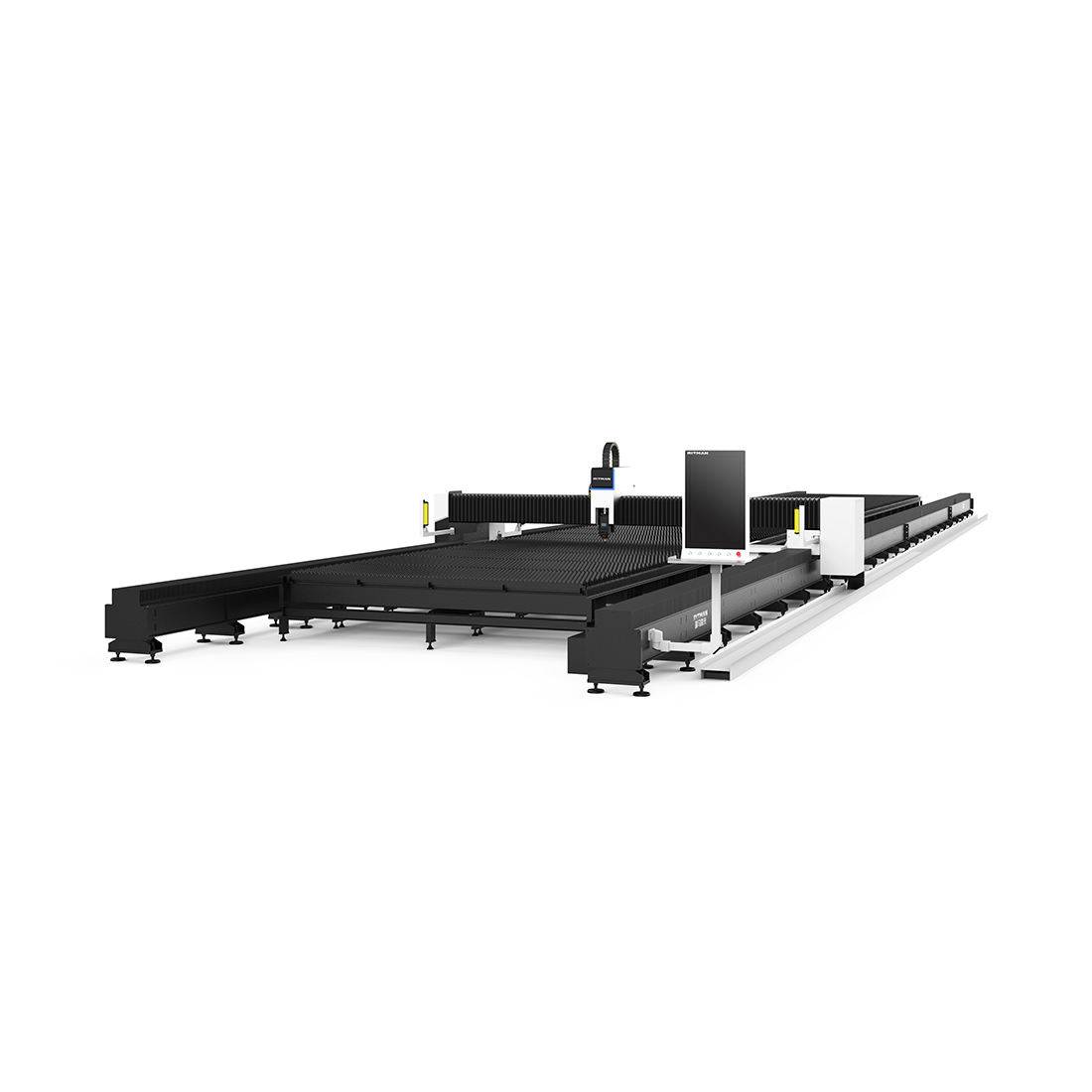
By achieving high precision cuts with a perpendicularity tolerance often exceeding ISO 9013 Class 2, the need for secondary grinding is virtually eliminated. This not only reduces man-hours but also ensures that the dimensions of the truss members remain consistent across a 12-meter or 18-meter span. The absence of mechanical stress during the cutting process means that the base material retains its internal stress profile, preventing the warping often seen with mechanical shearing or lower-density thermal processes.
Multifunctional Processing: Punching, Marking, and Cutting
Modern fiber laser systems are not merely cutting tools; they function as integrated fabrication centers. for Bridge Trusses, which require intricate bolt-hole patterns and clear assembly identifiers, the ability to perform multiple operations in a single program is invaluable.
Automated Marking for Assembly Traceability
Traceability is a mandatory requirement in bridge construction. Using the laser head at a lower power density, the system can etch heat numbers, part IDs, and bend lines directly onto the steel surface. Unlike ink-jet or physical stamping, laser marking is permanent and legible even after protective coatings are applied. This ensures that the logistics of the assembly site are streamlined, as every truss chord and diagonal member is clearly identified by the CNC program.
High-Accuracy Hole Piercing (Punch Replacement)
Traditional hole production involves mechanical punching or drilling, both of which introduce high maintenance costs and potential material deformation. A 20kW to 30kW fiber laser can “punch” or pierce bolt holes with a diameter-to-thickness ratio of 1:1 or better, maintaining perfect circularity. This eliminates the “drift” associated with drill bits and the micro-cracking associated with mechanical punches, thereby improving the load distribution across the bolted connections of the truss.
The Role of Laser Seam Tracking in Structural Steel
Large-scale bridge components are rarely perfectly flat or straight. Material warpage, thermal expansion, and manufacturing deviations in raw steel plates or I-beams can lead to significant errors if the cutting head maintains a fixed path. Laser seam tracking (or surface-following technology) uses high-speed sensors to map the actual topography of the workpiece in real-time.
Real-Time Path Correction
As the cutting head moves across a long truss chord, the laser seam tracking system detects deviations in the Z-axis (height) and the X-Y plane (alignment). The control system adjusts the focal position and the cutting path instantaneously. This ensures that the distance between the nozzle and the material remains constant, which is vital for maintaining consistent gas pressure and beam focus. Without this tracking, the kerf width would vary, leading to inconsistent edge quality and potential failure to meet the strict tolerances required for bridge joints.
Edge Finding and Alignment
For pre-fabricated beams or large plates, the system uses the tracking sensor to locate the exact edge of the material before beginning the cut. This “search and find” capability allows for the nesting of parts with minimal margins, maximizing material utilization and reducing scrap rates—a critical factor when dealing with expensive high-alloy bridge steels.
Technical Specifications and Kinematic Efficiency
To maximize the throughput of bridge truss production, the kinematic performance of the laser machine must match the power of the fiber source. Structural engineers focus on several key metrics:
Acceleration: High-speed gantry systems capable of 2.0G to 3.0G acceleration allow for rapid direction changes in complex gusset plate geometries.
Positioning Accuracy: Maintaining ±0.05mm over several meters of travel ensures that large-scale truss assemblies fit together without the need for on-site reaming of bolt holes.
Gas Control: Automated switching between Oxygen (for thick plate carbon steel) and Nitrogen (for stainless or clean-cut carbon steel) allows the system to optimize the exothermic reaction for speed or edge cleanliness.
Impact on Fatigue Life and Structural Integrity
Bridge trusses are dynamic structures. The quality of the cut surface directly impacts the fatigue life of the bridge. Micro-fissures or rough striations on the cut edge act as stress concentrators where cracks can initiate over decades of service. The laser seam tracking ensures that the beam remains perfectly perpendicular and the cut remains stable, resulting in a smooth, glass-like finish.
By utilizing a fiber laser, the thermal input is concentrated in an extremely small area. This minimizes the “softening” of quenched and tempered steels often used in modern bridge design. The structural engineer can rely on the fact that the material properties at the very edge of the cut are nearly identical to the bulk material, providing a higher safety factor in the final design.
Economic Analysis for Industrial Implementation
While the initial capital expenditure for a high-power fiber laser system with seam tracking is higher than traditional methods, the Return on Investment (ROI) is driven by three factors:
1. Reduction in Consumable Costs
Fiber lasers do not require the expensive mirrors, bellows, or high-purity laser gases needed by CO2 systems. Furthermore, there are no drill bits to sharpen or punches to replace. The primary consumables are the copper nozzles and protective windows, which have a long service life.
2. Labor Displacement
By combining marking, punching, and cutting into one machine, the number of “touches” per part is reduced. A single operator can manage the production of components that previously required a cutting table, a drill press station, and a manual grinding crew.
3. Material Savings
Advanced nesting software, combined with the precision of automated steel fabrication, allows for tighter spacing between parts. In a large-scale bridge project involving hundreds of tons of steel, a 5% increase in material utilization can save tens of thousands of dollars.
Conclusion: The Future of Bridge Engineering
The integration of fiber laser cutting and real-time tracking represents the pinnacle of current structural steel fabrication. For the bridge industry, where the margin for error is non-existent and the demands for longevity are paramount, these systems offer a standardized, repeatable, and highly efficient solution. By prioritizing precision at the component level, engineers can ensure the safety and reliability of the infrastructure while significantly reducing the time from design to ribbon-cutting.
-


LT240S tube laser cutting machine
-
LT120S tube laser cutting machine
-
Sale

Tank Fillet Welding Machine
Original price was: $1,000.00.$900.00Current price is: $900.00. -
Sale

MAK100 tube laser cutting machine
Original price was: $5,500.00.$5,000.00Current price is: $5,000.00. -

portable plasma air cutting machine
$1,200.00 -

2in1 fiber laser cutting machine
-

Air cooling Laser welding machine
-

HF h beam laser cutting machine
-

LT240 laser cutting machine
-

Laser welding machine
-


Cobot Welding Station
-

Gantry welding robot solution
-

Tracked Wheeled AGV Welding robot
-

LFH6020 Fiber laser cutting machine
-
LFP6020
-

robotic welidng machine
Advanced Fiber Laser Tube Processing Technology
Our CNC Fiber Laser Tube Cutting systems revolutionize metal fabrication by integrating high-precision cutting, punching, and profiling into a single automated workflow. Designed for versatility, this technology handles a wide array of profiles including Round, Square, Rectangular, and Oval tubes, as well as complex L-shaped and U-shaped channels.
- Precision Punching: High-speed hole punching with micron-level accuracy, eliminating the need for mechanical drilling or die-stamping.
- Complex Profiling: Advanced 3D pathing allows for intricate interlocking joints and specialized notch cuts, ideal for structural frames.
- High Material Efficiency: Intelligent nesting software minimizes scrap, reducing raw material costs across large production runs.
- Clean Finish: Delivers oxide-free, burr-free edges that require zero secondary grinding before welding.

Seamlessly processing multiple profiles with consistent precision.
Global Delivery & Logistics



From our high-tech manufacturing facility directly to your global site. PCL WeldCut ensures secure packaging, professional handling, and reliable international logistics to safeguard your equipment throughout the entire journey.