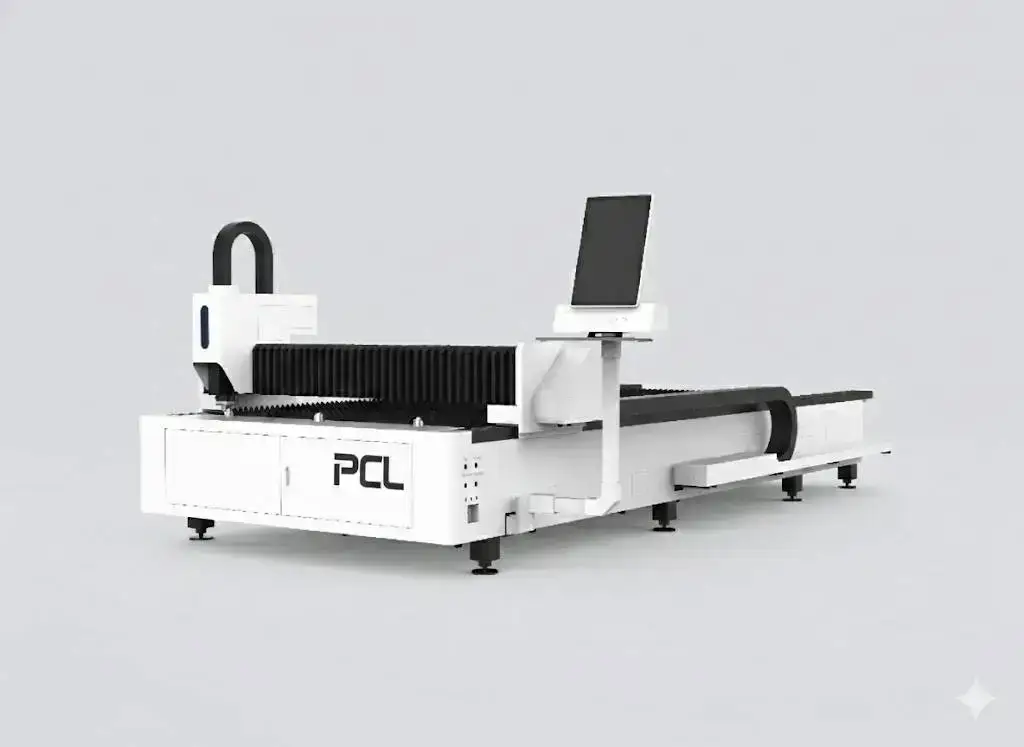
Fiber Laser Cutting Machine with Arc Voltage Control for LNG Projects
In this article
- Optimization of LNG Fabrication via High-Precision Fiber Laser Systems
- The Role of Z-Axis Height Sensing and Arc Voltage Feedback
- Eliminating Post-Processing: The No-Grinding Mandate
- Integrated Workflow: Punch, Mark, and Cut Operations
- Technical Advantages for Cryogenic Material Integrity
- Operational Efficiency and ROI in Energy Sector Fabrication
Optimization of LNG Fabrication via High-Precision Fiber Laser Systems
Industrial engineering in the Liquefied Natural Gas (LNG) sector demands rigorous adherence to material integrity and dimensional accuracy. The fabrication of cryogenic storage tanks, vaporizers, and distribution manifolds involves complex alloys, primarily stainless steel and 9% Nickel steel. Utilizing fiber Laser Cutting technology offers a specialized solution for these requirements, providing a high-energy density beam that ensures minimal thermal distortion and exceptional edge perpendicularity.
Unlike conventional thermal cutting methods, the fiber laser operates at a wavelength of approximately 1.06 microns, allowing for superior absorption in reflective alloys. This characteristic is critical when processing the heavy-gauge plates required for LNG pressure vessels. The focus remains on achieving a “ready-to-assemble” finish directly from the machine bed, optimizing the supply chain by removing secondary mechanical cleaning stages.
The Role of Z-Axis Height Sensing and Arc Voltage Feedback
In the context of large-format laser cutting for LNG components, maintaining a consistent standoff distance is paramount. While traditionally associated with other thermal processes, high-speed capacitive height sensing—often referred to in heavy industrial contexts as a specialized form of Z-axis height sensing—functions as the feedback loop to maintain the focal point relative to the material surface.
for LNG Projects, where plate flatness may vary across large spans, the laser head must adjust its vertical position dynamically. The control system monitors the capacitance (or voltage differential) between the nozzle and the workpiece. This ensures that the beam’s focal spot remains precisely positioned within the material thickness. Consistency in this gap prevents dross accumulation and ensures that the kerf remains uniform, which is essential for the tight tolerances required in cryogenic piping systems.
Eliminating Post-Processing: The No-Grinding Mandate
One of the most significant cost drivers in LNG fabrication is the labor-intensive process of edge grinding. Fiber laser cutting systems negate this requirement by producing a Heat Affected Zone (HAZ) that is remarkably narrow. The high cutting speeds and focused energy minimize the duration of thermal exposure to the base metal, preserving the metallurgical properties of the 9% Nickel steel.
The resulting cut edge is characterized by low surface roughness and an absence of oxide layers when nitrogen is used as the assist gas. This clean-cut technology is a prerequisite for downstream assembly in LNG projects, where any surface contamination or irregularity could compromise the integrity of the cryogenic containment. By delivering a finish that meets ISO 9013 Grade 1 or 2 standards, the fiber laser eliminates the need for manual grinding, thereby reducing man-hours and improving shop throughput.
Integrated Workflow: Punch, Mark, and Cut Operations
Modern fiber laser machines for the energy sector are multi-functional workstations. They are programmed to execute three distinct operations in a single CNC cycle:
1. Precision Marking and Identification
Traceability is a non-negotiable requirement for LNG infrastructure. The fiber laser can be modulated to perform low-power surface marking, etching heat numbers, part IDs, and bend lines directly onto the plate. This ensures that every component is identifiable throughout the lifecycle of the project without creating stress risers in the material.
2. High-Speed Piercing and Punching
Advanced laser controllers utilize “flash piercing” or multi-stage pulsing to create clean entry points. This “punching” capability allows for the creation of small-diameter holes that are dimensionally accurate enough for bolting or instrumentation ports, maintaining a 1:1 ratio between material thickness and hole diameter—a feat difficult to achieve with alternative thermal methods.
3. Final Contour Cutting
The final stage involves high-precision contouring. The Kerf width precision of a fiber laser is typically within the range of 0.1mm to 0.3mm. This level of accuracy is vital for the intricate geometries found in heat exchanger plates and manifold baffles used in LNG liquefaction trains.
Technical Advantages for Cryogenic Material Integrity
LNG projects rely on materials that remain ductile at temperatures as low as -196°C. Any micro-cracking or significant grain growth at the cut edge can lead to catastrophic failure under cryogenic stress. Fiber laser cutting provides a “cold” thermal process relative to other methods. The speed of the laser beam prevents heat soak, ensuring that the austenite stability of the stainless steel or the nickel-alloy matrix remains undisturbed.
Furthermore, the CNC integration allows for lead-in and lead-out strategies that prevent divots or “pips” at the start and end of the cut. This level of geometric control ensures that the stress distribution across the cut part is uniform, meeting the stringent safety factors required by international energy regulators.
Operational Efficiency and ROI in Energy Sector Fabrication
From an industrial engineering perspective, the transition to fiber laser systems with integrated height control represents a major shift in Return on Investment (ROI) calculations. The reduction in electrical consumption compared to CO2 lasers, combined with the post-processing elimination, results in a significantly lower cost per part.
In large-scale LNG projects, where thousands of tons of steel are processed, the cumulative time saved by avoiding the grinding booth can shorten project timelines by weeks. The high reliability of solid-state fiber laser sources—often exceeding 100,000 hours of diode life—ensures that the fabrication facility maintains maximum uptime during critical project phases.
Conclusion
The deployment of Fiber Laser Cutting Machines equipped with precise height sensing is a strategic necessity for modern LNG projects. By consolidating marking, piercing, and high-precision cutting into a single, automated process, fabricators can guarantee metallurgical integrity and dimensional precision. This technology not only adheres to the strict safety standards of the oil and gas industry but also drives operational excellence by delivering clean, weld-ready edges with zero secondary processing required.






