Optimizing Pressure Vessel Fabrication with 5-Axis Fiber Laser Beveling
In the heavy industrial sector, specifically the manufacturing of pressure vessels, the transition from conventional cutting methods to fiber Laser Cutting technology represents a significant leap in operational efficiency. Pressure vessels, which must withstand internal or external pressures exceeding 15 psi, require rigorous structural integrity. The precision of the initial cut and the geometry of the weld preparation are the most critical factors in meeting ASME Section VIII or PED standards. The implementation of a 5-axis fiber laser system allows for the execution of complex bevels on carbon steel and stainless steel plates, effectively consolidating multiple fabrication steps into a single machine cycle.
Technical Foundations of 5-Axis Beveling
The 5-axis fiber laser head operates on a sophisticated kinematic model. Unlike standard 2D cutting heads that remain perpendicular to the workpiece, the 5-axis head incorporates rotational and tilting axes—typically referred to as the A and B axes. This allows the laser beam to strike the material at angles ranging from 0 to 45 degrees, and in some high-end configurations, up to 50 degrees. For pressure vessel shells, this capability is essential for creating the V, Y, X, and K-shaped bevels required for full-penetration butt welds.
The precision of these cuts is governed by the machine’s CNC controller, which must perform real-time compensation for the beam’s focal length. As the head tilts, the distance between the nozzle and the plate changes. High-speed capacitive sensors maintain a constant standoff distance, ensuring that the 5-axis beveling process maintains a consistent kerf width and surface finish throughout the entire length of the cut, regardless of the angle.
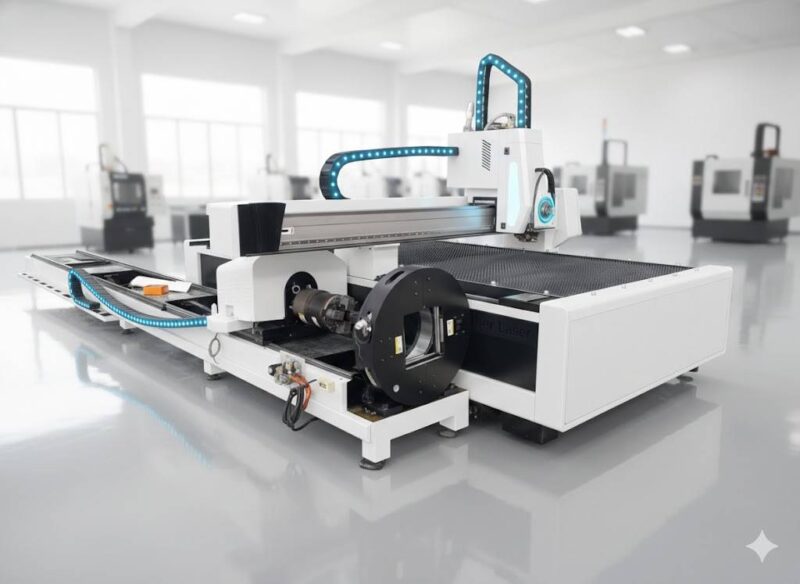
Eliminating Post-Processing: The No-Grinding Mandate
One of the primary cost drivers in traditional vessel fabrication is the manual labor associated with edge preparation. When plates are cut using less precise methods, the resulting edge often suffers from dross, heavy oxidation, or angular inaccuracy. This necessitates hours of manual grinding to reach a “bright metal” state suitable for high-quality welding. Fiber laser cutting operates at a wavelength of approximately 1.06 microns, which is highly absorbed by metals, resulting in a narrow Heat Affected Zone (HAZ) and a smooth, dross-free surface.
By utilizing high-power fiber sources—ranging from 12kW to 30kW—manufacturers can achieve a surface roughness that meets international welding specifications without secondary mechanical processing. This “ready-to-weld” state is achieved through optimized assist gas delivery (typically oxygen for carbon steel and nitrogen for stainless steel) and precise control over the pulse frequency of the laser. The elimination of grinding not only reduces labor costs but also improves the shop environment by removing metallic dust and noise pollution.
Integrated Punching, Marking, and Cutting Sequences
A significant advantage of modern fiber laser systems in an industrial engineering context is the ability to perform three distinct operations in one setup: punching, marking, and cutting. In pressure vessel manufacturing, the layout of nozzles, manways, and support brackets is complex. Traditionally, these locations were hand-marked or drilled after the shell was rolled.
With high precision fiber lasers, the machine can first “punch” or pierce center points for small-diameter holes that may require subsequent tapping. Following this, the laser can perform low-power surface marking to etch heat numbers, bend lines, or attachment locations directly onto the plate. Finally, the 5-axis head executes the perimeter cut and beveling. This single-source-of-truth approach ensures that every feature on the plate is dimensionally accurate relative to the vessel’s centerline, drastically reducing assembly errors during the fit-up phase.
Thermal Management and Material Integrity
Pressure vessels often utilize thick-walled materials (ranging from 10mm to 50mm or more). Managing the thermal input during the cutting process is vital to prevent material deformation or changes in grain structure. Fiber lasers offer superior power density, which allows for faster cutting speeds compared to other thermal processes. The higher the speed, the less time heat has to dissipate into the surrounding material.
Advanced piercing strategies, such as frequency-modulated ramping or “burst” piercing, allow the laser to penetrate thick plates without creating large craters or slag splash. This is particularly important for pressure vessel components where the surface integrity near the weld prep must be flawless to prevent inclusions or porosity in the final weld bead. The 5-axis system ensures that even at the start of a beveled cut, the entry point is clean and the angular transition is fluid.
CAD/CAM Integration for Complex Geometries
The efficiency of a 5-axis fiber laser is heavily dependent on the software ecosystem. Industrial engineers use specialized CAD/CAM nesting software to convert 3D vessel designs into 2D flat patterns with 3D bevel instructions. This software must account for the “unfolding” of the cylinder or dish end while calculating the precise path of the laser head to maintain the required bevel angle throughout the part’s geometry.
Modern nesting algorithms also optimize material utilization, which is critical when working with expensive alloys like 316L stainless steel or duplex grades. By nesting beveled parts closely together, the software minimizes scrap. Furthermore, the CNC can execute “common line cutting” even with beveled edges in certain configurations, further reducing cycle time and gas consumption.
Long-Term ROI and Process Reliability
From an investment perspective, the 5-axis Fiber Laser Cutting Machine represents a high-capital expenditure that yields a rapid return on investment (ROI) through throughput acceleration. In a traditional workflow, a plate might move from a cutting station to a grinding station, and then to a marking station. Each move introduces potential for damage and adds “work-in-progress” (WIP) time.
By consolidating these into a 5-axis fiber laser workflow, the lead time for a single vessel shell can be reduced by 40% to 60%. The reliability of the fiber laser source—which features no moving parts or mirrors in the beam generation path—ensures high uptime. For an industrial facility, this means more vessels shipped per year with a smaller footprint and fewer headcount requirements for manual edge prep. The focus remains entirely on the fiber laser cutting process as the centerpiece of a modern, automated fabrication line, ensuring that the final product meets the highest standards of safety and performance in pressurized environments.
Summary of Engineering Benefits
In summary, the application of 5-axis fiber laser technology to pressure vessel fabrication addresses the core challenges of dimensional accuracy and edge quality. The ability to produce complex bevels that are immediately ready for the welding stage removes the most significant bottleneck in the production chain. By leveraging high-power density and advanced motion control, manufacturers achieve a level of precision that was previously unattainable, setting a new benchmark for industrial efficiency and structural reliability.
-


LT240S tube laser cutting machine
-
LT120S tube laser cutting machine
-
Sale

Tank Fillet Welding Machine
Original price was: $1,000.00.$900.00Current price is: $900.00. -
Sale

MAK100 tube laser cutting machine
Original price was: $5,500.00.$5,000.00Current price is: $5,000.00. -

portable plasma air cutting machine
$1,200.00 -

2in1 fiber laser cutting machine
-

Air cooling Laser welding machine
-

HF h beam laser cutting machine
-

LT240 laser cutting machine
-

Laser welding machine
-


Cobot Welding Station
-

Gantry welding robot solution
-

Tracked Wheeled AGV Welding robot
-

LFH6020 Fiber laser cutting machine
-
LFP6020
-

robotic welidng machine
Advanced Fiber Laser Tube Processing Technology
Our CNC Fiber Laser Tube Cutting systems revolutionize metal fabrication by integrating high-precision cutting, punching, and profiling into a single automated workflow. Designed for versatility, this technology handles a wide array of profiles including Round, Square, Rectangular, and Oval tubes, as well as complex L-shaped and U-shaped channels.
- Precision Punching: High-speed hole punching with micron-level accuracy, eliminating the need for mechanical drilling or die-stamping.
- Complex Profiling: Advanced 3D pathing allows for intricate interlocking joints and specialized notch cuts, ideal for structural frames.
- High Material Efficiency: Intelligent nesting software minimizes scrap, reducing raw material costs across large production runs.
- Clean Finish: Delivers oxide-free, burr-free edges that require zero secondary grinding before welding.

Seamlessly processing multiple profiles with consistent precision.
Global Delivery & Logistics



From our high-tech manufacturing facility directly to your global site. PCL WeldCut ensures secure packaging, professional handling, and reliable international logistics to safeguard your equipment throughout the entire journey.