Optimizing Pressure Vessel Fabrication with 5-Axis Fiber Laser Technology
In the rigorous landscape of pressure vessel manufacturing, dimensional accuracy and structural integrity are the primary benchmarks of engineering success. Traditional fabrication workflows often involve fragmented stages—mechanical layout, separate punching or drilling, and manual edge preparation. The advent of fiber laser technology equipped with 5-Axis Beveling heads has redefined these workflows. By utilizing a high-energy density beam coupled with sophisticated motion control, manufacturers can achieve tolerances that were previously impossible with mechanical or thermal legacy systems.
This transition is driven by the need to meet ASME and PED standards while maximizing throughput. A fiber laser system does not merely cut; it serves as a multi-functional processing center. The ability to execute complex geometries on cylindrical shells, dished ends, and nozzles with a single setup reduces material handling and eliminates the cumulative error inherent in multi-stage processing.
The Mechanics of 5-Axis Beveling
The 5-axis fiber Laser Cutting head introduces two additional rotational axes (typically A and B) to the standard X, Y, and Z Cartesian coordinates. This allows the laser nozzle to tilt up to 45 degrees or more, maintaining a constant focal point while navigating the curved surfaces of a pressure vessel shell. For industrial engineers, the value lies in the 5-axis beveling capability, which permits the creation of V, X, Y, and K-shaped bevels in a single pass.
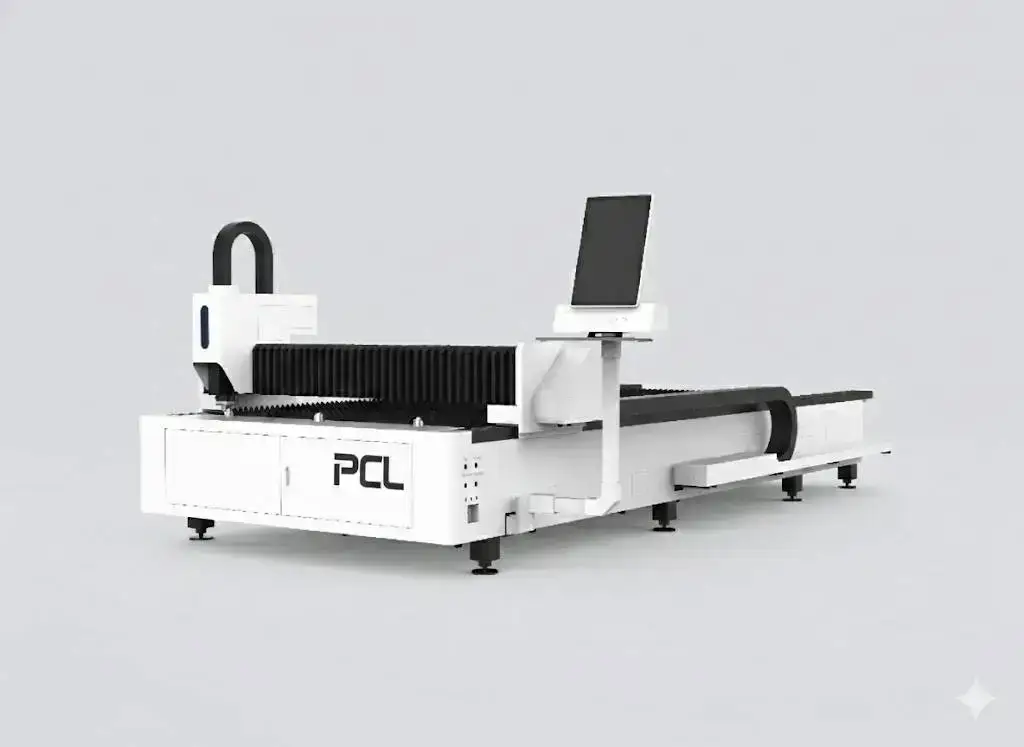
High-precision beveling is critical for the subsequent welding of heavy-wall vessels. The fiber laser’s ability to maintain a consistent kerf width and angle across the entire circumference of a longitudinal or circumferential joint ensures that the fit-up is seamless. This precision reduces the volume of filler metal required and ensures uniform penetration during the welding phase, directly impacting the vessel’s burst pressure rating and fatigue life.
Elimination of Secondary Grinding Operations
One of the most significant cost drivers in vessel fabrication is the manual labor associated with cleaning cut edges. Conventional thermal cutting methods often leave behind dross, heavy oxidation, or a substantial heat-affected zone (HAZ). Fiber lasers, operating at a wavelength of approximately 1.06 microns, provide a much higher absorption rate in metals, resulting in a cleaner, narrower cut.
The resulting edge quality from a 10kW to 20kW fiber laser is typically “ready-to-weld.” By achieving a surface roughness (Ra) that meets stringent engineering specifications, the need for post-cut grinding is entirely eliminated. This not only saves hundreds of man-hours per project but also ensures that the metallurgical properties of the base material—such as P91 grade steels or specialized stainless alloys—remain uncompromised by excessive heat input or mechanical hardening from grinding discs.
Integrated Punching, Marking, and Cutting
Efficiency in an industrial environment is measured by the reduction of “touch time.” Modern fiber laser systems integrate three critical functions into the CNC program:
1. Precision Punching and Hole Piercing
Instead of using mechanical drills for small-diameter nozzle openings or bolt holes, the fiber laser utilizes high-frequency pulsing to pierce material with minimal taper. This ensures that holes for instrumentation ports are perfectly perpendicular to the tangent of the vessel’s curvature.
2. Automated Component Marking
Traceability is a mandatory requirement in the oil, gas, and nuclear sectors. The laser head can be detuned to mark heat numbers, part IDs, and alignment lines directly onto the workpiece. This laser marking is permanent, legible, and does not create the stress concentrations associated with traditional metal stamping.
3. High-Speed Final Contouring
Once the marking and internal features are complete, the system transitions to high-speed contouring. The CNC controller manages real-time height sensing, ensuring the nozzle remains at an optimal standoff distance even if the raw plate has slight planar deviations.
Thermal Management and Material Integrity
Industrial engineers must account for the microstructural changes that occur during thermal cutting. The fiber laser’s high power density allows for extremely high feed rates, which minimizes the duration of heat exposure. Consequently, the HAZ is narrowed to a fraction of a millimeter. In pressure vessel manufacturing, where material ductility and toughness are paramount, preserving the original grain structure of the steel is essential for preventing hydrogen-induced cracking and stress corrosion.
Furthermore, the use of nitrogen as an assist gas during the cutting of stainless steel vessels prevents oxidation of the cut face. This maintains the corrosion-resistant properties of the alloy without requiring chemical pickling or additional mechanical polishing.
Software Integration and Nesting Optimization
The transition to 5-axis laser cutting is supported by advanced CAD/CAM algorithms. These programs can “unfold” complex vessel geometries into flat patterns for cutting, then recalculate the bevel angles based on the final formed radius. This ensures that after the plate is rolled, the bevel geometry aligns perfectly with the mating surface.
Nesting software further optimizes material utilization. Given the high cost of pressure-rated plate steel, reducing scrap through tight nesting of dished-end blanks and shell segments provides a direct boost to the project’s bottom line. The precision of the fiber laser allows for narrower skeleton bridges between parts, pushing material utilization rates toward the 85-90% range.
Conclusion: The Engineering ROI
From an industrial engineering perspective, the investment in a 5-axis fiber laser cutting system is justified by the radical simplification of the production flow. By consolidating the “punch, mark, and cut” cycle and delivering a weld-ready edge that requires no grinding, the facility can significantly shorten lead times. The reduction in manual labor, combined with the extreme precision of 5-axis motion, ensures that the final pressure vessel meets the highest safety and performance standards with optimized manufacturing costs.
-


LT240S tube laser cutting machine
-
LT120S tube laser cutting machine
-
Sale

Tank Fillet Welding Machine
Original price was: $1,000.00.$900.00Current price is: $900.00. -
Sale

MAK100 tube laser cutting machine
Original price was: $5,500.00.$5,000.00Current price is: $5,000.00. -

portable plasma air cutting machine
$1,200.00 -

2in1 fiber laser cutting machine
-

Air cooling Laser welding machine
-

HF h beam laser cutting machine
-

LT240 laser cutting machine
-

Laser welding machine
-


Cobot Welding Station
-

Gantry welding robot solution
-

Tracked Wheeled AGV Welding robot
-

LFH6020 Fiber laser cutting machine
-
LFP6020
-

robotic welidng machine
Advanced Fiber Laser Tube Processing Technology
Our CNC Fiber Laser Tube Cutting systems revolutionize metal fabrication by integrating high-precision cutting, punching, and profiling into a single automated workflow. Designed for versatility, this technology handles a wide array of profiles including Round, Square, Rectangular, and Oval tubes, as well as complex L-shaped and U-shaped channels.
- Precision Punching: High-speed hole punching with micron-level accuracy, eliminating the need for mechanical drilling or die-stamping.
- Complex Profiling: Advanced 3D pathing allows for intricate interlocking joints and specialized notch cuts, ideal for structural frames.
- High Material Efficiency: Intelligent nesting software minimizes scrap, reducing raw material costs across large production runs.
- Clean Finish: Delivers oxide-free, burr-free edges that require zero secondary grinding before welding.

Seamlessly processing multiple profiles with consistent precision.
Global Delivery & Logistics



From our high-tech manufacturing facility directly to your global site. PCL WeldCut ensures secure packaging, professional handling, and reliable international logistics to safeguard your equipment throughout the entire journey.