Optimization of Pressure Vessel Fabrication via 5-Axis Fiber Laser Beveling
In the demanding environment of pressure vessel manufacturing, structural integrity and geometric precision are non-negotiable. The transition to Fiber Laser Cutting with 5-axis capabilities represents a fundamental shift in how heavy-duty cylindrical shells, dished ends, and nozzles are processed. Unlike conventional methods that require multiple stations for layout, cutting, and edge preparation, a single fiber laser system facilitates a streamlined workflow that adheres to strict ASME and ISO standards.
Kinematic Precision of 5-Axis Systems
The 5-axis cutting head is the core component that enables complex beveling on curved surfaces. By utilizing three linear axes (X, Y, Z) and two rotational axes (A, B), the machine maintains a constant focal distance perpendicular to the material surface, even when executing steep bevel angles up to 45 degrees. This level of kinematic control is essential for creating the precise V, Y, X, and K-type joints required for high-pressure containment.
For industrial engineers, the primary advantage lies in the consistency of the kerf. Advanced motion control algorithms compensate for the change in material thickness encountered during angular cutting. This ensures that the root face and bevel angle remain uniform across the entire circumference of a vessel component, eliminating the variability often associated with manual or semi-automated processes.
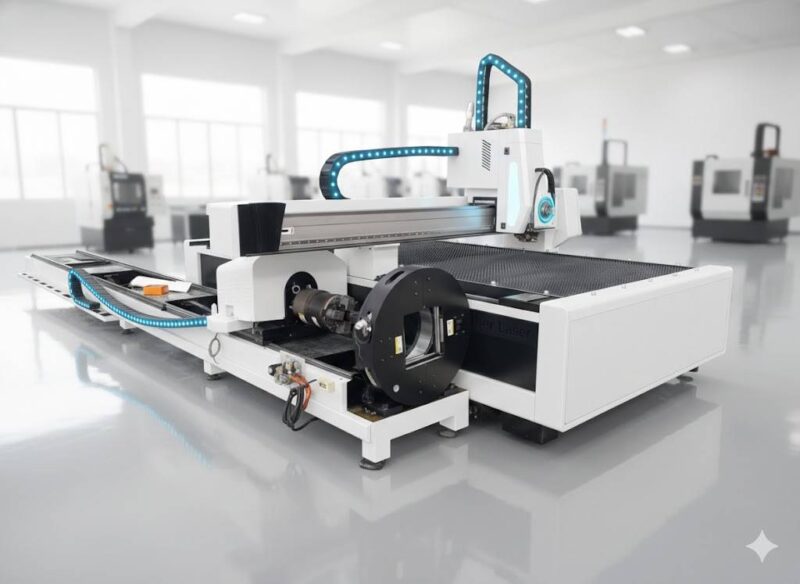
Eliminating Post-Processing: The “No-Grinding” Standard
One of the most significant cost drivers in pressure vessel production is secondary edge preparation. Traditional thermal cutting often leaves behind heavy dross and a thick oxide layer that must be mechanically removed to ensure weld quality. 5-Axis Beveling using fiber laser technology produces an exceptionally clean cut with minimal dross adhesion.
The high power density of the fiber laser results in a narrow Heat Affected Zone (HAZ). This localized thermal input preserves the metallurgical properties of the base metal, preventing the hardening of the cut edge. Because the edge quality is virtually “ready-to-weld,” the requirement for manual grinding is eliminated. From a throughput perspective, this removes a significant bottleneck in the production line, allowing parts to move directly from the cutting bed to the assembly jig.
Integrated Punching and Marking Protocols
A sophisticated fiber laser system does more than just sever material. It serves as a comprehensive layout tool. By modulating the laser pulse and frequency, the machine can perform high-speed punching and marking operations without compromising the material’s structural integrity.
Sequential Processing: Punch, Mark, and Cut
During the initial phase of the program, the laser performs center-point punching for bolt holes or nozzle locations. This is followed by surface marking of alignment lines, bending coordinates, and component identification codes. Once the layout is complete, the system transitions seamlessly into the final bevel cutting. This “one-hit” approach ensures that every mark and cut is perfectly synchronized with the digital CAD model, eliminating human error in manual layout and reducing the cumulative tolerance stack-up.
Thermal Management and Material Integrity
Pressure Vessels are frequently constructed from high-tensile carbon steels or specialized stainless alloys. These materials are sensitive to thermal cycling. Fiber lasers operate at a wavelength of approximately 1.06 microns, which is highly absorbed by metals, leading to faster cutting speeds and reduced energy dissipation into the surrounding material.
This efficiency minimizes thermal distortion, which is critical when cutting large-diameter shells. Maintaining the circularity of a shell section is vital for the subsequent fit-up of dished heads. When the thermal input is controlled, the parts retain their engineered dimensions, ensuring that the gap tolerances for automated longitudinal and circumferential seams are met without the need for excessive hydraulic clamping or corrective rework.
CAD/CAM Integration and Nesting Efficiency
The implementation of 5-axis fiber laser cutting is supported by advanced CAD/CAM software tailored for vessel geometry. These programs automatically calculate the unwrapped flat patterns of nozzles and intersecting shells, applying the necessary bevel offsets in the 3D environment. This digital integration allows for sophisticated nesting strategies that maximize material utilization.
Engineers can visualize the torch path to prevent collisions during steep-angle maneuvers. The software also manages lead-in and lead-out strategies to ensure that the start and end points of a cut do not create stress risers or irregularities in the bevel face. The result is a highly predictable manufacturing process that aligns perfectly with Industry 4.0 lean manufacturing principles.
Economic Impact and ROI Analysis
While the initial capital expenditure for a 5-axis fiber laser system is higher than standard 2D machines, the Return on Investment (ROI) is realized through several high-impact vectors:
Labor Reduction
The consolidation of layout, cutting, and grinding into a single automated cycle reduces the man-hours required per vessel. Skilled labor can be redirected from tedious manual preparation to high-value assembly and inspection tasks.
Consumable and Energy Efficiency
Fiber lasers boast wall-plug efficiencies of over 30%, significantly higher than CO2 alternatives. Furthermore, the absence of high-wear mechanical grinding tools reduces the ongoing cost of consumables and the environmental impact of grinding dust in the facility.
Material Savings
Precision nesting and a narrow kerf width allow for tighter spacing of parts on the raw plate. Over the course of a fiscal year, the reduction in scrap material can account for a significant percentage of the machine’s operating budget.
Conclusion: The Future of Vessel Fabrication
For the industrial engineer, the adoption of 5-axis fiber laser beveling is not merely a technical upgrade; it is a strategic repositioning of the production facility. By achieving high-precision edges, integrated marking, and zero post-process grinding, manufacturers can guarantee the quality and safety of Pressure Vessels while drastically shortening lead times. As material costs rise and the demand for higher pressure ratings increases, the precision offered by fiber laser technology becomes an essential component of a competitive manufacturing strategy.
-


Cantilever Welding Robot solution
-


GF laser cutting machine
-

P3015 plasma cutting machine
-

LFP3015 Fiber Laser Cutter
-

pipe plasma cutting machine
-
LFH 4020 Fiber Laser Cutting Machine
-
LFP4020
-

gantry plasma air cutting machine
-

3D robot cutting machine
-

8 axis plasma cutting machine
-

5 axis plasma cutting machine
-

LT360 tube laser cutting machine
-

robot welding workstation
-

SF6060 fiber laser cutting machine
Advanced Fiber Laser Tube Processing Technology
Our CNC Fiber Laser Tube Cutting systems revolutionize metal fabrication by integrating high-precision cutting, punching, and profiling into a single automated workflow. Designed for versatility, this technology handles a wide array of profiles including Round, Square, Rectangular, and Oval tubes, as well as complex L-shaped and U-shaped channels.
- Precision Punching: High-speed hole punching with micron-level accuracy, eliminating the need for mechanical drilling or die-stamping.
- Complex Profiling: Advanced 3D pathing allows for intricate interlocking joints and specialized notch cuts, ideal for structural frames.
- High Material Efficiency: Intelligent nesting software minimizes scrap, reducing raw material costs across large production runs.
- Clean Finish: Delivers oxide-free, burr-free edges that require zero secondary grinding before welding.

Seamlessly processing multiple profiles with consistent precision.
Global Delivery & Logistics



From our high-tech manufacturing facility directly to your global site. PCL WeldCut ensures secure packaging, professional handling, and reliable international logistics to safeguard your equipment throughout the entire journey.