Optimizing Pressure Vessel Fabrication with 5-Axis Fiber Laser Technology
In the heavy industrial landscape of oil and gas, the fabrication of storage tanks and pressure vessels demands a level of precision that traditional mechanical methods often fail to deliver consistently. The introduction of 5-axis fiber laser beveling has redefined the parameters of efficiency for industrial engineers. Unlike 3-axis systems that are limited to vertical cuts, the 5-axis configuration allows for complex geometries and precise edge preparation essential for high-pressure containment. The primary objective is to move from raw plate to a weld-ready component in a single automated cycle, ensuring that the dimensional tolerances meet stringent API and ASME standards.
Mechanical Kinematics of 5-Axis Beveling Heads
The core of this technology lies in the specialized cutting head, which integrates two additional rotational axes (typically A and B or C) alongside the standard X, Y, and Z linear movements. This allows the laser beam to maintain a constant focal distance while tilting at angles up to ±45 degrees. For oil and gas tanks, which involve large-diameter shells and dished ends, the ability to execute precision beveling for V, X, Y, and K joints is critical. This mechanical flexibility ensures that the laser energy is delivered perpendicular to the intended bevel face, minimizing kerf distortion and maintaining a uniform root face across the entire circumference of the workpiece.
Eliminating Secondary Operations: The No-Grinding Advantage
One of the most significant cost drivers in tank fabrication is the labor-intensive process of manual grinding. Conventional thermal cutting often leaves a thick dross layer and a hardened carbon edge that must be mechanically removed. High-power fiber lasers, however, utilize a high-energy density beam that vaporizes metal instantaneously. When coupled with high-pressure nitrogen or oxygen assist gases, the resulting cut surface achieves a roughness (Ra) value that often falls below 12.5 microns. By achieving a grind-free surface finish, facilities can bypass the secondary cleaning stage, directly reducing man-hours and eliminating the ergonomic risks associated with handheld grinding tools.
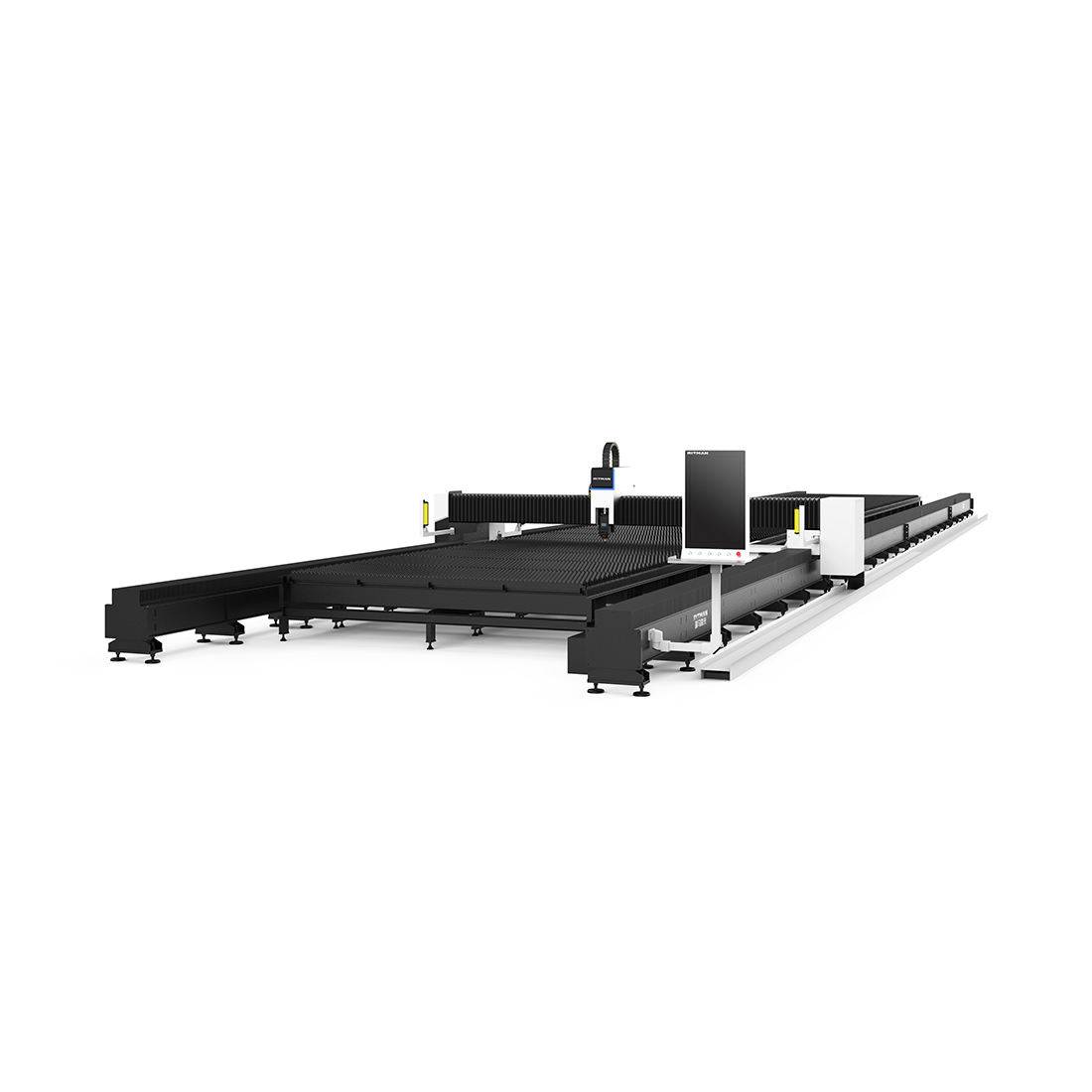
The Integrated Workflow: Punch, Mark, and Cut
Modern 5-axis fiber laser systems are not merely cutting tools; they are multi-process fabrication centers. For industrial engineers, the ability to sequence automated marking and punching within the same nesting program is a force multiplier.
Precision Punching and Piercing
The initial stage of the cycle involves high-speed piercing. Fiber lasers utilize pulsed piercing technology to create clean entry points without the “crater” effect common in older technologies. This is particularly vital for thick-walled tanks where material integrity at the start of the cut is paramount. The laser can “punch” small-diameter holes for nozzle fitments with a diameter-to-thickness ratio of 1:1, maintaining circularity tolerances within ±0.1mm.
Traceability through Laser Marking
In the oil and gas sector, material traceability is a regulatory requirement. The 5-axis laser can be programmed to switch to a low-power etching mode to mark heat numbers, part IDs, and alignment guides directly onto the plate surface. These marks remain visible after coating or painting, ensuring that every shell plate or baffle can be tracked through the entire lifecycle of the vessel.
Metallurgical Integrity and the Heat-Affected Zone
From a materials science perspective, the primary concern with thermal cutting is the heat-affected zone (HAZ). Excessive heat input can alter the grain structure of carbon steel or stainless steel, leading to localized hardening or reduced corrosion resistance. Fiber lasers operate at a wavelength of approximately 1.06 microns, which is highly absorbed by metals. This allows for faster travel speeds and a significantly narrower HAZ compared to other thermal processes. By keeping the thermal footprint localized, the structural properties of the tank plates are preserved, ensuring the vessel can withstand cyclic loading and thermal expansion in the field.
Precision Fit-Up and Weld Volume Reduction
The accuracy of a 5-axis laser cut—often within ±0.05mm—translates directly to superior fit-up during the assembly of large-diameter shells. In traditional fabrication, gaps between plates are common, requiring larger weld passes to fill. The tight dimensional tolerances provided by fiber Laser Cutting ensure that plates meet edge-to-edge with minimal gap. This reduces the total volume of filler metal required, shortens the welding time, and minimizes the risk of distortion in the final vessel structure.
Operational Efficiency and ROI for Industrial Engineers
When conducting a Capex evaluation of 5-axis fiber laser machinery, the ROI is calculated through several vectors:
- Material Utilization: Advanced nesting software optimizes plate usage, while the narrow kerf of the laser allows for tighter nesting of complex bevelled parts.
- Gas Consumption: Modern nozzles and eco-mode settings reduce the consumption of assist gases during the “mark” and “cut” phases.
- Labor Allocation: By automating the beveling and marking processes, skilled welders can focus on assembly rather than edge preparation.
- Consumable Life: Unlike mechanical cutters, the laser is a non-contact tool, meaning there is no tool wear, ensuring consistent quality from the first part to the last.
Future-Proofing Tank Production
As the energy sector moves toward more complex storage solutions, including hydrogen and LNG, the materials used are becoming thinner yet stronger. The 5-axis fiber laser is uniquely suited for these high-alloy materials, providing the high-speed processing capabilities needed to stay competitive. The transition to a “one-touch” fabrication philosophy—where a plate is loaded and a fully marked, beveled, and cut component is unloaded—represents the pinnacle of modern industrial engineering in the pressure vessel domain.
Conclusion
The integration of 5-axis fiber laser beveling into oil and gas tank fabrication represents a shift toward higher precision and leaner manufacturing. By focusing on the inherent strengths of fiber laser technology—namely its ability to produce clean, ready-to-weld edges without the need for grinding—engineers can realize significant improvements in both quality and throughput. The synergy of marking, punching, and cutting in a single setup not only ensures compliance with rigorous industry standards but also provides a sustainable competitive advantage through reduced labor costs and material waste.
-


LT240S tube laser cutting machine
-
LT120S tube laser cutting machine
-
Sale

Tank Fillet Welding Machine
Original price was: $1,000.00.$900.00Current price is: $900.00. -
Sale

MAK100 tube laser cutting machine
Original price was: $5,500.00.$5,000.00Current price is: $5,000.00. -

portable plasma air cutting machine
$1,200.00 -

2in1 fiber laser cutting machine
-

Air cooling Laser welding machine
-

HF h beam laser cutting machine
-

LT240 laser cutting machine
-

Laser welding machine
-


Cobot Welding Station
-

Gantry welding robot solution
-

Tracked Wheeled AGV Welding robot
-

LFH6020 Fiber laser cutting machine
-
LFP6020
-

robotic welidng machine
Advanced Fiber Laser Tube Processing Technology
Our CNC Fiber Laser Tube Cutting systems revolutionize metal fabrication by integrating high-precision cutting, punching, and profiling into a single automated workflow. Designed for versatility, this technology handles a wide array of profiles including Round, Square, Rectangular, and Oval tubes, as well as complex L-shaped and U-shaped channels.
- Precision Punching: High-speed hole punching with micron-level accuracy, eliminating the need for mechanical drilling or die-stamping.
- Complex Profiling: Advanced 3D pathing allows for intricate interlocking joints and specialized notch cuts, ideal for structural frames.
- High Material Efficiency: Intelligent nesting software minimizes scrap, reducing raw material costs across large production runs.
- Clean Finish: Delivers oxide-free, burr-free edges that require zero secondary grinding before welding.

Seamlessly processing multiple profiles with consistent precision.
Global Delivery & Logistics



From our high-tech manufacturing facility directly to your global site. PCL WeldCut ensures secure packaging, professional handling, and reliable international logistics to safeguard your equipment throughout the entire journey.