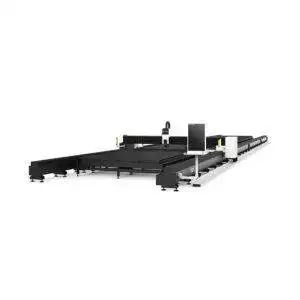
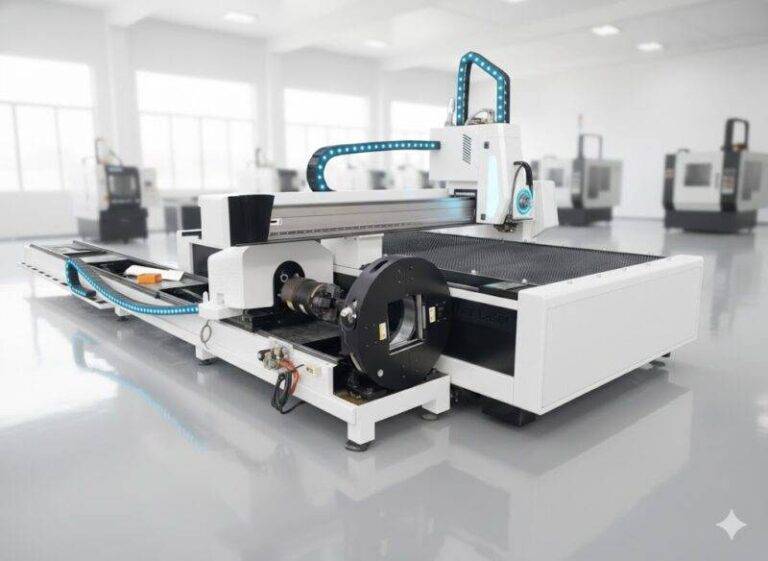
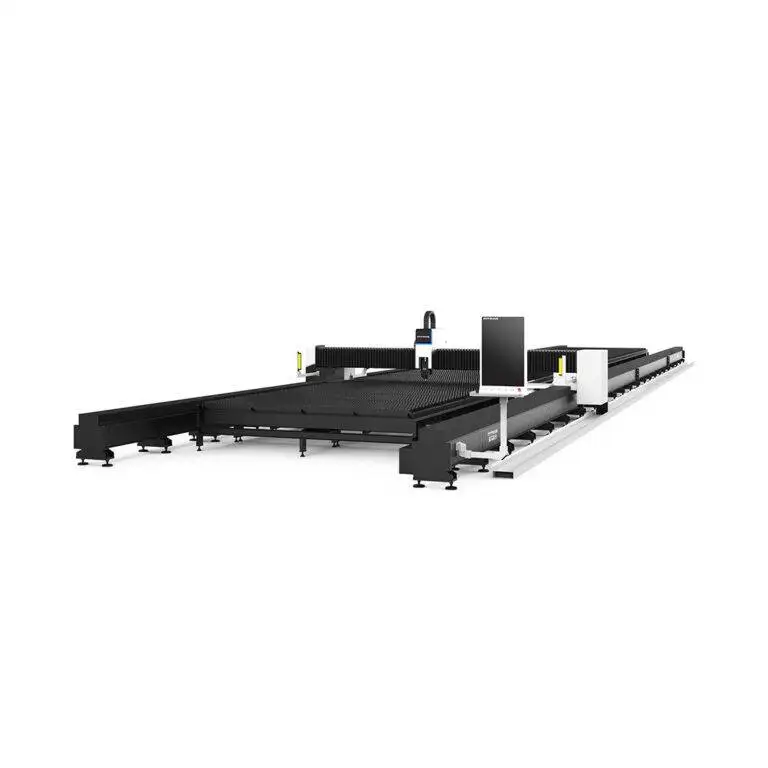
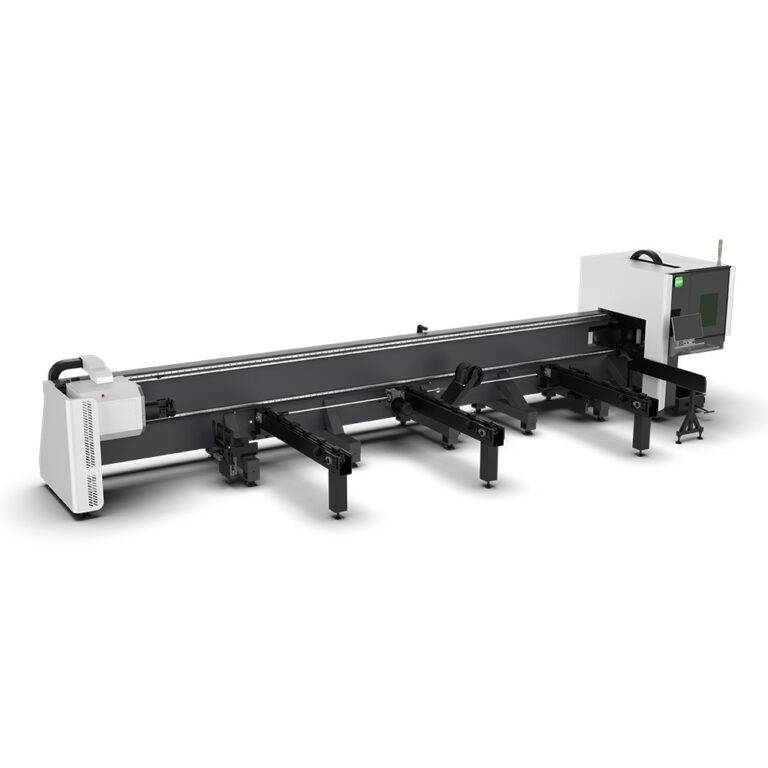
Fiber Laser Cutting Machine with 5-Axis Beveling for Oil & Gas Tanks
In this article
Advanced Kinematics of 5-Axis Fiber Laser Systems
In the heavy industrial sector, specifically the production of large-scale Oil & Gas Tanks, the geometric accuracy of plate edges is a critical factor in structural integrity. Traditional flat-bed cutting requires secondary operations to create the necessary edge preparations for pressurized containment. The 5-Axis Beveling fiber laser system solves this by introducing two additional rotational axes (typically A and B) to the standard X, Y, and Z Cartesian coordinates. This allows the laser head to tilt up to ±45 degrees or more, depending on the focal length and nozzle geometry.
The mechanical synchronization of these five axes is managed by high-speed CNC controllers capable of real-time kerf compensation. When the laser head tilts, the distance between the nozzle tip and the material surface changes dynamically. Sophisticated height sensing (capacitive sensing) must maintain a constant standoff distance to ensure stable gas dynamics. For the industrial engineer, this means the system can execute complex bevel profiles—including top bevels, bottom bevels, and land areas—without removing the workpiece from the slats.
Thermal Management and the Heat-Affected Zone (HAZ)
One of the primary technical advantages of Fiber Laser Cutting over legacy thermal processes is the concentration of energy. Fiber lasers operate at a wavelength of approximately 1.06 microns, which is highly absorbable by carbon steel and stainless steel alloys commonly used in tank farm construction. The high power density results in a significantly narrower heat-affected zone (HAZ).
For oil and gas applications, minimizing the HAZ is vital to prevent grain growth and maintain the metallurgical properties of the parent metal. Excessive heat can lead to embrittlement at the edge, which may compromise the vessel’s ability to withstand cyclic pressure loads. The fiber laser’s narrow kerf and high feed rate ensure that the thermal input is localized, preserving the mechanical toughness and corrosion resistance of the material. This precision eliminates the need for post-cut edge cleaning or mechanical shaving, as the surface roughness (Rz) remains within the strict tolerances required for high-pressure applications.
Integration of Multi-Process Capabilities: Punch, Mark, and Cut
Efficiency in heavy fabrication is often hampered by the movement of large plates between different workstations. A modern Precision Fabrication laser system consolidates three distinct processes into one automated routine. First, the system utilizes high-frequency pulsing to “punch” or pierce the material. Unlike mechanical punching, laser piercing is programmable, allowing for different stages (Stage 1 to Stage 4 piercing) where power, gas pressure, and focal position are modulated to prevent “volcano” effects and ensure a clean entry point.
Second, the marking capability allows for the engraving of heat numbers, part IDs, and assembly guides directly onto the tank plates. This is achieved by de-focusing the beam or reducing the power density to a level that alters the surface reflectivity without penetrating the full thickness of the plate. Finally, the cutting process follows, transitioning seamlessly from marking to high-speed beveling. This single-pass workflow ensures that all features are dimensionally synchronized, eliminating the stack-up errors that occur when moving parts between a marking station and a cutting station.
Eliminating Post-Process Grinding
In traditional tank manufacturing, the time spent on manual grinding often equals or exceeds the time spent on the primary cut. Manual grinding is labor-intensive, creates significant noise and dust, and introduces human error regarding the bevel angle consistency. Fiber laser beveling produces a “ready-to-use” edge. The chemical composition of the assist gas—typically Oxygen for carbon steel or Nitrogen for stainless steel—is optimized to leave a clean, oxide-free (with Nitrogen) or minimally oxidized (with Oxygen) surface.
The 5-axis head’s ability to maintain a consistent angle across the entire length of a 12-meter plate ensures that the root gap during assembly remains constant. This consistency is a fundamental requirement for automated girth welding systems used in tank construction. By providing a precision-beveled edge with a surface finish that meets ISO 9013 standards, the laser system effectively removes the “grinding bottleneck” from the production floor.
Software and Nesting Logic for Bevel Optimization
The transition to 5-axis laser cutting is underpinned by advanced CAM software. Nesting for beveling is significantly more complex than 2D nesting because the “footprint” of the part changes based on the tilt angle. The software must calculate the “overtravel” of the laser head to prevent collisions with adjacent parts or the machine frame. Industrial engineers utilize these algorithms to maximize material utilization, which is a major cost driver in oil and gas projects involving high-grade alloys.
The CNC controller must also account for the change in effective material thickness when the laser is at an angle. For example, a 20mm plate cut at a 45-degree angle presents an effective thickness of approximately 28.28mm to the laser beam. The software automatically adjusts the feed rate and power settings to ensure complete penetration and a smooth dross-free finish. This level of automation reduces the reliance on highly skilled operators, as the “process intelligence” is embedded within the machine’s parameters.
Economic and Operational Impact (ROI)
From an operational standpoint, the investment in a 5-axis fiber laser system is justified through the reduction of Total Cost of Ownership (TCO). While the initial capital expenditure (CAPEX) is higher than 2D systems, the reduction in Operational Expenditure (OPEX) is substantial. The primary savings are found in:
– Labor: Elimination of secondary grinding and manual marking crews.
– Consumables: Fiber lasers have high wall-plug efficiency (35-40%), reducing electricity consumption compared to older CO2 technologies.
– Quality Control: Reduction in rejected parts due to inaccurate bevel angles or thermal distortion.
– Throughput: Faster cycle times per plate allow for higher tonnage output per shift.
In the context of Oil & Gas tank fabrication, where timelines are tight and safety standards are non-negotiable, the ability to produce high-precision, beveled plates with zero secondary handling is a significant competitive advantage. The fiber laser represents the pinnacle of current thermal cutting technology, providing the accuracy, speed, and versatility required for the next generation of industrial infrastructure.
Conclusion: The Future of Pressure Vessel Fabrication
The integration of 5-axis beveling into fiber laser systems marks a paradigm shift in how we approach large-scale plate fabrication. By focusing on the physics of the fiber laser—its high energy density, narrow kerf, and minimal thermal impact—engineers can design more efficient production lines. The elimination of grinding, the precision of the 5-axis kinematics, and the multi-process capability of marking and cutting ensure that the finished components meet the most stringent industry codes. For the modern industrial facility, this is not merely an upgrade in cutting speed; it is a fundamental optimization of the entire manufacturing lifecycle for oil and gas storage assets.