Optimizing Pressure Vessel Fabrication with 5-Axis Fiber Laser Technology
In the heavy industrial landscape of Oil & Gas, the fabrication of storage tanks and pressure vessels demands uncompromising precision. Traditional methods of preparing plate edges for assembly often involve multi-stage workflows, including mechanical cutting followed by manual grinding to achieve the necessary bevel profiles. The implementation of 5-axis fiber laser beveling represents a paradigm shift in this domain. By integrating high-power fiber laser sources with sophisticated multi-axis motion control, engineers can now execute complex geometries with micron-level accuracy, fundamentally altering the economics of tank production.
The Mechanics of 5-Axis Precision
The core advantage of a 5-axis system lies in its kinematic flexibility. Unlike standard 2D laser systems that operate on a vertical Z-axis, a 5-axis head incorporates tilt and rotation (A and B axes). This allows the laser beam to maintain a perpendicular or angled orientation relative to the material surface, regardless of the part’s contour. for Oil & Gas Tanks, which frequently require V, X, Y, or K-shaped bevels to facilitate deep-penetration welds, this capability is essential.
The fiber laser source provides a high-density energy beam that creates a narrow kerf. When combined with a 5-axis head, the system compensates for the beam’s focal point in real-time as the angle changes. This ensures that the edge quality remains consistent across the entire thickness of the plate, typically ranging from 6mm to over 30mm for high-pressure applications. The result is a weld-ready edge that requires zero secondary processing.
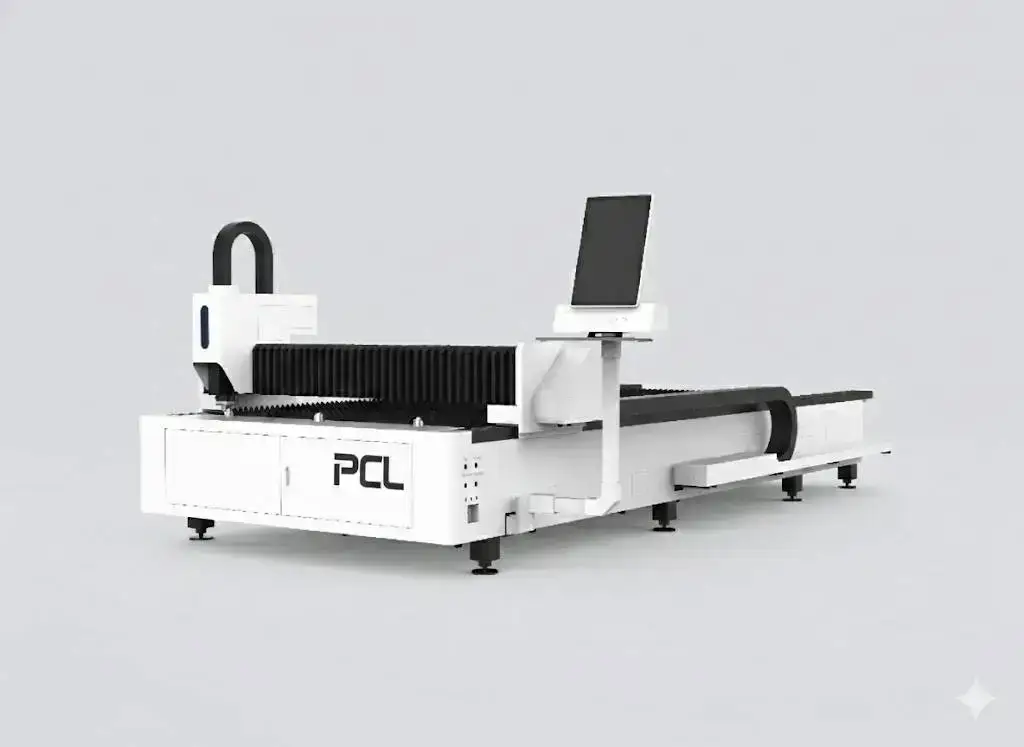
Eliminating Secondary Operations: No Grinding Required
In conventional fabrication, the cutting process is merely the first step. Due to the thermal distortion and dross produced by lower-precision methods, plates often require extensive grinding to remove oxidation layers and achieve the specified bevel angle. Fiber Laser Cutting operates at a wavelength (approximately 1.06 microns) that is highly absorbed by carbon and stainless steels, resulting in a localized, intense heat source.
This concentration of energy minimizes the Heat-Affected Zone (HAZ), preserving the metallurgical properties of the base metal. Because the fiber laser process is so clean, the edges are free of slag and carbonization. For an industrial engineer, this translates to a significant reduction in man-hours. By moving directly from the laser bed to the assembly jig, the floor-to-floor time for a single tank section is reduced by as much as 40%.
Integrated Punching and Marking Workflows
Beyond the perimeter cut and beveling, Oil & Gas tank fabrication requires precise hole placement for nozzles, manways, and instrumentation ports. A 5-axis fiber laser machine handles these requirements through a “punch, mark, and cut” strategy.
Using high-speed pulse modulation, the laser can “punch” start holes with minimal pierce diameters, maintaining the integrity of the surrounding material. Furthermore, the system can be programmed to etch or mark the plate surface. This marking capability is used for part identification, bend lines, and alignment markers for internal baffles. Having all these features executed in a single setup ensures perfect spatial correlation between the bevel, the holes, and the assembly marks, eliminating the tolerance stack-up associated with moving parts between different machines.
High-Speed Throughput and Material Efficiency
Efficiency in industrial engineering is measured by the optimization of resources. Fiber laser systems boast electrical conversion efficiencies significantly higher than older CO2 or mechanical alternatives. However, the true ROI for tank manufacturers comes from nesting efficiency and cutting speed.
Advanced CAD/CAM software tailored for automated edge preparation allows for tight nesting of tank components. Because the fiber laser kerf is so narrow, parts can be placed closer together, reducing scrap rates. On a project involving thousands of tons of high-grade steel, a 5% improvement in material yield can equate to substantial capital savings. Furthermore, the rapid traverse speeds of modern fiber lasers reduce the idle time between cuts, ensuring that the machine stays in a high-state of duty cycle.
Maintaining Structural Integrity through Precision
The Oil & Gas industry is governed by stringent codes such as ASME Section VIII and API 650. These standards dictate the tolerances for joint fit-up and the quality of the base metal near the weld. Fiber laser cutting provides a level of repeatability that manual processes cannot match. The 5-axis system ensures that the root face and bevel angle are consistent across long spans, which is critical for automated longitudinal and circumferential seams.
When the fit-up is precise, the volume of weld consumable required is minimized, and the risk of weld defects—such as lack of fusion or inclusions—is drastically reduced. In essence, the precision of the kerf precision provided by the laser acts as a quality assurance mechanism for the subsequent stages of fabrication.
Data-Driven Manufacturing and Industry 4.0
Modern 5-axis fiber laser machines are not just cutting tools; they are data hubs. Integration with ERP systems allows for real-time tracking of plate consumption and machine performance. For the industrial engineer, this provides the granular data needed to perform bottleneck analysis and optimize production schedules.
The software can simulate the 5-axis movement before the first pierce, identifying potential collisions with the work-holding fixtures or the material itself. This digital twin approach ensures that complex tank geometries, such as those found in dome ends or spherical storage vessels, are cut correctly the first time, every time.
Conclusion: The Competitive Edge
Adopting 5-axis fiber laser cutting technology is no longer an optional upgrade for competitive fabricators in the Oil & Gas sector; it is a strategic necessity. By consolidating cutting, beveling, punching, and marking into a single high-precision process, manufacturers eliminate the labor-intensive grinding stage and improve the structural integrity of their products. The result is a streamlined production line that meets the rigorous demands of the energy industry with higher speed, lower costs, and superior metallurgical quality.
-


Cantilever Welding Robot solution
-


GF laser cutting machine
-

P3015 plasma cutting machine
-

LFP3015 Fiber Laser Cutter
-

pipe plasma cutting machine
-
LFH 4020 Fiber Laser Cutting Machine
-
LFP4020
-

gantry plasma air cutting machine
-

3D robot cutting machine
-

8 axis plasma cutting machine
-

5 axis plasma cutting machine
-

LT360 tube laser cutting machine
-

robot welding workstation
-

SF6060 fiber laser cutting machine
Advanced Fiber Laser Tube Processing Technology
Our CNC Fiber Laser Tube Cutting systems revolutionize metal fabrication by integrating high-precision cutting, punching, and profiling into a single automated workflow. Designed for versatility, this technology handles a wide array of profiles including Round, Square, Rectangular, and Oval tubes, as well as complex L-shaped and U-shaped channels.
- Precision Punching: High-speed hole punching with micron-level accuracy, eliminating the need for mechanical drilling or die-stamping.
- Complex Profiling: Advanced 3D pathing allows for intricate interlocking joints and specialized notch cuts, ideal for structural frames.
- High Material Efficiency: Intelligent nesting software minimizes scrap, reducing raw material costs across large production runs.
- Clean Finish: Delivers oxide-free, burr-free edges that require zero secondary grinding before welding.

Seamlessly processing multiple profiles with consistent precision.
Global Delivery & Logistics



From our high-tech manufacturing facility directly to your global site. PCL WeldCut ensures secure packaging, professional handling, and reliable international logistics to safeguard your equipment throughout the entire journey.