Technical Optimization of LNG Fabrication via 5-Axis Fiber Laser Systems
In the specialized sector of Liquefied Natural Gas (LNG) infrastructure, the demand for structural integrity and dimensional precision is non-negotiable. LNG projects typically involve the fabrication of massive cryogenic storage tanks, complex piping manifolds, and regasification modules. Traditionally, these components required multi-stage processing, including separate mechanical drilling, manual marking, and intensive edge preparation. The introduction of 5-axis fiber laser beveling technology has transformed this workflow by providing a singular, high-efficiency platform capable of handling the entire fabrication sequence in one setup.
The core advantage of fiber laser technology in this context is its ability to maintain high energy density over a localized area. When applied to 9% nickel steel or high-grade stainless steel—materials ubiquitous in LNG environments—the fiber laser produces a minimal heat-affected zone (HAZ). This preservation of material properties is critical for cryogenic applications where structural ductility must be maintained at temperatures as low as -196 degrees Celsius.
The Mechanics of 5-Axis Bevel Cutting
Standard 2D Laser Cutting is limited to vertical profiles. However, LNG pressure vessels and large-diameter pipes require complex edge preparations including V, X, K, and Y-shaped bevels. A 5-axis fiber laser beveling head utilizes two additional rotational axes (A and B) alongside the traditional X, Y, and Z Cartesian coordinates. This allows the cutting head to tilt up to 45 or even 50 degrees depending on the specific machine configuration.
From an industrial engineering perspective, the precision of these angles determines the success of the assembly phase. Fiber lasers achieve angular tolerances within +/- 0.5 degrees. This level of accuracy ensures that when large-scale plates are rolled into cylinders for LNG tanks, the root gap and bevel face align perfectly, removing the need for manual corrections or gap-filling during the joining process.
Eliminating Secondary Operations: No Grinding Required
One of the most significant cost drivers in heavy industrial fabrication is the “clean-up” phase. Mechanical cutting or lower-precision thermal methods often leave dross, slag, or carbonization on the cut edge. This requires hundreds of man-hours dedicated to manual grinding to reach a “bright metal” finish suitable for high-spec LNG applications.
High-power fiber lasers (ranging from 12kW to 30kW) utilize high-pressure nitrogen or oxygen assist gases to blow away molten material instantly. The result is a dross-free, mirror-like finish on the bevel face. By implementing automated bevel cutting, facilities can bypass the grinding station entirely. This not only reduces labor costs but also improves the safety profile of the workshop by reducing noise and metal dust exposure.
The Three-in-One Workflow: Punch, Mark, and Cut
Modern fiber laser software allows for the integration of multiple production steps into a single NC (Numerical Control) program. For LNG piping components, which require rigorous traceability and precise bolt-hole alignment, the machine executes a three-phase cycle:
1. Precision Punching and Hole Piercing
Instead of traditional drilling, the fiber laser utilizes high-speed pulsing to pierce holes with diameters as small as the material thickness. For flange connections in LNG manifolds, the laser ensures perfectly circular apertures with zero mechanical stress on the surrounding lattice. This maintains the structural fatigue limits required for pressurized systems.
2. Surface Marking and Traceability
LNG projects are governed by strict ISO and ASME standards requiring every component to be traceable. The fiber laser can be de-focused or operated at lower power to etch heat numbers, part IDs, and assembly guides directly onto the plate surface. Because this is done in the same coordinate system as the cut, there is zero risk of marking misalignment, which often occurs when parts are moved between stations.
3. High-Speed Bevel Cutting
Following the marking and piercing, the 5-axis head engages the beveling sequence. The CNC controller compensates for kerf width in real-time, adjusting the path to account for the angle of the head. This ensures that the internal and external dimensions of the part remain consistent regardless of the bevel complexity.
Thermal Management and Material Integrity
LNG components are often fabricated from thick-section plates. The challenge with thick-plate cutting is the accumulation of heat, which can lead to thermal expansion and dimensional drift. Industrial-grade fiber lasers utilize sophisticated “cool-cut” technologies or water-mist nozzles to dissipate heat during the process. By managing the thermal gradient, the machine ensures that a 10-meter long plate for a storage tank wall remains within a 1mm tolerance across its entire length.
Furthermore, because the fiber laser operates at a wavelength of approximately 1.06 microns, the energy absorption rate in reflective materials like stainless steel is significantly higher than in CO2 lasers. This leads to faster travel speeds, which inherently reduces the time the heat source is in contact with any single point, further narrowing the HAZ.
Operational Efficiency and ROI for LNG Contractors
When calculating the Return on Investment (ROI) for a 5-axis fiber laser system in an LNG context, engineers must look beyond simple “inches per minute” cutting speeds. The true value lies in the LNG cryogenic storage fabrication throughput. By consolidating tasks, the “floor-to-floor” time for a complex vessel head or a segmented elbow is reduced by as much as 60%.
Key metrics for evaluation include:
- Reduction in material handling: Parts stay on one bed from raw plate to finished component.
- Consumable savings: Fiber lasers have higher wall-plug efficiency (approx. 30-40%) compared to older technologies.
- Nesting efficiency: Advanced CAM software can nest beveled parts closer together, reducing scrap in expensive high-nickel alloys.
Conclusion: The Future of High-Precision Energy Infrastructure
The transition toward more efficient energy sources requires a parallel transition in fabrication technology. The 5-axis Fiber Laser Cutting Machine represents the pinnacle of this shift. By providing a solution that delivers high precision, eliminates the need for secondary grinding, and integrates marking and punching, it meets the rigorous demands of LNG projects head-on. As the industry moves toward even larger storage capacities and more complex offshore regasification units, the reliance on automated, high-precision laser beveling will only intensify, cementing its role as a cornerstone of modern industrial engineering.
-


Cantilever Welding Robot solution
-


GF laser cutting machine
-

P3015 plasma cutting machine
-

LFP3015 Fiber Laser Cutter
-

pipe plasma cutting machine
-
LFH 4020 Fiber Laser Cutting Machine
-
LFP4020
-

gantry plasma air cutting machine
-

3D robot cutting machine
-

8 axis plasma cutting machine
-

5 axis plasma cutting machine
-

LT360 tube laser cutting machine
-

robot welding workstation
-

SF6060 fiber laser cutting machine
Advanced Fiber Laser Tube Processing Technology
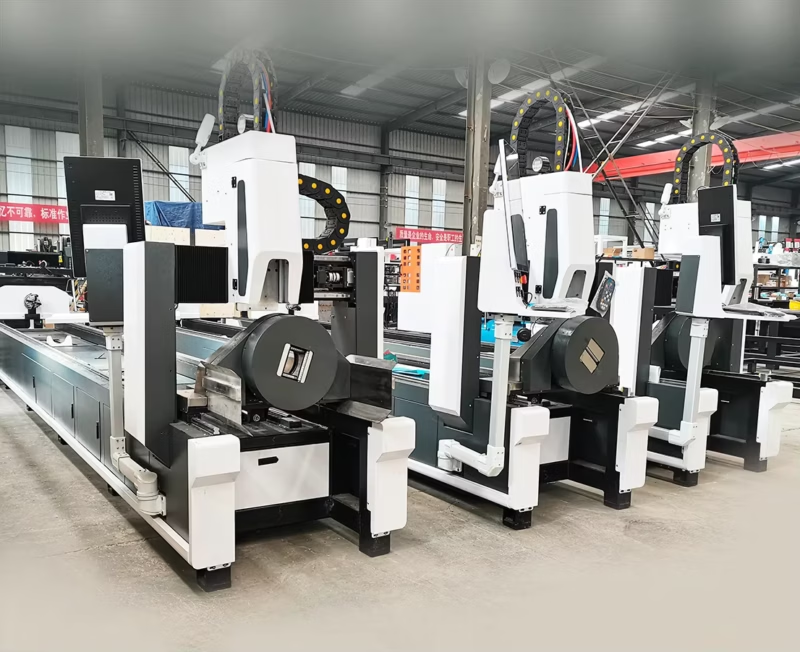
Our CNC Fiber Laser Tube Cutting systems revolutionize metal fabrication by integrating high-precision cutting, punching, and profiling into a single automated workflow. Designed for versatility, this technology handles a wide array of profiles including Round, Square, Rectangular, and Oval tubes, as well as complex L-shaped and U-shaped channels.
- Precision Punching: High-speed hole punching with micron-level accuracy, eliminating the need for mechanical drilling or die-stamping.
- Complex Profiling: Advanced 3D pathing allows for intricate interlocking joints and specialized notch cuts, ideal for structural frames.
- High Material Efficiency: Intelligent nesting software minimizes scrap, reducing raw material costs across large production runs.
- Clean Finish: Delivers oxide-free, burr-free edges that require zero secondary grinding before welding.

Seamlessly processing multiple profiles with consistent precision.
Global Delivery & Logistics



From our high-tech manufacturing facility directly to your global site. PCL WeldCut ensures secure packaging, professional handling, and reliable international logistics to safeguard your equipment throughout the entire journey.