Optimization of Structural Steel Fabrication via Fiber Laser Integration
In the current landscape of heavy industrial manufacturing, the transition toward high-precision automation is no longer a luxury but a requirement for maintaining global competitiveness. The implementation of fiber Laser Cutting systems specifically engineered for structural steel profiles—such as H-beams, I-beams, and channels—represents a significant leap in process efficiency. Traditional methods often involve disparate stages of mechanical drilling, manual marking, and thermal cutting, each introducing cumulative tolerances and labor bottlenecks. By contrast, a fiber-based approach centralizes these functions, utilizing a concentrated coherent light beam to achieve tolerances that were previously unattainable in large-scale structural work.
The Role of 3D Vision Positioning in Geometric Accuracy
One of the primary challenges in structural steel fabrication is the inherent inconsistency of raw materials. Beams and profiles often arrive with slight bows, twists, or dimensional variances that fall within mill tolerances but complicate precision automated cutting. This is where 3D vision positioning becomes the critical intelligence of the system. Unlike static cutting programs that assume a perfect workpiece, 3D vision systems utilize high-speed cameras and laser line profilers to map the actual geometry of the steel in real-time.
The vision system captures a point cloud of the beam’s surface, identifying the exact orientation and any deviations from the digital twin or CAD model. The machine’s control software then applies dynamic offsets to the cutting path. This ensures that every bolt hole, notch, and flange cut is perfectly aligned with the actual center line of the material, rather than the theoretical one. For industrial engineers, this means a drastic reduction in rework and the elimination of fit-up issues during site assembly.
Eliminating Secondary Processes: The No-Grinding Advantage
In conventional steel processing, the thermal impact on the material often necessitates extensive secondary grinding to remove dross, slag, or hardened edges before the steel can move to the assembly or coating phase. Fiber laser technology operates at a wavelength that is highly absorbed by steel, allowing for a much narrower Heat-Affected Zone (HAZ). The result is a clean, dross-free edge that meets strict architectural and engineering standards immediately upon exit from the machine.
The absence of grinding not only saves significant labor hours but also enhances the safety of the shop environment by reducing airborne particulates and noise pollution. From a lean manufacturing perspective, removing a non-value-added step like manual grinding streamlines the value stream map, allowing the material to flow directly from the cutting cell to the next stage of production. The precision of the fiber laser ensures that the edge roughness (Rz) is kept within limits that satisfy high-performance coating requirements without further surface preparation.
Integrated Functionality: Punching, Marking, and Cutting
The modern fiber laser for structural steel fabrication is not a single-purpose tool; it is a multi-process center. While “punching” traditionally refers to a mechanical press, in the context of advanced laser systems, it refers to the high-speed “laser punching” or piercing of circular bolt holes with extreme geometric accuracy. These systems can execute complex hole patterns in a fraction of the time required by mechanical drills, without the tool wear associated with hardened steel alloys.
High-Speed Laser Punching (Hole Cutting)
The fiber laser can interpolate circular paths with high acceleration, producing holes with minimal taper and perfect cylindricity. This is vital for structural integrity, as bolt-up connections require precise tolerances to ensure load distribution is uniform across the connection. The ability to “punch” holes of varying diameters in the same cycle without a tool change is a force multiplier for throughput.
Surface Marking and Part Identification
Traceability is a cornerstone of modern industrial engineering. Integrated fiber lasers can perform high-speed surface marking, etching part numbers, QR codes, or assembly layout lines directly onto the steel. This marking is done at a lower power setting to ensure it does not compromise the structural integrity of the flange or web. By etching layout lines directly onto the members, the system provides clear visual guides for subsequent assembly, reducing the reliance on manual measurement and blue-print interpretation on the shop floor.
Throughput Analysis and Technical Efficiency
From a technical standpoint, the efficiency of a fiber laser system is measured by its “beam-on” time versus the total cycle time. with 3D Vision positioning, the setup time is virtually eliminated. The system detects the material location automatically, meaning the operator does not need to manually align the beam to the cutting head. This leads to a significant increase in the number of tons processed per shift.
Furthermore, fiber lasers require significantly less maintenance than older thermal cutting technologies. With no internal moving parts in the resonator and no mirrors to align, the uptime of the system is optimized for continuous industrial operation. The power conversion efficiency of fiber lasers—often exceeding 40%—also results in lower utility costs per foot of cut, contributing to a more favorable Return on Investment (ROI) for the facility.
Structural Integrity and Material Utilization
The narrow kerf width of a fiber laser—often less than 1mm—allows for tighter nesting of parts and more intricate cuts that would be impossible with wider-cutting technologies. This precision allows engineers to design more complex connections that can reduce the overall weight of the steel structure without sacrificing strength. Because the laser can cut through thick flanges with minimal thermal distortion, the structural properties of the steel remain intact, ensuring the finished component adheres to the metallurgical specifications required by building codes.
Conclusion: The Future of the Steel Shop
The integration of fiber laser technology with 3D vision represents the pinnacle of structural steel processing. By consolidating the functions of marking, punching, and cutting into a single automated sequence, manufacturers can achieve a level of precision and speed that was previously unachievable. The elimination of secondary grinding and the reduction of human error through automated positioning create a streamlined production environment characterized by high quality and low waste. For the industrial engineer, the data is clear: the transition to 3D vision-guided fiber laser systems is the most effective path toward optimizing structural steel workflows and ensuring long-term operational excellence.
-


Cantilever Welding Robot solution
-


GF laser cutting machine
-

P3015 plasma cutting machine
-

LFP3015 Fiber Laser Cutter
-

pipe plasma cutting machine
-
LFH 4020 Fiber Laser Cutting Machine
-
LFP4020
-

gantry plasma air cutting machine
-

3D robot cutting machine
-

8 axis plasma cutting machine
-

5 axis plasma cutting machine
-

LT360 tube laser cutting machine
-

robot welding workstation
-

SF6060 fiber laser cutting machine
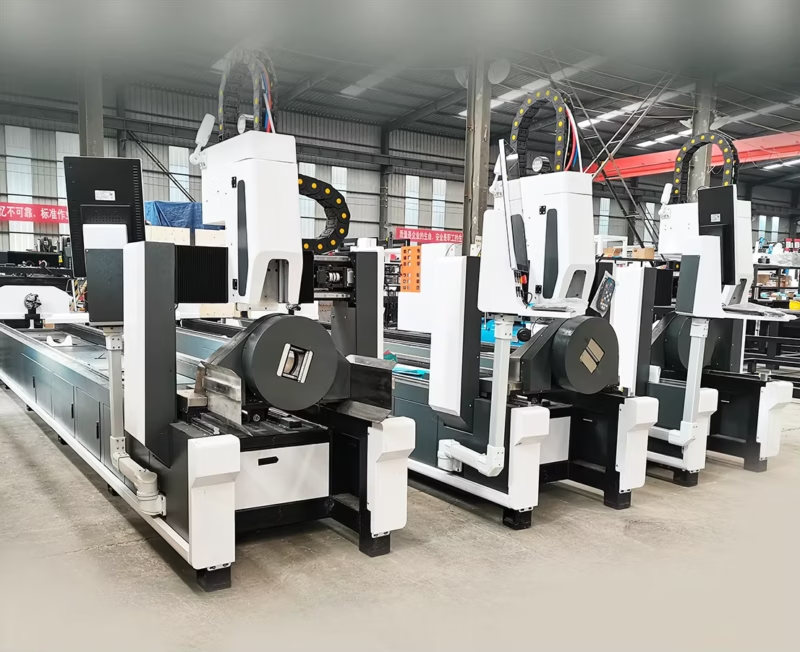
Advanced Fiber Laser Tube Processing Technology
Our CNC Fiber Laser Tube Cutting systems revolutionize metal fabrication by integrating high-precision cutting, punching, and profiling into a single automated workflow. Designed for versatility, this technology handles a wide array of profiles including Round, Square, Rectangular, and Oval tubes, as well as complex L-shaped and U-shaped channels.
- Precision Punching: High-speed hole punching with micron-level accuracy, eliminating the need for mechanical drilling or die-stamping.
- Complex Profiling: Advanced 3D pathing allows for intricate interlocking joints and specialized notch cuts, ideal for structural frames.
- High Material Efficiency: Intelligent nesting software minimizes scrap, reducing raw material costs across large production runs.
- Clean Finish: Delivers oxide-free, burr-free edges that require zero secondary grinding before welding.

Seamlessly processing multiple profiles with consistent precision.
Global Delivery & Logistics



From our high-tech manufacturing facility directly to your global site. PCL WeldCut ensures secure packaging, professional handling, and reliable international logistics to safeguard your equipment throughout the entire journey.