Optimizing Steel Structure Fabrication via Fiber Laser Integration
In the current landscape of heavy industrial manufacturing, the transition from conventional mechanical processing to advanced Fiber Laser Cutting represents a significant shift in production philosophy. For decades, structural steel fabrication relied on a fragmented chain of operations involving separate stations for layout marking, mechanical drilling, and thermal severing. However, the introduction of high-wattage fiber resonators coupled with multi-axis gantries has synthesized these steps into a singular, high-velocity process.
The industrial engineering objective is clear: minimize material handling, reduce the total cost of quality, and eliminate non-value-added activities. Fiber laser technology achieves this by utilizing a solid-state gain medium to produce a beam with a wavelength of approximately 1.06 microns. This short wavelength allows for high absorption rates in carbon steel and stainless steel, resulting in a narrow kerf width and a minimal heat-affected zone (HAZ). Unlike legacy thermal methods, the fiber laser maintains the metallurgical integrity of the structural member, ensuring that the structural properties of the steel remain consistent with design specifications.
The Critical Role of 3D Vision Positioning
One of the primary challenges in Steel Structure Fabrication is the inherent geometric inconsistency of raw materials. Large H-beams, I-beams, and square tubes often exhibit “camber,” “sweep,” or “twist” resulting from the rolling or cooling processes at the mill. Traditional CNC programming assumes a perfectly straight workpiece, which leads to dimensional inaccuracies when cutting complex miter joints or bolt-hole patterns over long spans.
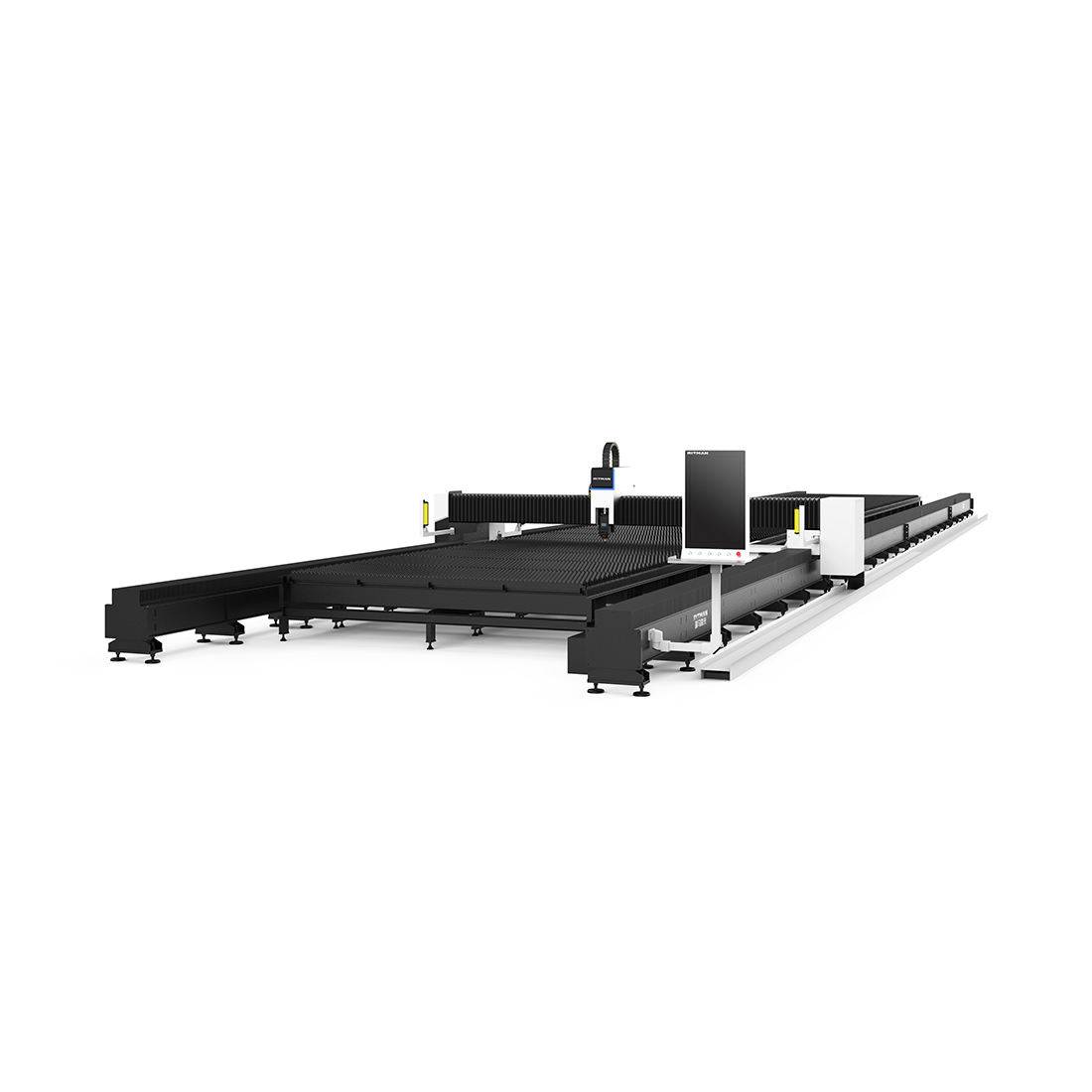
To rectify this, modern industrial systems utilize 3D Vision Positioning. This technology employs high-speed industrial cameras or laser line profilers to perform a real-time scan of the structural section before the cutting sequence begins. By capturing a dense point cloud of the actual workpiece, the system’s software calculates the deviation between the “as-built” physical beam and the “as-designed” CAD model.
Dynamic Compensation and Path Optimization
Once the 3D vision system identifies the spatial orientation and deformation of the steel, the CNC controller dynamically adjusts the cutting path. This is not merely a global offset; it is a localized compensation that ensures every hole, notch, and bevel is placed relative to the actual center-line and flanges of the beam. For the industrial engineer, this means a total elimination of manual layout errors. The precision afforded by vision-guided systems ensures that when these components reach the job site, the fit-up is perfect, drastically reducing the labor required for assembly.
Consolidated Workflow: Punch, Mark, and Cut
A primary metric for shop floor efficiency is the “Floor-to-Floor” time. The fiber laser machine optimizes this by performing three distinct operations in a single setup:
High-Precision Hole Production (Punch Equivalent)
While traditional shops use mechanical punches or drills, the fiber laser produces “bolt-ready” holes. The high power density allows the beam to pierce the material in milliseconds. Because the laser is a non-contact tool, there is no tool wear or mechanical stress applied to the material. This ensures that the circularity and cylindrical tolerance of the holes meet the stringent requirements of structural bolting standards (such as AISC or Eurocode 3) without the need for subsequent reaming.
Automated Part Marking and Identification
Traceability is a regulatory requirement in modern infrastructure projects. Fiber lasers can be modulated to perform high-speed surface marking. By reducing the power output, the system etches part numbers, heat numbers, and assembly orientation marks directly onto the steel. This replaces manual stamping or ink-jet marking, which are prone to fading or human error. Marking occurs at the same station as the cutting, ensuring that the identity of the part is permanently linked to its physical geometry.
Advanced Profile Cutting and Notching
Complex geometries such as cope cuts, rat holes, and compound miters are executed with a precision that manual methods cannot replicate. The fiber laser’s ability to maintain a stable focal point through multi-axis motion allows for clean cuts on the webs and flanges of beams simultaneously. The high-pressure assist gas (typically oxygen or nitrogen) effectively ejects the molten metal, leaving an edge that is smooth and ready for immediate assembly.
Eliminating Secondary Processes: The No-Grinding Advantage
From an operational cost perspective, the most significant benefit of fiber laser technology is the elimination of secondary grinding. Traditional thermal cutting methods often leave heavy dross, slag, or a hardened carbon layer on the cut surface. This requires manual labor with angle grinders to clean the edge before the part can be utilized in a structure.
Fiber laser cutting produces a surface finish with extremely low roughness values (Ra). The high-frequency pulse control of the fiber resonator prevents the accumulation of slag at the bottom of the cut. By delivering a “clean” edge directly from the machine, the facility can reallocate labor resources from the grinding bay to higher-value assembly tasks. This leads to a leaner manufacturing process and a significant reduction in the consumption of abrasive discs and power tools.
Industrial Engineering Impacts on Throughput
When analyzing Automated Structural Processing through the lens of Total Productive Maintenance (TPM) and Lean manufacturing, the fiber laser system provides several key advantages:
Material Utilization and Nesting
Sophisticated nesting algorithms can be applied to structural shapes, much like they are for plate cutting. Because the laser kerf is so thin (often less than 0.5mm), parts can be nested closer together. 3D vision ensures that even if a beam is slightly bowed, the nesting software can account for that geometry to maximize the yield from every linear meter of steel.
Energy Efficiency and Operational Costs
Fiber lasers exhibit a wall-plug efficiency of 30% to 40%, which is significantly higher than older CO2 laser technologies. For a high-duty cycle steel fabrication facility, this translates to lower utility costs and a smaller carbon footprint. Additionally, the lack of moving parts in the fiber resonator (unlike turbines in gas lasers) results in higher machine uptime and lower scheduled maintenance intervals.
Conclusion: The Future of Structural Steel
The integration of fiber laser cutting with 3D Vision positioning is not just a technological upgrade; it is a fundamental shift toward “Industry 4.0” in the steel sector. By leveraging the precision of light and the intelligence of computer vision, fabricators can achieve a level of accuracy and efficiency that was previously impossible. The ability to punch, mark, and cut in a single pass while eliminating the need for manual grinding creates a streamlined production flow. As project timelines become tighter and labor costs continue to rise, the adoption of these automated systems becomes the defining factor in a fabrication facility’s competitive advantage and long-term viability.
-


LT240S tube laser cutting machine
-
LT120S tube laser cutting machine
-
Sale

Tank Fillet Welding Machine
Original price was: $1,000.00.$900.00Current price is: $900.00. -
Sale

MAK100 tube laser cutting machine
Original price was: $5,500.00.$5,000.00Current price is: $5,000.00. -

portable plasma air cutting machine
$1,200.00 -

2in1 fiber laser cutting machine
-

Air cooling Laser welding machine
-

HF h beam laser cutting machine
-

LT240 laser cutting machine
-

Laser welding machine
-


Cobot Welding Station
-

Gantry welding robot solution
-

Tracked Wheeled AGV Welding robot
-

LFH6020 Fiber laser cutting machine
-
LFP6020
-

robotic welidng machine
Advanced Fiber Laser Tube Processing Technology
Our CNC Fiber Laser Tube Cutting systems revolutionize metal fabrication by integrating high-precision cutting, punching, and profiling into a single automated workflow. Designed for versatility, this technology handles a wide array of profiles including Round, Square, Rectangular, and Oval tubes, as well as complex L-shaped and U-shaped channels.
- Precision Punching: High-speed hole punching with micron-level accuracy, eliminating the need for mechanical drilling or die-stamping.
- Complex Profiling: Advanced 3D pathing allows for intricate interlocking joints and specialized notch cuts, ideal for structural frames.
- High Material Efficiency: Intelligent nesting software minimizes scrap, reducing raw material costs across large production runs.
- Clean Finish: Delivers oxide-free, burr-free edges that require zero secondary grinding before welding.

Seamlessly processing multiple profiles with consistent precision.
Global Delivery & Logistics



From our high-tech manufacturing facility directly to your global site. PCL WeldCut ensures secure packaging, professional handling, and reliable international logistics to safeguard your equipment throughout the entire journey.