Advancing Marine Fabrication: The Role of Fiber Laser Precision
In the heavy industrial landscape of shipbuilding, the transition toward high-power Fiber Laser Cutting marks a fundamental shift in production efficiency. Traditionally, shipyards struggled with the physical limitations of thermal cutting tools that required significant rework. The fiber laser, operating at wavelengths typically around 1.06 microns, offers an energy density that exceeds previous technologies by several orders of magnitude. This concentrated energy allows for a narrower kerf and a significantly reduced heat-affected zone (HAZ), which is critical for maintaining the structural integrity of high-tensile marine steels.
From an industrial engineering perspective, the objective is the elimination of non-value-added steps. When a fiber laser system is deployed, the edge quality achieved is often ready for assembly immediately upon completion of the cut. The precision of the beam minimizes dross and slag, effectively removing the need for secondary processing such as edge grinding or bevel cleaning. This capability directly impacts the total cycle time of hull block assembly, allowing for faster throughput in the fabrication shop.
3D Vision Positioning: Solving Large-Scale Material Deformation
Shipbuilding involves massive steel plates, often exceeding 20 meters in length. These plates are rarely perfectly flat; they exhibit inherent waviness from the rolling mill or slight deformations due to gravity and storage. Standard 2D cutting paths fail to account for these vertical deviations, leading to focal point inconsistencies and dimensional inaccuracies. The integration of 3D Vision Positioning addresses this by using laser line scanners or structured light sensors to map the topography of the workpiece in real-time.
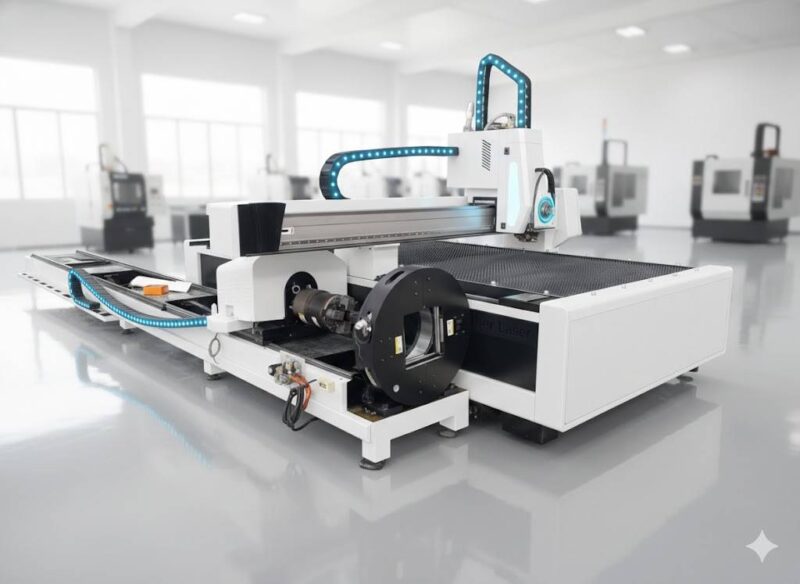
The vision system generates a high-resolution point cloud that the CNC controller uses to dynamically adjust the Z-axis height and the cutting path parameters. By compensating for the plate’s “waviness,” the system ensures that the laser focal point remains locked at the optimal depth relative to the material surface. This spatial awareness is essential for maintaining consistent cut quality across the entire surface area of a large-deck section or bulkhead plate, ensuring that the final parts meet the stringent tolerances required for modular ship construction.
The Triple Capability: Punch, Mark, and Cut Workflow
Efficiency in modern shipyards is driven by multi-functional machinery. A high-power fiber laser system is not merely a cutting tool; it is a comprehensive fabrication center. The software integration allows for a seamless transition between three distinct operations in a single nesting program: punching (piercing), marking, and cutting.
High-Speed Piercing and Punching
Unlike mechanical punching, which requires tool changes and causes vibration, the fiber laser utilizes high-frequency pulsing to “punch” start holes with micro-millimeter precision. This rapid piercing capability is vital for complex nests with hundreds of internal cutouts. The speed of the pierce reduces the overall “beam-on” time per plate, directly lowering the cost per part.
Automated Marking for Assembly
Shipbuilding requires extensive layout marking for stiffeners, brackets, and pipe supports. By utilizing the fiber laser at a lower power setting, the machine can etch alphanumeric codes, alignment lines, and welding symbols directly onto the plate. This permanent marking is performed in the same coordinate system as the cutting path, eliminating the risk of human error during manual layout. This integration ensures that downstream assembly teams have precise, clear instructions etched directly onto the steel.
Precision Cutting and Profiling
The final stage is the high-speed profiling of the part. Because the 3D vision system has already calibrated the surface, the cut is executed with a level of accuracy that allows for “tight-fit” tolerances. In the context of large-scale marine engineering, reducing the gap between joined parts from 3mm to 0.5mm significantly reduces the volume of filler metal required in later stages, though the focus here remains strictly on the efficiency of the cut itself.
Eliminating the Bottleneck: No Grinding Requirements
One of the most significant cost drivers in ship component fabrication is the labor-intensive process of grinding edges to remove oxides and dross. Fiber laser cutting, particularly when using nitrogen or high-pressure air as an assist gas, produces a clean, oxide-free surface. For stainless steel or aluminum components used in specialized vessel superstructures, this is a non-negotiable requirement.
The industrial engineer calculates the ROI of fiber lasers not just on cutting speed, but on the hours of manual labor saved. When the 3D vision system ensures the cut is perpendicular and clean despite plate curvature, the part can move directly from the cutting bed to the assembly jig. The metallurgical properties of the edge remain stable, preventing the brittleness often associated with slower, high-heat thermal processes. This maintains the fatigue life of the ship’s hull, which is a primary concern for naval architects and classification societies.
Maximizing Material Utilization through Intelligent Nesting
Material Utilization is a key performance indicator in any heavy manufacturing environment. Steel plate represents a significant portion of a vessel’s raw material cost. Fiber laser systems, with their narrow kerf widths (often under 0.2mm), allow for much tighter nesting of parts compared to older technologies. Common-line cutting, where two parts share a single cut path, is made more reliable through the precision of 3D vision tracking.
When the CNC system knows the exact orientation and deformation of the plate via the vision sensors, it can nest parts closer to the plate edges and closer to each other without risk of “tip-up” collisions or kerf interference. This reduces scrap rates by 5-10%, representing hundreds of tons of steel saved over the course of a large ship construction project. The ability to cut complex geometries, such as lightening holes in floor segments or intricate brackets, without the need for additional machining, further consolidates the value proposition.
Integrating CAD/CAM with Vision Feedback Loops
The workflow begins with the 3D model of the ship. Modern CAM software translates these models into G-code that includes vision system instructions. As the laser head moves, the vision system feeds back data to the controller, creating a closed-loop environment. If the sensor detects a deviation in the plate that exceeds the programmed tolerance, the system can automatically pause or adjust, preventing the production of a non-conforming part.
This level of automation reduces the reliance on highly skilled machine operators. The “intelligence” is built into the machine’s ability to see and react to the physical reality of the material. In a sector where labor shortages are common, the ability to maintain high precision through automated 3D positioning is a strategic advantage for any shipyard aiming to modernize.
Summary of Engineering Advantages
The implementation of fiber laser technology with 3D Vision positioning transforms the fabrication shop from a source of bottlenecks into a high-speed production engine. By focusing on high-precision cutting, integrated marking, and the elimination of secondary rework, shipbuilders can achieve a level of dimensional accuracy that was previously impossible. The result is a streamlined manufacturing process that prioritizes material efficiency and structural integrity, ensuring that the components produced are ready for immediate integration into the vessel’s structure.
-


LT240S tube laser cutting machine
-
LT120S tube laser cutting machine
-
Sale

Tank Fillet Welding Machine
Original price was: $1,000.00.$900.00Current price is: $900.00. -
Sale

MAK100 tube laser cutting machine
Original price was: $5,500.00.$5,000.00Current price is: $5,000.00. -

portable plasma air cutting machine
$1,200.00 -

2in1 fiber laser cutting machine
-

Air cooling Laser welding machine
-

HF h beam laser cutting machine
-

LT240 laser cutting machine
-

Laser welding machine
-


Cobot Welding Station
-

Gantry welding robot solution
-

Tracked Wheeled AGV Welding robot
-

LFH6020 Fiber laser cutting machine
-
LFP6020
-

robotic welidng machine
Advanced Fiber Laser Tube Processing Technology
Our CNC Fiber Laser Tube Cutting systems revolutionize metal fabrication by integrating high-precision cutting, punching, and profiling into a single automated workflow. Designed for versatility, this technology handles a wide array of profiles including Round, Square, Rectangular, and Oval tubes, as well as complex L-shaped and U-shaped channels.
- Precision Punching: High-speed hole punching with micron-level accuracy, eliminating the need for mechanical drilling or die-stamping.
- Complex Profiling: Advanced 3D pathing allows for intricate interlocking joints and specialized notch cuts, ideal for structural frames.
- High Material Efficiency: Intelligent nesting software minimizes scrap, reducing raw material costs across large production runs.
- Clean Finish: Delivers oxide-free, burr-free edges that require zero secondary grinding before welding.

Seamlessly processing multiple profiles with consistent precision.
Global Delivery & Logistics



From our high-tech manufacturing facility directly to your global site. PCL WeldCut ensures secure packaging, professional handling, and reliable international logistics to safeguard your equipment throughout the entire journey.