Optimization of Pressure Vessel Fabrication via Fiber Laser Technology
In the demanding field of pressure vessel manufacturing, dimensional accuracy and structural integrity are non-negotiable. Traditional fabrication workflows often rely on manual marking and mechanical cutting tools, which introduce significant human error and material deformation. The transition to fiber Laser Cutting systems represents a paradigm shift in how industrial engineers approach heavy-wall vessel components. By utilizing high-power fiber sources, manufacturers can achieve precise apertures for nozzles, manways, and drainage ports with tolerances previously unattainable on curved surfaces.
Unlike CO2 alternatives, fiber lasers operate at a wavelength of approximately 1.06 micrometers, allowing for high absorption rates in metals such as carbon steel and stainless steel. This efficiency results in a narrow heat-affected zone (HAZ), which is critical for maintaining the metallurgical properties of pressure-retaining components. The core of this technological advancement lies in the ability to deliver a concentrated energy beam that yields a clean, vertical cut, effectively streamlining the production pipeline.
The Role of 3D Vision Positioning in Curved Surface Processing
One of the primary challenges in pressure vessel manufacturing is the inherent variability in dished ends and cylindrical shells. Due to the forming processes—such as spinning or pressing—actual workpieces rarely match the theoretical CAD models perfectly. This is where 3D vision positioning becomes an essential component of the industrial engineering stack.
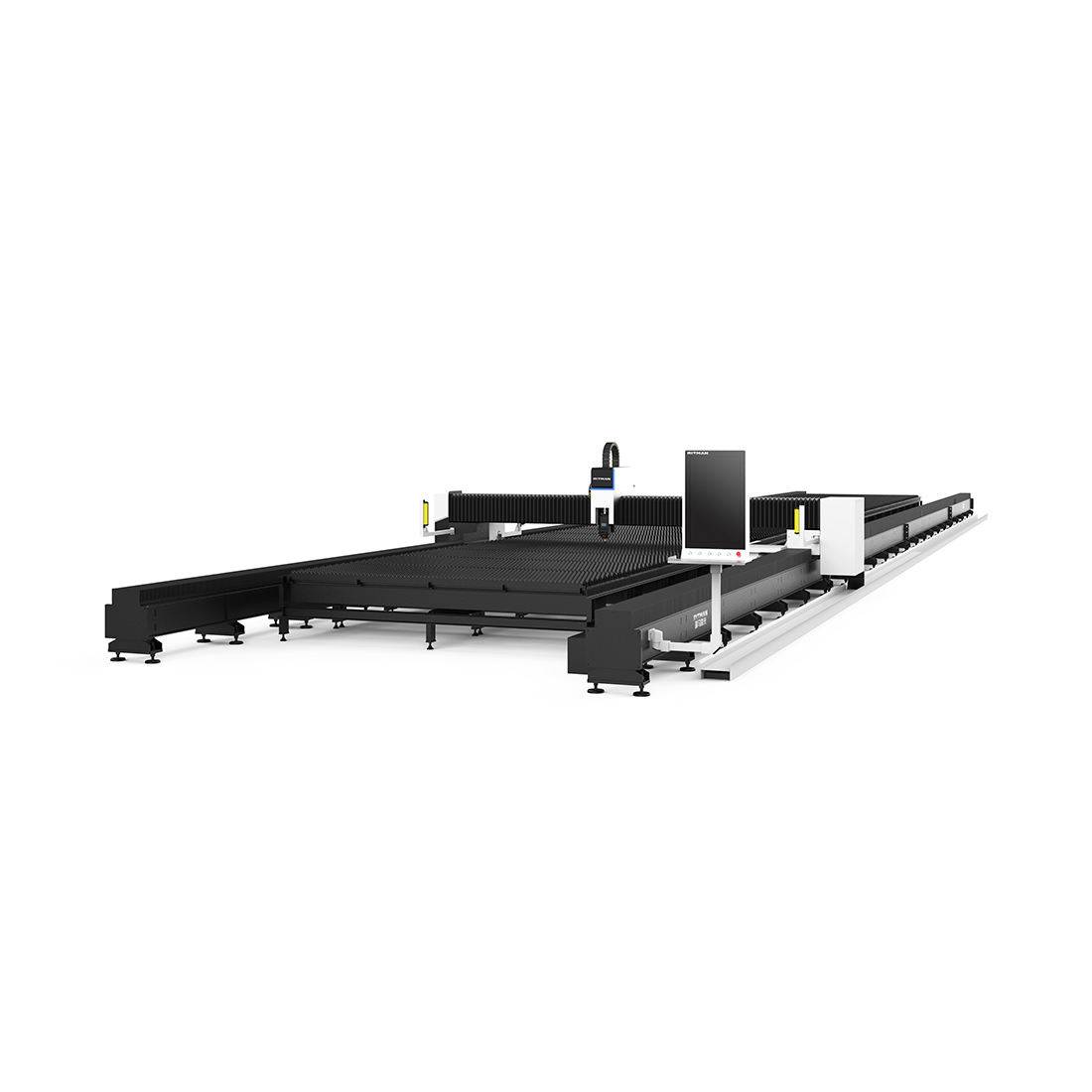
Advanced vision systems utilize high-speed industrial cameras or Lidar sensors mounted on the laser head to perform a non-contact scan of the workpiece surface. The system captures a point cloud that identifies the actual geometry of the vessel. By comparing the real-world coordinates with the digital design, the control software applies real-time compensation to the cutting path. This ensures that the laser focal point remains constant relative to the surface, regardless of any warping or deviations in the vessel’s curvature.
Integrated Workflow: Punching, Marking, and Cutting
Efficiency in a high-volume production environment is measured by the reduction of “air time” and the consolidation of machine tasks. Modern fiber laser cutting machines for Pressure Vessels are engineered to perform a multi-stage sequence within a single setup:
High-Precision Marking and Identification
Before the primary cutting operation begins, the laser system can be modulated to a lower power setting for surface marking. This is used to engrave heat numbers, part IDs, and assembly alignment lines directly onto the metal. Because this marking is executed by the same machine that performs the cut, the spatial relationship between the labels and the apertures is perfect, facilitating easier downstream assembly and traceability for regulatory compliance.
Automated Center Punching
For components that require secondary mechanical fasteners or specific alignment pins, the fiber laser provides a “punch” function. By delivering a short, high-energy pulse, the machine creates a precise indentation or pilot hole. This eliminates the need for manual center-punching and ensures that every reference point is synchronized with the global coordinate system of the vessel.
Final Orifice Cutting
The final stage is the high-speed cutting of the hole or profile. Utilizing nitrogen or oxygen as an assist gas, the fiber laser pierces the material and executes the cut with a kerf width as small as 0.1mm. The result is a highly accurate orifice that allows for seamless fit-up of nozzles and manway necks.
Achieving the “No Grinding” Standard
From an Industrial Engineering perspective, the most significant cost-saving benefit of fiber laser cutting is the elimination of secondary processes. Traditional cutting methods often leave rough edges, heavy dross, or carbonized layers that require labor-intensive manual grinding to meet welding prep standards.
The high beam quality of a fiber laser ensures that the molten material is cleanly ejected by the assist gas. The resulting surface finish is often “weld-ready” straight from the machine. This “no grinding” capability reduces labor costs by up to 40% and significantly improves the shop floor environment by reducing dust and noise associated with abrasive grinding tools. Furthermore, the absence of mechanical stress during the laser process ensures that the edges of the pressure vessel openings remain free of micro-cracks, which is a vital consideration for vessels operating under high cyclic pressure.
Kinematic Flexibility: 5-Axis and Robotic Integration
To handle the complex geometry of pressure vessels, fiber laser systems are often integrated with 5-axis gantry structures or 6-axis robotic arms. This kinematic flexibility allows the cutting head to remain perpendicular to the tangent of the vessel’s surface at all times. When coupled with 3D vision positioning, the system can dynamicallly adjust its tilt and rotation to navigate around the rounded “knuckle” area of a dished end or the longitudinal seams of a shell.
This level of automation enables “lights-out” manufacturing for certain segments of the vessel production. Once the vessel is loaded onto the rotators and the vision system has completed its initial scan, the machine can execute dozens of cuts across the entire surface without manual intervention.
Technical ROI and Process Scalability
The implementation of a 3D vision-guided fiber laser system is a strategic investment in process scalability. For industrial facilities producing a high volume of standard vessels or complex custom reactors, the reduction in cycle time is profound. By consolidating the layout, punching, marking, and cutting into a single automated station, the bottleneck of manual prep work is removed.
Material Utilization and Environmental Impact
High-precision laser cutting also maximizes material utilization. The narrow kerf allows for tighter nesting of parts if the machine is used for cutting plate before rolling. Additionally, the fiber laser is remarkably energy-efficient, converting a higher percentage of electrical power into light compared to legacy technologies. This leads to lower operational overhead and a smaller carbon footprint for the manufacturing facility.
Conclusion: The Future of Vessel Fabrication
The integration of 3D vision and fiber laser technology represents the pinnacle of modern pressure vessel fabrication. By prioritizing precision at the cutting stage, manufacturers ensure that every subsequent step in the assembly process is more accurate and less labor-intensive. The ability to mark, punch, and cut with a single tool—while achieving a finish that requires no grinding—sets a new benchmark for quality and efficiency in heavy industry.
-


LT240S tube laser cutting machine
-
LT120S tube laser cutting machine
-
Sale

Tank Fillet Welding Machine
Original price was: $1,000.00.$900.00Current price is: $900.00. -
Sale

MAK100 tube laser cutting machine
Original price was: $5,500.00.$5,000.00Current price is: $5,000.00. -

portable plasma air cutting machine
$1,200.00 -

2in1 fiber laser cutting machine
-

Air cooling Laser welding machine
-

HF h beam laser cutting machine
-

LT240 laser cutting machine
-

Laser welding machine
-


Cobot Welding Station
-

Gantry welding robot solution
-

Tracked Wheeled AGV Welding robot
-

LFH6020 Fiber laser cutting machine
-
LFP6020
-

robotic welidng machine
Advanced Fiber Laser Tube Processing Technology
Our CNC Fiber Laser Tube Cutting systems revolutionize metal fabrication by integrating high-precision cutting, punching, and profiling into a single automated workflow. Designed for versatility, this technology handles a wide array of profiles including Round, Square, Rectangular, and Oval tubes, as well as complex L-shaped and U-shaped channels.
- Precision Punching: High-speed hole punching with micron-level accuracy, eliminating the need for mechanical drilling or die-stamping.
- Complex Profiling: Advanced 3D pathing allows for intricate interlocking joints and specialized notch cuts, ideal for structural frames.
- High Material Efficiency: Intelligent nesting software minimizes scrap, reducing raw material costs across large production runs.
- Clean Finish: Delivers oxide-free, burr-free edges that require zero secondary grinding before welding.

Seamlessly processing multiple profiles with consistent precision.
Global Delivery & Logistics



From our high-tech manufacturing facility directly to your global site. PCL WeldCut ensures secure packaging, professional handling, and reliable international logistics to safeguard your equipment throughout the entire journey.
One thought on “Fiber Laser Cutting Machine with 3D Vision positioning for for Pressure Vessels”
The customer support for the LT120S was very helpful during installation.