Advanced Geometric Accuracy in Oil and Gas Tank Fabrication
The manufacturing of large-scale Oil & Gas storage tanks and pressure vessels requires a level of precision that traditional mechanical methods struggle to maintain. As the industry moves toward higher safety standards and stricter tolerances, the implementation of fiber Laser Cutting has become a fundamental shift in production methodology. Unlike conventional thermal processes, the fiber laser utilizes a high-power density beam to achieve rapid sublimation of the material, resulting in a narrow kerf width and minimal thermal influence on the surrounding substrate.
In the context of tank fabrication, the challenge often lies in the non-linear nature of the workpieces. Large-diameter shells, dished ends, and manway nozzles present complex curvatures that demand dynamic tool-path adjustments. This is where the synergy between the laser source and vision-based automation becomes critical. By utilizing a high-frequency fiber source, engineers can execute intricate geometries on 10mm to 30mm carbon steel or stainless steel plates with a level of repeatability that was previously unattainable.
The Role of 3D Vision Positioning in Surface Compensation
Traditional CNC cutting relies on the assumption that the material is perfectly flat and aligned with the machine’s coordinate system. However, in the heavy industry sector, large tank sections often exhibit material warping or slight deviations in radius. The integration of 3D vision positioning systems allows the machine to “see” the workpiece in three-dimensional space before the first pierce is made.
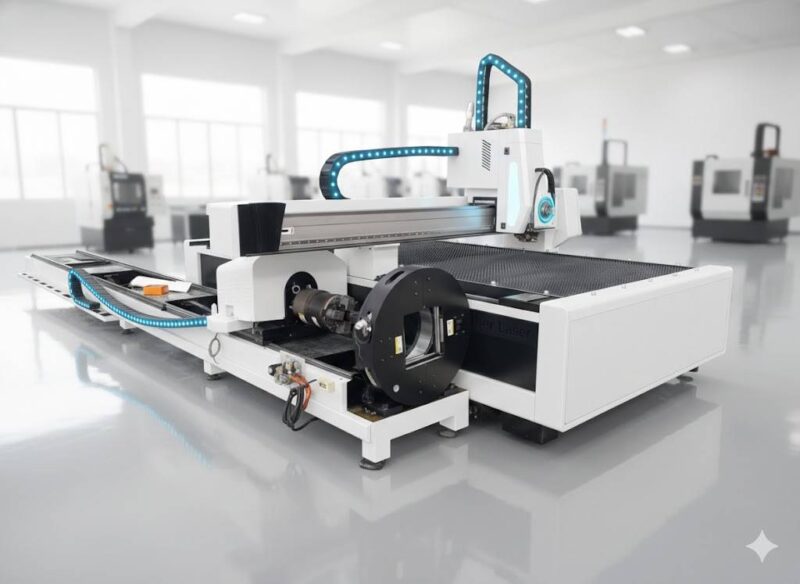
These vision systems typically employ structured light or LiDAR sensors to perform an automated surface mapping of the tank shell. The system generates a point cloud that identifies the exact spatial orientation of the surface. This data is then fed back into the motion controller, which performs a real-time coordinate transformation. The result is a cutting head that maintains a constant focal distance relative to the curved surface, ensuring the beam quality remains optimal throughout the entire path. This eliminates the risk of “lost cuts” or focus-drift, which are common when working on irregular industrial surfaces.
The Integrated Workflow: Punching, Marking, and Cutting
One of the most significant efficiency gains in an industrial engineering context is the consolidation of multiple fabrication steps into a single machine cycle. Modern fiber laser systems designed for the Oil & Gas sector are no longer just “cutting machines”; they are multi-process fabrication centers.
The process begins with the “Punch” phase, where the laser performs high-speed hole piercing with localized heat control to prevent material blowout. This is followed by the “Mark” phase, where the laser power is modulated to etch serial numbers, alignment markers, or heat numbers directly onto the plate. Finally, the “Cut” phase executes the final geometry. Because all three actions occur in a single setup, the cumulative error associated with moving the workpiece between different stations is eliminated. For an engineer, this translates to a significant reduction in the total cycle time (TCT) and an increase in material utilization rates.
Eliminating Secondary Processes: The No-Grinding Advantage
In traditional tank manufacturing, the “edge-ready” state is a bottleneck. Thermal cutting often leaves a rough, dross-heavy edge that requires manual grinding to reach a state suitable for inspection or assembly. Fiber laser technology fundamentally changes this requirement. The high-velocity assist gas (typically Oxygen or Nitrogen) effectively clears the molten material from the kerf, leaving behind a surface finish that often meets ISO 9013 Range 2 or 3 standards.
By achieving a clean, square edge directly from the machine, the need for secondary grinding is eradicated. This is particularly vital for the Heat Affected Zone (HAZ). Fiber lasers produce a significantly smaller HAZ compared to other thermal methods. for Oil & Gas Tanks, where the metallurgical integrity of the grain structure is paramount to prevent stress corrosion cracking (SCC), minimizing the HAZ is not just an efficiency gain—it is a critical safety improvement. The reduced heat input ensures that the mechanical properties of the specialized alloys used in pressure vessels remain within their design specifications.
Optimizing Operational ROI through Automation
From a managerial perspective, the investment in a fiber laser system with 3D vision is justified through the drastic reduction in labor costs and scrap material. The 3D vision system allows for “nesting on remnants,” where the camera identifies the usable area on a previously cut sheet, allowing the operator to maximize every square millimeter of high-cost alloy.
Furthermore, the absence of mechanical contact between the tool and the workpiece means there is no tool wear. Unlike mechanical punches or drills, the laser maintains the same level of precision on the 10,000th cut as it did on the first. For engineers focused on Lean Manufacturing principles, this technology provides the predictable, high-throughput output required for Just-In-Time (JIT) production schedules in the energy sector.
Conclusion: The Future of Pressure Vessel Fabrication
The implementation of 3D-vision-enabled fiber lasers represents the pinnacle of current fabrication technology for the Oil & Gas industry. By combining micron-level precision with intelligent surface compensation, manufacturers can produce tank components that fit together perfectly during the final assembly phase. This high-fidelity fit-up reduces the stress on the structure and ensures a longer service life for the asset. As the industry continues to evolve toward Industry 4.0 standards, the integration of vision and laser will remain the benchmark for quality and efficiency in heavy-duty manufacturing.
-


Cantilever Welding Robot solution
-


GF laser cutting machine
-

P3015 plasma cutting machine
-

LFP3015 Fiber Laser Cutter
-

pipe plasma cutting machine
-
LFH 4020 Fiber Laser Cutting Machine
-
LFP4020
-

gantry plasma air cutting machine
-

3D robot cutting machine
-

8 axis plasma cutting machine
-

5 axis plasma cutting machine
-

LT360 tube laser cutting machine
-

robot welding workstation
-

SF6060 fiber laser cutting machine
Advanced Fiber Laser Tube Processing Technology
Our CNC Fiber Laser Tube Cutting systems revolutionize metal fabrication by integrating high-precision cutting, punching, and profiling into a single automated workflow. Designed for versatility, this technology handles a wide array of profiles including Round, Square, Rectangular, and Oval tubes, as well as complex L-shaped and U-shaped channels.
- Precision Punching: High-speed hole punching with micron-level accuracy, eliminating the need for mechanical drilling or die-stamping.
- Complex Profiling: Advanced 3D pathing allows for intricate interlocking joints and specialized notch cuts, ideal for structural frames.
- High Material Efficiency: Intelligent nesting software minimizes scrap, reducing raw material costs across large production runs.
- Clean Finish: Delivers oxide-free, burr-free edges that require zero secondary grinding before welding.

Seamlessly processing multiple profiles with consistent precision.
Global Delivery & Logistics



From our high-tech manufacturing facility directly to your global site. PCL WeldCut ensures secure packaging, professional handling, and reliable international logistics to safeguard your equipment throughout the entire journey.