Advanced Material Processing in Oil & Gas Fabrication
The manufacturing of storage tanks and pressure vessels for the oil and gas sector demands rigorous adherence to structural integrity standards. Traditional fabrication workflows often suffer from cumulative tolerances and high labor costs associated with manual layout and post-cut finishing. The introduction of fiber Laser Cutting technology has redefined these parameters, offering a high-density energy source capable of processing thick-walled carbon and stainless steel with micron-level precision. Unlike legacy thermal cutting methods, the fiber laser operates at a wavelength (typically 1.064 microns) that is highly absorbed by metallic substrates, resulting in a narrow kerf width and a minimal heat-affected zone (HAZ).
The Role of 3D Vision Positioning Systems
Oil and gas tanks are rarely perfectly uniform; cylindrical shells and dished ends often exhibit slight geometric deviations from the theoretical CAD model due to prior rolling or forming processes. Standard 2D laser systems cannot account for these spatial variances, leading to misaligned nozzle holes and poor fit-up. 3D vision positioning solves this by utilizing industrial cameras and laser line sensors to perform a real-time spatial scan of the workpiece. This non-contact measurement creates a “digital twin” of the actual tank surface.
The system’s software calculates the offset between the physical part and the design file, dynamically adjusting the 5-axis laser head’s trajectory. This ensures that every aperture—whether it is a manhole or a small-diameter drainage port—is cut normal to the surface, maintaining the exact geometric orientation required for high-pressure ratings. This level of automation eliminates manual marking-out and the risk of human error in complex layout tasks.
The Unified Workflow: Punch, Mark, and Cut
Efficiency in an industrial setting is measured by the reduction of “touches” per part. A fiber laser system integrated with advanced CNC control allows for three distinct operations in a single setup, significantly lowering cycle times.
1. Precision Punching (Pilot Hole Creation)
Before the primary cut begins, the laser can execute high-speed “punching” or piercing sequences. For thick-walled tank materials, the fiber laser utilizes frequency-modulated pulses to pierce the material without creating excessive slag or craters. This ensures that the start point of the actual cut is clean and does not compromise the circularity of the final hole.
2. Automated Marking and Traceability
Traceability is a mandatory requirement under ASME and API standards. The fiber laser system can be programmed to switch to a low-power marking mode to etch heat numbers, part ID codes, and fit-up alignment lines directly onto the tank surface. Because this is done in the same coordinate system as the cutting, the relative accuracy between the cut edge and the layout marks is absolute. This eliminates the need for separate ink-jetting or mechanical engraving stations.
3. High-Speed Final Cutting
The final cutting stage leverages the full power of the fiber source (ranging from 12kW to 30kW for heavy industry). The high energy density allows for cutting speeds that are significantly higher than traditional mechanical methods. More importantly, the edge quality achieved is “weld-ready.” The absence of dross and the smoothness of the cut face mean that the material can move directly to the assembly stage without any intermediary grinding or cleaning steps.
Eliminating Post-Process Grinding
In conventional tank fabrication, secondary grinding is a significant bottleneck, often accounting for 30% of total labor hours in the prep stage. Oil & Gas pressure vessels require clean edges to prevent inclusions during the subsequent assembly phases. Fiber laser cutting achieves a surface roughness (Ra) that typically negates the need for mechanical abrasion. By maintaining a stable gas flow (Oxygen or Nitrogen) through the cutting nozzle, the system ensures that the molten metal is ejected cleanly, leaving a square edge with no adherence of re-solidified material.
Technical Specifications and Performance Metrics
To quantify the advantages of fiber laser systems in tank production, consider the following performance comparison based on a 20mm carbon steel shell plate:
| Parameter | Traditional Mechanical/Thermal | Fiber Laser with 3D Vision |
|---|---|---|
| Positioning Accuracy | ± 2.0 mm (Manual Layout) | ± 0.05 mm (Vision Guided) |
| Edge Preparation | Requires Grinding | Weld-Ready / No Grinding |
| Heat-Affected Zone | Extensive (>1.5 mm) | Minimal (<0.2 mm) |
| Setup Time | High (Multiple Stations) | Low (Single Setup) |
Integration with Smart Manufacturing
The automated hole processing workflow is increasingly integrated into broader Industry 4.0 frameworks. Data from the 3D vision system can be fed back into the plant’s PLM (Product Lifecycle Management) system to document the exact dimensions of every nozzle cutout. This provides a digital record of compliance and quality assurance. Furthermore, nesting algorithms for tank plates can be optimized to reduce material scrap, as the high precision of the laser allows for tighter spacing between parts without the risk of thermal deformation affecting adjacent cuts.
Structural Integrity and HAZ Management
For Oil & Gas applications, the metallurgical properties of the cut edge are as important as the dimensions. High-power fiber lasers operate with such speed that the total heat input into the base metal is drastically reduced compared to other thermal processes. This prevents grain growth and carbide precipitation in stainless steels, which are critical for maintaining corrosion resistance in sour gas environments. The narrow HAZ ensures that the parent metal’s ductility and impact strength remain within the specified design limits, reducing the likelihood of stress corrosion cracking (SCC) at the connection points.
Conclusion: The Engineering ROI
From an industrial engineering perspective, the transition to fiber laser cutting with 3D vision is a strategic upgrade in CAPEX that yields rapid ROI through the reduction of OPEX. By consolidating punching, marking, and cutting into a single automated cycle, and by eliminating the labor-intensive grinding of edges, manufacturers can increase their throughput by as much as 40-50%. In the competitive landscape of Oil & Gas infrastructure, the ability to deliver tanks with superior precision and documented traceability is a significant technological advantage.
-


LT240S tube laser cutting machine
-
LT120S tube laser cutting machine
-
Sale

Tank Fillet Welding Machine
Original price was: $1,000.00.$900.00Current price is: $900.00. -
Sale

MAK100 tube laser cutting machine
Original price was: $5,500.00.$5,000.00Current price is: $5,000.00. -

portable plasma air cutting machine
$1,200.00 -

2in1 fiber laser cutting machine
-

Air cooling Laser welding machine
-

HF h beam laser cutting machine
-

LT240 laser cutting machine
-

Laser welding machine
-


Cobot Welding Station
-

Gantry welding robot solution
-

Tracked Wheeled AGV Welding robot
-

LFH6020 Fiber laser cutting machine
-
LFP6020
-

robotic welidng machine
Advanced Fiber Laser Tube Processing Technology
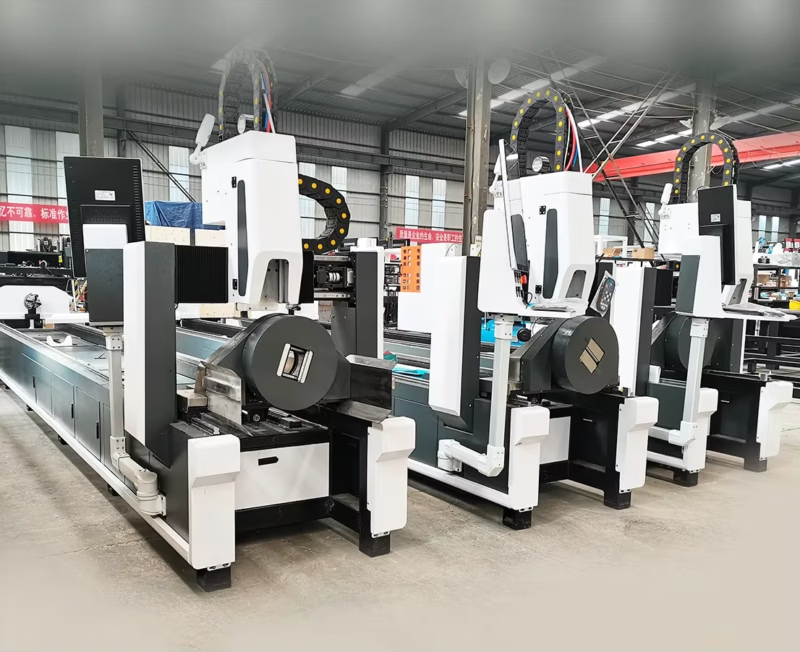
Our CNC Fiber Laser Tube Cutting systems revolutionize metal fabrication by integrating high-precision cutting, punching, and profiling into a single automated workflow. Designed for versatility, this technology handles a wide array of profiles including Round, Square, Rectangular, and Oval tubes, as well as complex L-shaped and U-shaped channels.
- Precision Punching: High-speed hole punching with micron-level accuracy, eliminating the need for mechanical drilling or die-stamping.
- Complex Profiling: Advanced 3D pathing allows for intricate interlocking joints and specialized notch cuts, ideal for structural frames.
- High Material Efficiency: Intelligent nesting software minimizes scrap, reducing raw material costs across large production runs.
- Clean Finish: Delivers oxide-free, burr-free edges that require zero secondary grinding before welding.

Seamlessly processing multiple profiles with consistent precision.
Global Delivery & Logistics



From our high-tech manufacturing facility directly to your global site. PCL WeldCut ensures secure packaging, professional handling, and reliable international logistics to safeguard your equipment throughout the entire journey.