Advanced Fabrication Strategies for Construction Machinery
In the current landscape of heavy equipment manufacturing—encompassing excavators, loaders, and cranes—the demand for structural integrity and dimensional consistency has reached an all-time high. Traditional fabrication methods often suffer from throughput bottlenecks and manual rework. The transition to high-power fiber Laser Cutting systems represents a fundamental shift in industrial engineering strategy. These systems provide the necessary energy density to process thick-plate high-strength steels with a level of precision that was previously unattainable in large-scale structural components.
The primary advantage of the fiber laser lies in its wavelength and beam quality. Fiber lasers operate at a wavelength of approximately 1.06 microns, which is more readily absorbed by metallic surfaces compared to older CO2 technologies. This results in a smaller heat-affected zone (HAZ) and a much narrower kerf width. For construction machinery components that require tight tolerances for pin-joint assembly and structural alignment, this precision is the foundation of quality control.
3D Vision Positioning: Eliminating Manual Setup Errors
One of the most significant challenges in large-format cutting is the variability of the workpiece. Heavy steel plates are rarely perfectly flat, and pre-processed components may have slight geometric deviations. 3D vision positioning solves this by utilizing industrial cameras and laser line scanners to map the exact topography and orientation of the material on the cutting bed. This system creates a digital twin of the physical workpiece in real-time.
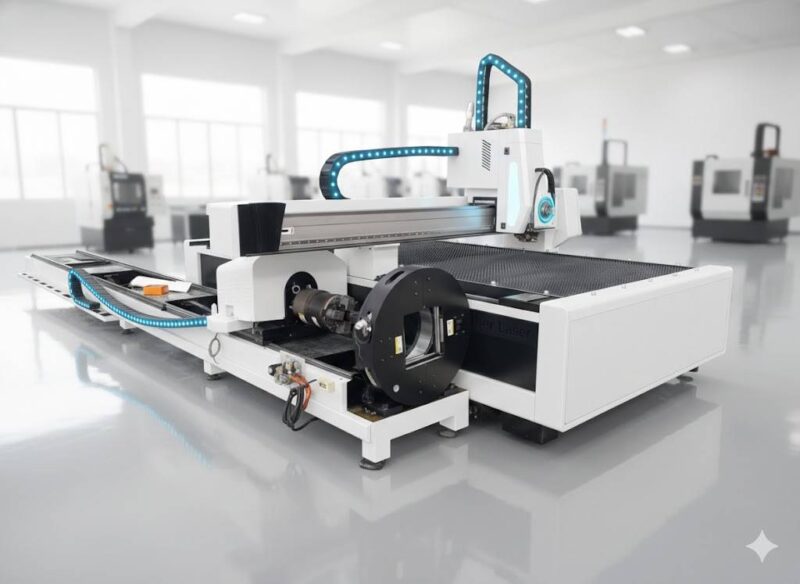
From an industrial engineering perspective, this eliminates the need for complex mechanical jigging and manual edge-finding. The vision system automatically detects the plate’s coordinates and adjusts the cutting path to compensate for any skew or thermal expansion. By integrating 3D vision, the machine can identify pre-drilled holes or previous features to ensure that new cuts are perfectly concentric or aligned with existing geometry. This “intelligent alignment” reduces scrap rates and ensures that every part meets the CAD-defined specification without operator intervention.
Consolidated Workflow: Punch, Mark, and Cut
Efficiency in a production line is measured by the reduction of “touches” per part. The fiber laser system serves as a multi-functional workstation that executes three critical operations in a single cycle: punching (piercing), marking, and cutting.
High-Speed Piercing and Punching Substitutes
Modern fiber lasers utilize high-frequency pulsing and oxygen or nitrogen assist gases to “punch” holes with extreme speed. Unlike mechanical punching, there is no tool wear or risk of plate deformation. For construction machinery, where bolt patterns and hydraulic routing holes are numerous, the ability to laser-pierce small-diameter holes in thick plate—maintaining a 1:1 ratio of hole diameter to plate thickness—is a critical capability.
Integrated Part Marking
Traceability is mandatory in the construction industry. By modulating the laser power, the system can etch QR codes, part numbers, and assembly guides directly onto the surface of the steel. This automated marking happens at the same station as the cutting, ensuring that the identification stays with the part throughout the entire downstream assembly process. It removes the need for secondary inkjet or stamping stations, reducing the footprint of the fabrication cell.
Precision Cutting without Secondary Processing
The hallmark of a well-calibrated fiber laser is the “finish” of the cut edge. For heavy machinery, the edge quality must be sufficient to pass ultrasonic testing and ensure long-term fatigue resistance. Fiber laser cutting produces a square edge with minimal dross (slag). This leads to one of the most significant cost savings in the factory: the no grinding requirement. In traditional fabrication, workers spend hours removing dross and smoothing edges. A high-precision laser cut is ready for the next stage of production immediately, significantly increasing the Overall Equipment Effectiveness (OEE) of the plant.
Optimizing Throughput for High-Strength Alloys
Construction equipment often utilizes specialized alloys like HARDOX or STRENX, which are designed for wear resistance and high yield strength. These materials are sensitive to heat. The fiber laser’s high cutting speed minimizes the time the heat source is in contact with the material, preserving the metallurgical properties of the alloy.
Industrial engineers must also consider the gas dynamics involved in the process. The use of high-pressure nitrogen as an assist gas allows for “clean cutting,” preventing oxidation on the cut edge. This is vital for components that will later be painted or powder-coated, as paint adheres better to a non-oxidized laser-cut edge than to an oxidized surface. This further reinforces the “no-grind” and “no-cleaning” philosophy that streamlines the production flow.
Safety and Environmental Impact in the Smart Factory
Transitioning to fiber laser technology also addresses modern safety and environmental standards. These machines are typically fully enclosed, protecting operators from high-intensity light and capturing 100% of the dust and fumes via high-efficiency filtration systems. Compared to older cutting methods, fiber lasers are also remarkably energy-efficient, converting electrical power into light with over 30% efficiency, which translates to lower operational costs per meter of cut.
Data-Driven Manufacturing and Predictive Maintenance
The integration of 3D vision and CNC control allows for the collection of massive amounts of data. Industrial engineers can monitor nozzle wear, gas consumption, and cutting speeds in real-time. If the 3D vision system detects a trend in material deformation, the software can provide feedback to the upstream material suppliers or adjust the nesting strategy to better distribute heat. This level of granular control is what defines Industry 4.0 in heavy machinery fabrication.
Implementation and ROI Analysis
While the initial capital expenditure for a fiber laser with 3D vision is higher than traditional tools, the Return on Investment (ROI) is realized through three specific avenues:
1. Reduction in labor costs by eliminating manual grinding and layout marking.
2. Increase in material utilization through tighter nesting and vision-assisted placement on remnants.
3. Higher throughput by consolidating multiple fabrication steps into a single machine cycle.
Conclusion: The Standard for Modern Heavy Fabrication
For the construction machinery industry, the shift toward fiber laser cutting with 3D vision is not merely an incremental upgrade; it is a total optimization of the fabrication process. By achieving high-precision results that eliminate the need for secondary grinding and by consolidating punching, marking, and cutting into a single automated step, manufacturers can produce higher-quality equipment at a lower cost per unit. As structural requirements become more stringent, the ability to deliver consistent, burr-free, and perfectly aligned components will be the primary differentiator in manufacturing excellence.
-


LT240S tube laser cutting machine
-
LT120S tube laser cutting machine
-
Sale

Tank Fillet Welding Machine
Original price was: $1,000.00.$900.00Current price is: $900.00. -
Sale

MAK100 tube laser cutting machine
Original price was: $5,500.00.$5,000.00Current price is: $5,000.00. -

portable plasma air cutting machine
$1,200.00 -

2in1 fiber laser cutting machine
-

Air cooling Laser welding machine
-

HF h beam laser cutting machine
-

LT240 laser cutting machine
-

Laser welding machine
-


Cobot Welding Station
-

Gantry welding robot solution
-

Tracked Wheeled AGV Welding robot
-

LFH6020 Fiber laser cutting machine
-
LFP6020
-

robotic welidng machine
Advanced Fiber Laser Tube Processing Technology
Our CNC Fiber Laser Tube Cutting systems revolutionize metal fabrication by integrating high-precision cutting, punching, and profiling into a single automated workflow. Designed for versatility, this technology handles a wide array of profiles including Round, Square, Rectangular, and Oval tubes, as well as complex L-shaped and U-shaped channels.
- Precision Punching: High-speed hole punching with micron-level accuracy, eliminating the need for mechanical drilling or die-stamping.
- Complex Profiling: Advanced 3D pathing allows for intricate interlocking joints and specialized notch cuts, ideal for structural frames.
- High Material Efficiency: Intelligent nesting software minimizes scrap, reducing raw material costs across large production runs.
- Clean Finish: Delivers oxide-free, burr-free edges that require zero secondary grinding before welding.

Seamlessly processing multiple profiles with consistent precision.
Global Delivery & Logistics



From our high-tech manufacturing facility directly to your global site. PCL WeldCut ensures secure packaging, professional handling, and reliable international logistics to safeguard your equipment throughout the entire journey.