Engineering Review: Water-cooled Cobot Welding Machine – Bengaluru, India
In this article
- Field Engineering Report: Implementation of Water-Cooled Cobot Welding Systems in Bengaluru Heavy…
- 1.0 Introduction and Site Context
- 2.0 Technical Specifications of the Cobot Welding Machine
- 3.0 Application in Structural Steel Welding
- 4.0 Integration Challenges in the Bengaluru Environment
- 5.0 Metallurgical Observations and Quality Control
- 6.0 Human-Machine Collaboration: Lessons Learned
- 7.0 Economic Impact and Throughput Analysis
- 8.0 Conclusion
Field Engineering Report: Implementation of Water-Cooled Cobot Welding Systems in Bengaluru Heavy Fabrication
1.0 Introduction and Site Context
This report details the technical deployment and operational evaluation of a water-cooled Cobot Welding Machine within a medium-scale structural steel fabrication facility located in the Peenya Industrial Estate, Bengaluru. The facility primarily handles high-volume production of support trusses and heavy-duty brackets for the regional infrastructure sector.
The transition from manual Metal Active Gas (MAG) welding to Collaborative Robotics was driven by two primary factors: the increasing scarcity of Class-A certified manual welders in the Karnataka region and the requirement for 100% duty cycle performance on 10mm to 20mm Structural Steel welding projects. Unlike traditional industrial robots that require extensive safety cell infrastructure, the cobot unit was selected for its small footprint and ability to work alongside human fitters in a shared workspace.
2.0 Technical Specifications of the Cobot Welding Machine
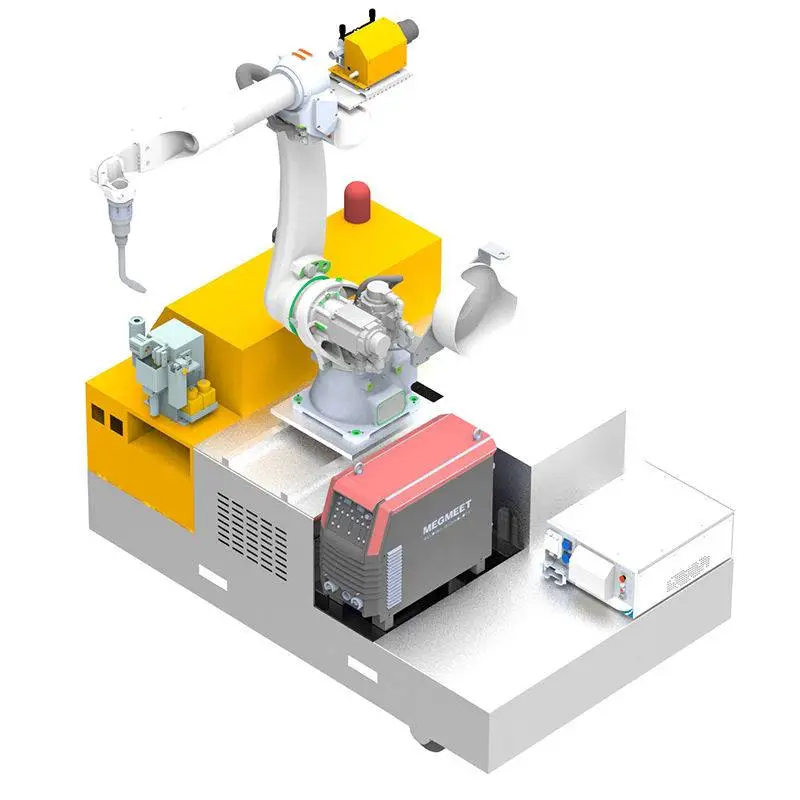
The system under review comprises a 6-axis collaborative arm integrated with a 500A power source. A critical differentiator in this setup is the water-cooled torch integration. In the ambient temperatures of a Bengaluru workshop—which can fluctuate between 22°C and 38°C inside the shed—air-cooled torches frequently suffer from thermal degradation during continuous 1.2mm wire runs.
2.1 Synergy Between Hardware and Collaborative Robotics
The “synergy” in Collaborative Robotics is found in the interplay between the machine’s force-torque sensors and the welding power source’s software interface. The Cobot Welding Machine is not merely a robotic arm holding a torch; it is a unified digital ecosystem. In our field test, we utilized “lead-through programming,” where the head welder manually moves the arm to define the weld path. The software then interpolates these points, applying consistent travel speeds and weave patterns that are virtually impossible to maintain manually over an eight-hour shift.
3.0 Application in Structural Steel Welding
The core of our evaluation centered on Structural Steel welding using IS 2062 Grade E250 steel. The structural integrity of these components depends on deep penetration and the absence of undercut—defects that often occur in manual welding due to operator fatigue.
3.1 Multi-Pass Fillet Welds
For 12mm fillet welds, we programmed the Cobot Welding Machine to perform a three-pass sequence. The first pass (root) focused on penetration at 280A and 28V. The subsequent two capping passes were executed with a slight oscillation (weave) to ensure fusion at the toes of the weld. The consistency of the collaborative arm ensured that the inter-pass temperature remained within the 150°C to 200°C range, critical for maintaining the metallurgical properties of the heat-affected zone (HAZ).
3.2 The Water-Cooling Advantage
During Structural Steel welding, the heat radiation from the molten pool is intense. Air-cooled systems typically require a 40% rest period to prevent cable meltdown. The water-cooled Cobot Welding Machine utilized a dedicated chiller unit, circulating a glycol-water mix through the power cable and torch neck. This allowed for uninterrupted welding for over 45 minutes of arc-on time, effectively doubling the daily throughput of the station compared to manual or air-cooled robotic counterparts.
4.0 Integration Challenges in the Bengaluru Environment
While the technical advantages are clear, the deployment in a local “real-world” shop floor presented specific environmental and logistical hurdles that required engineering workarounds.
4.1 Power Quality and Grid Stability
Bengaluru’s industrial power grid is prone to voltage sag and transient surges. Collaborative robotics are sensitive to these fluctuations. We observed that the control PC of the Cobot Welding Machine would occasionally reboot during heavy motor starts elsewhere in the factory. The solution was the installation of a dedicated 5kVA online UPS specifically for the cobot controller, isolating the logic circuits from the heavy-draw welding inverter.
4.2 Dust and Particulate Management
The grinding dust prevalent in structural shops is a nemesis to the cooling fans of a Cobot Welding Machine. We noted a buildup of metallic dust on the joints of the collaborative arm within the first 100 hours of operation. Lesson learned: Protective “leather sleeves” or specialized robotic covers are mandatory to prevent fine particulates from entering the encoder housings and joints, which could otherwise lead to “collision” false positives in the collaborative sensors.
5.0 Metallurgical Observations and Quality Control
Upon sectioning the test coupons welded by the cobot, we observed a significantly more refined grain structure compared to manual samples. This is attributed to the precise control over the heat input (kJ/mm).
Heat Input Formula applied:
HI = (Amps x Volts x 0.8 Efficiency) / (Travel Speed in mm/s x 1000)
By locking the travel speed via the Collaborative Robotics software at exactly 4.5mm/s, we maintained a consistent heat input of 1.4 kJ/mm. Manual welders in the same shop fluctuated between 1.1 and 1.8 kJ/mm, leading to inconsistent penetration profiles. The Cobot Welding Machine eliminated this variable, resulting in a 98% first-pass acceptance rate under Ultrasonic Testing (UT).
6.0 Human-Machine Collaboration: Lessons Learned
The term “Collaborative” implies a partnership. In our Peenya site, we did not replace the welder; we redefined his role to that of a “Welding Technician.”
6.1 Tactical Programming
The most successful operators were those who understood Structural Steel welding fundamentals but lacked the manual dexterity for perfect beads. They used the Cobot Welding Machine as a tool to execute their knowledge. For example, when welding a complex gusset plate, the technician would set the tack welds manually and then “hand off” the heavy-duty long seams to the cobot. This reduced physical strain and allowed the technician to prep the next assembly while the machine was in arc-on mode.
6.2 Safety Protocols
Despite the “collaborative” nature, the heat and UV radiation from Structural Steel welding require physical barriers. We implemented localized welding curtains and high-volume fume extraction units at the source. The cobot’s ability to stop on contact is a secondary safety feature; the primary safety concern remains the arc itself.
7.0 Economic Impact and Throughput Analysis
Over a 30-day observation period, the water-cooled Cobot Welding Machine delivered a 35% increase in total weld metal deposition. The reduction in post-weld cleaning (spatter) due to the stabilized arc of the pulsed-MAG power source further reduced secondary labor costs. For the Bengaluru market, where lead times for infrastructure components are tightening, the ability to run a night shift with minimal supervision—given the cobot’s reliability—is a major competitive advantage.
8.0 Conclusion
The deployment of a water-cooled Cobot Welding Machine in the Bengaluru industrial landscape proves that Collaborative Robotics is no longer a luxury for high-end aerospace only. In the rugged world of Structural Steel welding, the combination of high-duty cycle hardware and intuitive software interfaces allows local manufacturers to meet international quality standards while optimizing local labor resources.
Final Engineering Takeaways:
- Cooling is Critical: Never spec an air-cooled torch for structural cobot work in Indian ambient conditions.
- Power Conditioning: Budget for an online UPS to protect the sensitive collaborative encoders.
- Skill Shift: Focus training on “weld parameters” rather than “hand-eye coordination.” The machine handles the motion; the human must handle the metallurgy.
Report Prepared By:
Senior Welding Engineer
Field Operations – Bengaluru Division







