Field Engineering Report: Implementation of Single Pulse Laser Welding Cobots in Hai Phong Industrial Sector
1. Project Overview and Environmental Context
This report details the technical deployment and performance validation of Single Pulse 1.5kW Fiber Laser Welding Cobots at a Tier-1 maritime and aerospace component facility in Hai Phong, Vietnam. The objective was to transition from manual GTAW (Gas Tungsten Arc Welding) to automated laser solutions to address throughput bottlenecks in thin-gauge Titanium welding.
Hai Phong’s industrial climate presents specific challenges for high-precision Laser Technology. With average relative humidity often exceeding 80%, the management of the optical path and the integrity of shielding gases became paramount. My observation during the first week was that standard TIG methods were resulting in excessive Heat Affected Zones (HAZ) and atmospheric contamination. The shift to a Laser Welding Cobot was not merely an upgrade in speed, but a necessity for metallurgical integrity.
2. The Synergy of Laser Technology and Collaborative Robotics
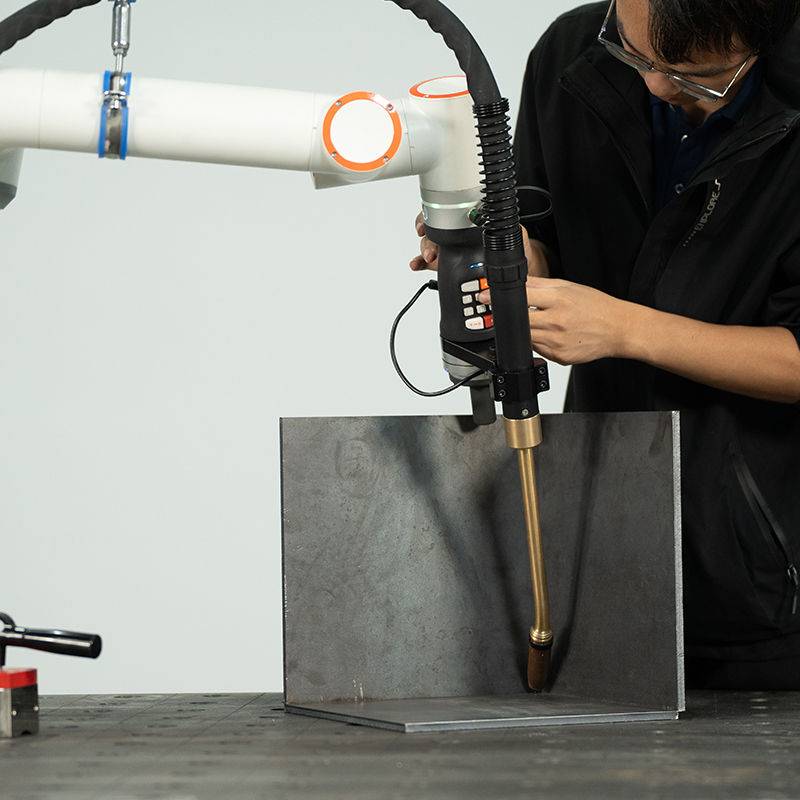
The core of this deployment lies in the synergy between the fiber source and the collaborative arm. Unlike traditional high-power CO2 lasers or fixed CNC laser cells, the Laser Welding Cobot offers a 6-axis degree of freedom that mimics the human wrist but with a positional repeatability of ±0.03mm.
2.1 Beam Characteristics and Pulse Modulation
In Titanium welding, heat management is the difference between a compliant part and scrap. Using Single Pulse Laser Technology allows us to control the peak power and pulse duration with microsecond precision. By utilizing a “Single Pulse” regime rather than continuous wave (CW) for specific corner joints, we successfully reduced the total heat input by 40% compared to traditional pulsed TIG. The cobot’s controller communicates directly with the laser source via EtherCAT, ensuring that power ramping is synchronized with the arm’s acceleration and deceleration curves. This prevents “burn-through” at the start and end of the weld path.
3. Technical Deep-Dive: Titanium Welding Challenges in Hai Phong
Titanium Grade 2 and Grade 5 are notoriously reactive at temperatures above 400°C. In the Hai Phong facility, the primary hurdle was the rapid oxidation caused by the humid ambient air.
3.1 Shielding Gas Dynamics
While the Laser Welding Cobot provides the movement, the Laser Technology provides the concentrated energy. However, neither can prevent embrittlement if the shielding gas coverage is insufficient. We engineered a custom trailing shield integrated into the cobot’s end-of-arm tooling (EOAT). We utilized 99.999% high-purity Argon.
Lesson Learned: In the high-humidity environment of Hai Phong, we found that standard rubber gas lines were permeating enough moisture to cause slight discoloration (straw-yellow to blue) in the titanium beads. We switched to stainless steel braided PTFE lines to maintain the dew point of the gas until the point of delivery.
3.2 The Keyhole Stability Problem
During Titanium welding, the keyhole created by the laser beam is prone to instability. If the Laser Welding Cobot travels too slowly, the weld pool collapses; too fast, and we see lack of fusion. The synergy here involves using the cobot’s “Wobble” function—a high-frequency oscillation of the laser beam integrated into the optical head. By oscillating the beam in a circular pattern (2mm width at 150Hz), we stabilized the keyhole and improved the tolerance for fit-up gaps, which are common in large-scale Hai Phong fabrications.
4. Practical Application: Real-World Workshop Integration
Integrating a Laser Welding Cobot into a workshop that has traditionally relied on manual labor requires a shift in technical culture. In Hai Phong, the labor force is highly skilled in manual dexterity but required significant upskilling in “teaching” the cobot.
4.1 Teaching and Path Programming
One of the primary advantages of the Laser Welding Cobot is the “lead-through” programming. I instructed the local engineers to physically move the arm to define the weld path. However, for Titanium welding, the standoff distance (focal point) is critical. A variance of even 1mm can move the focus out of the “sweet spot,” leading to surface oxidation rather than deep penetration. We implemented a laser-based height sensor to compensate for part warping during the weld cycle.
4.2 Thermal Distortion Management
In the Hai Phong facility, we were working on 1.2mm thick titanium heat exchanger plates. Traditional welding caused these plates to “oil-can” or potato-chip due to thermal stresses. The Laser Technology applied via the cobot allowed for a narrow, deep weld profile. Because the cobot maintains a constant velocity that a human cannot match, the heat input is perfectly uniform. This eliminated the need for post-weld straightening processes, saving approximately 15 man-hours per unit.
5. Lessons Learned from the Hai Phong Field Site
After three months of operation, several critical technical insights have been documented for future deployments of Laser Welding Cobots in Southeast Asian maritime environments.
5.1 Optical Maintenance in Tropical Climates
The protective windows of the laser head are the most vulnerable component. In Hai Phong, the combination of salt air and high humidity led to condensation on the optics during shift changes when the air conditioning was cycled.
Engineering Fix: We implemented a pressurized, filtered dry-air purge within the optical head housing. This ensures that the Laser Technology is never compromised by “fogging,” which would otherwise scatter the beam and cause catastrophic failure of the fiber delivery cable.
5.2 Power Grid Fluctuation
The industrial power grid in parts of Hai Phong can experience voltage sags. Fiber lasers are sensitive to these fluctuations. A dedicated UPS (Uninterruptible Power Supply) and voltage regulator were required to ensure the Laser Welding Cobot did not lose its positional homing or suffer from “dithering” in the laser output power during critical Titanium welding passes.
5.3 Joint Preparation Standards
A recurring issue was the assumption that Laser Technology could “weld through” surface contaminants. On the contrary, Titanium welding requires surgical cleanliness. We had to implement a strict acetone-wipe and stainless-steel brushing protocol within 10 minutes of the cobot start-cycle. Any delay resulted in porosity due to the high humidity in the workshop reacting with the titanium during the melt phase.
6. Metallurgical Results and Quality Assurance
Post-implementation testing was conducted via X-ray diffraction and dye penetrant inspection. The results were superior to previous manual benchmarks:
- Tensile Strength: 98% of base metal strength (Ti Grade 2).
- HAZ Width: Reduced from 3.5mm (Manual TIG) to 0.8mm (Laser Cobot).
- Color Gradient: Consistent “Silver” finish, indicating zero atmospheric contamination.
7. Conclusion
The deployment of the Laser Welding Cobot in Hai Phong demonstrates that the marriage of Laser Technology and collaborative robotics is the most viable path for high-specification Titanium welding. The ability to precisely control pulse energy while maintaining a consistent mechanical path allows for a level of repeatability that manual welders cannot achieve in tropical industrial conditions. For future scale-ups, the focus must remain on environmental control (gas purity and optical purging) and rigid jigging to fully exploit the precision of the cobot arm. This transition has moved the Hai Phong facility from a traditional “job shop” to a high-precision digital fabrication center.
Report Prepared By: Senior Welding Engineer
Date: May 22, 2024
Location: Hai Phong, Vietnam
-


Cantilever Welding Robot solution
-


GF laser cutting machine
-

P3015 plasma cutting machine
-

LFP3015 Fiber Laser Cutter
-

pipe plasma cutting machine
-
LFH 4020 Fiber Laser Cutting Machine
-
LFP4020
-

gantry plasma air cutting machine
-

3D robot cutting machine
-

8 axis plasma cutting machine
-

5 axis plasma cutting machine
-

LT360 tube laser cutting machine
-

robot welding workstation
-

SF6060 fiber laser cutting machine
Advanced Fiber Laser Tube Processing Technology
Our CNC Fiber Laser Tube Cutting systems revolutionize metal fabrication by integrating high-precision cutting, punching, and profiling into a single automated workflow. Designed for versatility, this technology handles a wide array of profiles including Round, Square, Rectangular, and Oval tubes, as well as complex L-shaped and U-shaped channels.
- Precision Punching: High-speed hole punching with micron-level accuracy, eliminating the need for mechanical drilling or die-stamping.
- Complex Profiling: Advanced 3D pathing allows for intricate interlocking joints and specialized notch cuts, ideal for structural frames.
- High Material Efficiency: Intelligent nesting software minimizes scrap, reducing raw material costs across large production runs.
- Clean Finish: Delivers oxide-free, burr-free edges that require zero secondary grinding before welding.

Seamlessly processing multiple profiles with consistent precision.
Global Delivery & Logistics



From our high-tech manufacturing facility directly to your global site. PCL WeldCut ensures secure packaging, professional handling, and reliable international logistics to safeguard your equipment throughout the entire journey.