Engineering Review: Single Pulse Cobot Welding Machine – Mumbai, India
In this article
- Field Report: Implementing Single Pulse Cobot Welding Systems in the Navi Mumbai…
- 1. Introduction and Objective
- 2. The Synergy of Collaborative Robotics in the Mumbai Workshop
- 3. Technical Specifications: Titanium Welding with Single Pulse
- 4. Real-World Challenges and Technical Fixes
- 5. Lessons Learned from the Field
- 6. Comparative Analysis: Manual vs. Cobot
- 7. Conclusion and Recommendations
Field Report: Implementing Single Pulse Cobot Welding Systems in the Navi Mumbai Industrial Sector
1. Introduction and Objective
This report details the technical deployment and operational assessment of a Single Pulse Cobot Welding Machine at a specialized aerospace fabrication facility in Navi Mumbai, India. The primary objective was to transition from manual GTAW (Gas Tungsten Arc Welding) to an automated solution using Collaborative Robotics for the high-precision Titanium welding of Grade 5 (Ti-6Al-4V) pressure vessels and ducting.
In the Mumbai industrial context, space is a premium and the skilled welder shortage is acute. The implementation focused on whether a Cobot Welding Machine could maintain the stringent metallurgical requirements of Titanium welding while operating in a non-caged, high-humidity environment typical of the Konkan coast.
2. The Synergy of Collaborative Robotics in the Mumbai Workshop
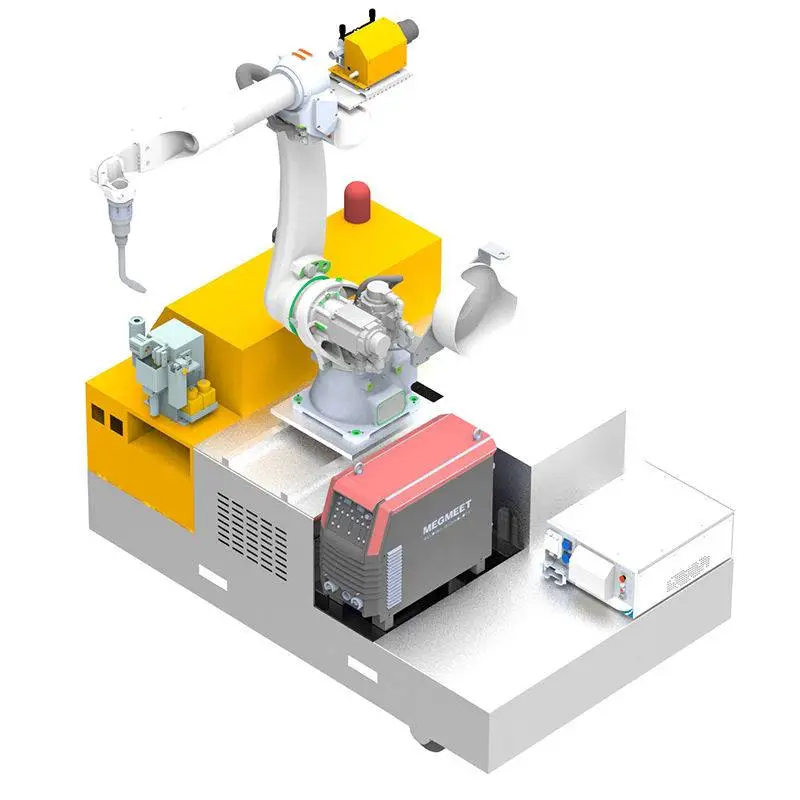
Unlike traditional industrial robots that require extensive safety fencing and dedicated floor space—luxuries many Mumbai-based workshops cannot afford—Collaborative Robotics allows the machine to work alongside human operators. In this specific deployment, the Cobot Welding Machine was integrated into a workstation measuring only 3m x 3m.
2.1 Lead-Through Programming and Local Workforce Integration
A critical technical advantage observed was the ‘lead-through’ programming. We utilized senior manual welders to ‘teach’ the cobot the torch angles required for complex circular seams. This synergy turned the welder into a robotic supervisor. The Cobot Welding Machine handled the travel speed and arc length consistency, while the human operator focused on the real-time monitoring of the trailing shield and gas coverage.
2.2 Safety and Proximity
In the cramped quarters of a Thane-Belapur road facility, the integrated force-torque sensors of the Collaborative Robotics system were tested. The machine’s ability to cease motion upon contact allowed for a high-density floor layout, increasing the throughput per square foot by 40% compared to a traditional robotic cell.
3. Technical Specifications: Titanium Welding with Single Pulse
Titanium welding is notoriously unforgiving. The primary challenge is preventing atmospheric contamination (Oxygen, Nitrogen, and Hydrogen) which leads to embrittlement. Our setup utilized a Single Pulse MIG-based Cobot Welding Machine modified for precision shielding.
3.1 Pulse Parameters for Ti-6Al-4V
The single pulse profile was tuned to manage the Heat Affected Zone (HAZ). We set the peak current at 210A with a background current of 45A at a frequency of 120Hz. This specific pulsing allowed for deep penetration while minimizing the overall heat input, which is vital to prevent grain growth in the Titanium substrate. The Cobot Welding Machine maintained a travel speed of 350mm/min, a rate impossible to maintain manually with the same level of consistency over an 8-hour shift.
3.2 Shielding Gas Management in Humid Environments
Mumbai’s relative humidity (often exceeding 80%) poses a significant risk for Titanium welding. Even trace moisture in the air can contaminate the weld pool. We implemented a dual-shielding strategy:
- Primary Shield: 99.999% Pure Argon delivered through the torch.
- Secondary Trailing Shield: Custom-designed 3D-printed titanium shroud mounted on the Cobot Welding Machine arm to maintain an inert atmosphere until the weld cooled below 400°C.
4. Real-World Challenges and Technical Fixes
4.1 Power Grid Stability
The Mumbai industrial power grid is prone to micro-fluctuations. During the first week of deployment, we noticed arc instability that resulted in ‘straw-colored’ oxidation on the Titanium surface. This indicated a momentary drop in the wire feed speed or the pulse frequency. We rectified this by installing a dedicated 15kVA servo-stabilizer and an active power filter to ensure the Cobot Welding Machine received a clean sine wave.
4.2 Wire Feed Consistency in High Salinity
The proximity to the Arabian Sea means the air is saline. We observed that the Titanium filler wire (ERTi-5) would develop surface friction issues if left exposed. We transitioned to a sealed, desiccated wire feeding unit integrated into the Collaborative Robotics framework. This ensured that the feed motor of the Cobot Welding Machine didn’t encounter resistance, which would otherwise cause ‘stutter’ in the pulse delivery.
5. Lessons Learned from the Field
5.1 Torch Rigidity vs. Cobot Sensitivity
One major lesson learned was the impact of torch weight. Titanium welding requires heavy trailing shields. Initially, this added mass caused the Collaborative Robotics arm to trigger ‘collision’ alarms during high-speed air moves. We had to recalibrate the payload settings of the Cobot Welding Machine and optimize the Center of Gravity (CoG) offsets.
Lesson: Never underestimate the torque applied by the gas hoses and trailing shields on the cobot’s 6th axis.
5.2 Surface Preparation is 90% of the Success
In manual welding, a welder might compensate for a slightly dirty surface by ‘washing’ the arc. The Cobot Welding Machine will not. We learned that for Titanium welding in a tropical environment, the cleaning window is less than 4 hours. If a part was cleaned in the morning and welded in the afternoon, the humidity caused enough surface oxidation to fail X-ray inspection. We implemented a strict ‘clean-and-weld’ 30-minute protocol.
5.3 The ‘Ghosting’ Effect in Pulse Welding
During the single-pulse operation, we noticed a ‘ghosting’ or rippling effect that was inconsistent. After a deep dive into the Collaborative Robotics software logs, we found it was caused by the vibration of the workbench. In Mumbai’s multi-story industrial units, vibrations from heavy presses on the ground floor can transfer to the cobot. We installed anti-vibration mounts on the cobot base, which immediately stabilized the arc plasma.
6. Comparative Analysis: Manual vs. Cobot
6.1 Quality Metrics
The rejection rate for manual Titanium welding due to porosity or oxidation was roughly 12% in this facility. After 60 days of utilizing the Cobot Welding Machine, the rejection rate dropped to 1.5%. The consistency of the single pulse meant that the heat input was identical on every inch of the seam, leading to a uniform alpha-case layer that met aerospace standards.
6.2 Productivity Metrics
A typical circumferential weld on a 200mm diameter pipe took a manual welder 45 minutes, including cooling breaks and repositioning. The Collaborative Robotics setup completed the same weld in 12 minutes. Because the cobot does not suffer from ‘arc flash’ fatigue or heat exhaustion (a major factor in the Mumbai heat), it maintained this pace throughout the shift.
7. Conclusion and Recommendations
The deployment of the Cobot Welding Machine for Titanium welding in Navi Mumbai has been a technical success, provided that environmental factors like humidity and power stability are controlled. Collaborative Robotics has proven to be the correct methodology for this high-precision application where space is constrained and human expertise is still required for setup and oversight.
Final Engineering Recommendations:
- Gas Quality: Always use an in-line moisture trap for Argon lines in Mumbai.
- Grounding: Ensure ‘Star’ earthing for the Cobot Welding Machine to prevent high-frequency interference from neighboring heavy machinery.
- Training: Focus training on ‘recovery’—teaching local operators how to reset the Collaborative Robotics arm without losing the weld path coordinates if a safety stop is triggered.
The future of Titanium welding in the Indian aerospace sector lies in these hybrid systems. They bridge the gap between the artisanal skill of the Indian welder and the relentless precision of digital automation.
Report Compiled By:
Senior Welding Engineer, Special Projects Division
Mumbai, MH.







