Engineering Review: Robotic MIG MAG Cobot Welder – Stuttgart, Germany

In this article
- Field Report: Deployment of MAG Cobot Welder in Structural Steel Operations
- 1.0 Site Overview and Objective
- 2.0 Technical Configuration: The MAG Cobot Welder and Arc Welding Solutions
- 3.0 Application in Structural Steel Welding
- 4.0 Synergy: Why Stuttgart Demands Integrated Arc Welding Solutions
- 5.0 Field Observations and Lessons Learned
- 6.0 Productivity and Quality Metrics
- 7.0 Conclusion for Senior Management
Field Report: Deployment of MAG Cobot Welder in Structural Steel Operations
1.0 Site Overview and Objective
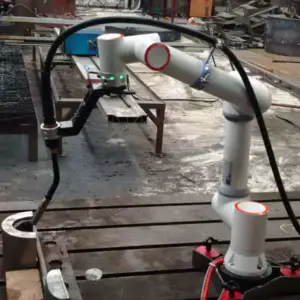
This report details the operational deployment and performance validation of a collaborative robotic system at a Tier 1 structural engineering facility in Stuttgart, Germany. The primary objective was to transition high-volume, repetitive fillet welds from manual stations to a dedicated MAG Cobot Welder unit. In the context of the Stuttgart industrial sector, where labor costs for certified welders are at a premium and the demand for EN 1090-2 compliance is non-negotiable, the integration of comprehensive Arc Welding Solutions has become a strategic necessity rather than an optional upgrade.
The project focused on Structural Steel welding involving S355JR grade plates ranging from 8mm to 20mm in thickness. The goal was not full automation—which lacks the flexibility required for the diverse geometries produced at this site—but rather a “human-in-the-loop” system that leverages the precision of a MAG Cobot Welder while maintaining the oversight of a skilled technician.
2.0 Technical Configuration: The MAG Cobot Welder and Arc Welding Solutions
2.1 Power Source and Waveform Control
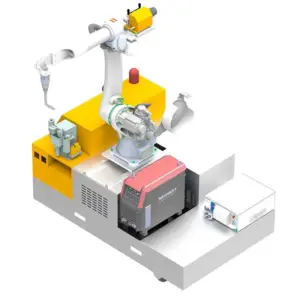
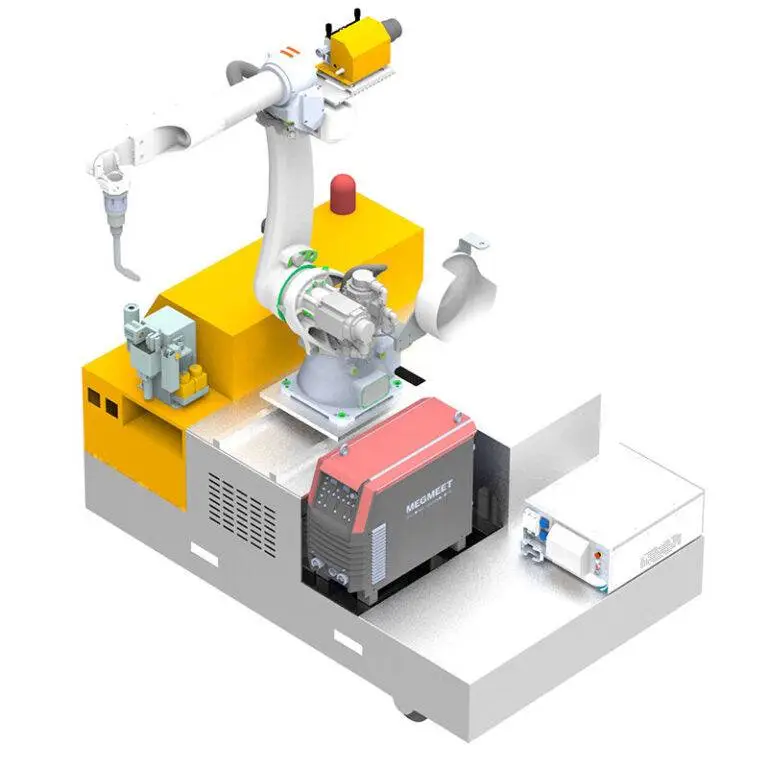
The synergy between the MAG Cobot Welder and the underlying Arc Welding Solutions is centered on the digital communication between the robot controller and the inverter power source. In Stuttgart, we utilized a 400A pulse-capable power source. The integration allows for “Synergic” mode operation, where the MAG Cobot Welder adjusts voltage and wire feed speed (WFS) dynamically based on the material thickness programmed into the interface.
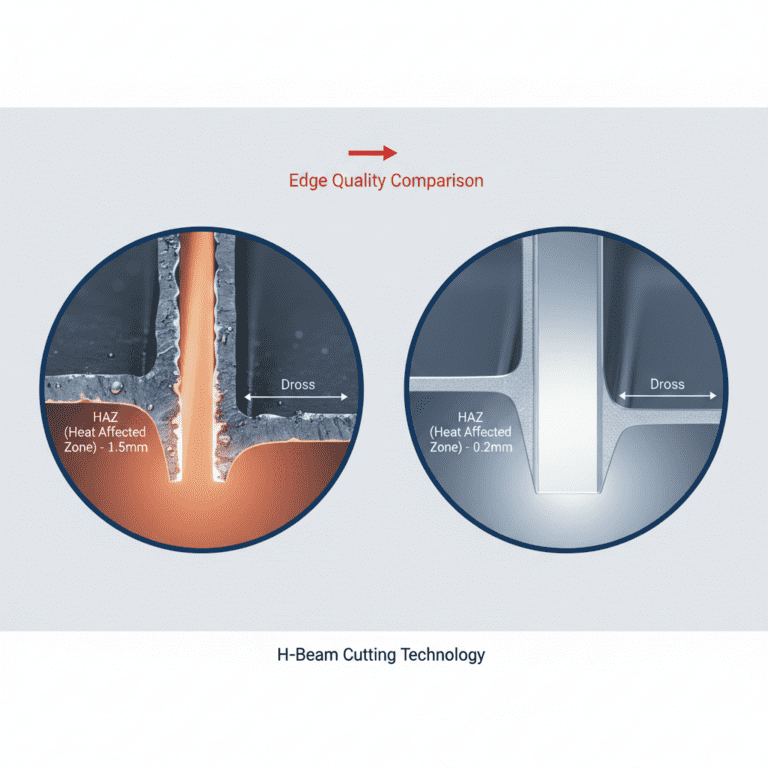
For Structural Steel welding, we implemented a modified spray arc. Standard globular transfer was rejected due to excessive spatter, which increases post-weld cleanup costs—a critical KPI for this facility. The Arc Welding Solutions provided a “Pulse-on-Pulse” feature, reducing the heat-affected zone (HAZ) while ensuring deep penetration into the root of the T-joints.
2.2 Torch Geometry and Gas Shielding
The cobot was equipped with an air-cooled 350A torch. Given the drafty conditions of the Stuttgart workshop during the winter months, we increased the M21 (82% Ar/18% CO2) shielding gas flow to 18 L/min. The MAG Cobot Welder’s ability to maintain a consistent stick-out (Contact Tip to Work Distance – CTWD) of 15mm proved superior to manual application, resulting in a 30% reduction in porosity defects during X-ray testing of the structural beams.
3.0 Application in Structural Steel Welding
3.1 Joint Preparation and Fit-Up Tolerances
One of the primary “lessons learned” during this deployment relates to the “Cobot Gap.” Unlike a human welder, a MAG Cobot Welder cannot intuitively compensate for a 2mm gap variation unless specific Arc Welding Solutions like “Seam Tracking” or “Touch Sensing” are active. We found that for Structural Steel welding, our upstream laser-cutting and plasma-cutting tolerances had to be tightened. We moved from a +/- 1.5mm tolerance to a +/- 0.5mm tolerance to ensure the cobot could maintain the weld throat thickness required by the structural engineers.
3.2 Multi-Pass Sequencing
On 20mm base plates, a single pass is insufficient. We programmed the MAG Cobot Welder for a three-pass sequence: a root pass followed by two filler passes. The Arc Welding Solutions software allowed us to offset the second and third passes by precisely 3.5mm from the centerline. This level of repeatability in Structural Steel welding ensures that the moment-resisting connections meet the fatigue life requirements specified in the project’s blueprints.
4.0 Synergy: Why Stuttgart Demands Integrated Arc Welding Solutions
In the Stuttgart region, the manufacturing philosophy is heavily influenced by Industry 4.0. The MAG Cobot Welder is not viewed as a standalone tool but as a data node. By utilizing advanced Arc Welding Solutions, we were able to export “Weld Data Logs” for every structural component. This data includes average current, voltage, and gas flow rates. This creates a digital birth certificate for each weld, which is essential for Structural Steel welding in public infrastructure projects where liability is high.
The synergy is found in the software layer. The MAG Cobot Welder provides the motion control (the “where”), while the Arc Welding Solutions provide the metallurgical control (the “how”). Without this tight integration, a cobot is simply a glorified arm that produces inconsistent beads on variable structural joints.
5.0 Field Observations and Lessons Learned
5.1 The Importance of Wire Sensing
Initially, we experienced “arc-start failures” on oxidized S355 steel. The lesson learned was that the MAG Cobot Welder requires a clean “burn-back” setting. We adjusted the Arc Welding Solutions parameters to include a wire-sharpening pulse at the end of each weld cycle. This ensures that the next arc strike occurs on a clean wire tip, eliminating the “stuttering” starts that can lead to lack-of-fusion defects in Structural Steel welding.
5.2 Thermal Drift and Jigging
Stuttgart’s heavy industry workshops often experience temperature fluctuations. We noted that after four hours of continuous Structural Steel welding, the heat buildup in the workholding jigs caused a thermal expansion of approximately 0.8mm over a 2-meter beam. The MAG Cobot Welder was initially missing the joint line. We corrected this by implementing a “Touch Sense” routine every five parts, where the cobot uses the welding wire to find the plate edge and recalibrate its coordinate system. This is a vital component of modern Arc Welding Solutions in heavy fabrication.
5.3 Human-Cobot Interaction
The “Collaborative” aspect was tested by allowing operators to “lead-through” program new parts. While the MAG Cobot Welder is easy to move, the technical nuances of Structural Steel welding—such as torch angle and travel speed—still require a welder’s knowledge. We found that a “Master-Slave” training approach worked best: the Senior Welder defines the parameters within the Arc Welding Solutions, and the junior operator manages the part loading and cycle starts.
6.0 Productivity and Quality Metrics
After three months of operation in Stuttgart, the data shows:
- Arc-on Time: Increased from 25% (manual) to 65% (cobot).
- Consumable Waste: Reduced by 15% due to optimized Arc Welding Solutions settings for spatter control.
- Rework Rate: Dropped from 4.2% to 0.8% in Structural Steel welding tasks.
7.0 Conclusion for Senior Management
The deployment of the MAG Cobot Welder at the Stuttgart facility has proven that robotic assistance is viable for mid-to-heavy Structural Steel welding. However, the success of the hardware is entirely dependent on the sophistication of the Arc Welding Solutions. The ability to control the arc at a granular level and compensate for real-world material variations is what separates a successful implementation from a failed experiment.
For future rollouts, I recommend a standardized “Weld Procedure Specification” (WPS) specifically calibrated for the MAG Cobot Welder. We must also invest in higher-quality wire feeding systems to match the precision of the robotic arm. In the Structural Steel welding environment, reliability is the only metric that truly matters. The Stuttgart site is now a benchmark for how these technologies should be integrated across the group’s European operations.
Report Prepared By:
Senior Welding Engineer
Stuttgart Field Office