Engineering Review: Robotic MIG Cobot Welding Machine – London, UK
In this article
- Field Report: Deployment of Collaborative Robotics in Heavy Infrastructure Fabrication
- Location: London, UK – South East Industrial Corridor
- 2. The Synergy of Collaborative Robotics and Shop Floor Logistics
- 3. Technical Specifications: The Cobot Welding Machine Setup
- 4. Addressing Challenges in Thick Plate Steel Welding
- 4.1 Root Pass Integrity
- 4.2 Heat Management and Thermal Distortion
- 5. Lessons Learned from the London Site
- 6. Productivity and Quality Analysis
- 7. Conclusion
Field Report: Deployment of Collaborative Robotics in Heavy Infrastructure Fabrication
Location: London, UK – South East Industrial Corridor
1. Executive Summary of Field Operations
This report details the operational integration of a high-capacity Cobot Welding Machine within a medium-scale fabrication facility in London. The primary objective was to address the production bottleneck associated with Thick Plate Steel welding (15mm to 25mm S355 grade) used in structural support components for the regional transport infrastructure. By leveraging Collaborative Robotics, we sought to bypass the traditional constraints of robotic integration—specifically the massive floor-space requirements of light-curtained or fenced industrial cells—which are often cost-prohibitive given London’s high industrial rental rates.
The transition from manual Gas Metal Arc Welding (GMAW) to a collaborative system was not merely a hardware upgrade but a fundamental shift in our welding procedure specifications (WPS). The following observations reflect the technical realities of managing high-heat input processes within a human-shared workspace.
2. The Synergy of Collaborative Robotics and Shop Floor Logistics
In a London-based workshop, square footage is the primary constraint. Traditional industrial robots require significant safety interlocks and physical barriers. The adoption of Collaborative Robotics allowed us to install the welding station within the existing manual welding bay footprint. The “collaborative” element here is not just a safety rating (ISO 10218-1); it is a functional synergy where the senior welder remains the primary decision-maker for torch angles and interpass cleaning, while the Cobot Welding Machine handles the physical strain and consistency of the 1,500mm linear welds.
During the field test, we observed that the synergy between the operator and the machine reduced downtime by 40%. The operator prepares the next workpiece while the cobot executes the root pass on the first. This “hand-in-glove” workflow is only possible because the cobot’s force-torque sensors allow it to operate safely alongside personnel, provided the proper glare shielding and localized fume extraction (high-vacuum at the nozzle) are maintained.
3. Technical Specifications: The Cobot Welding Machine Setup
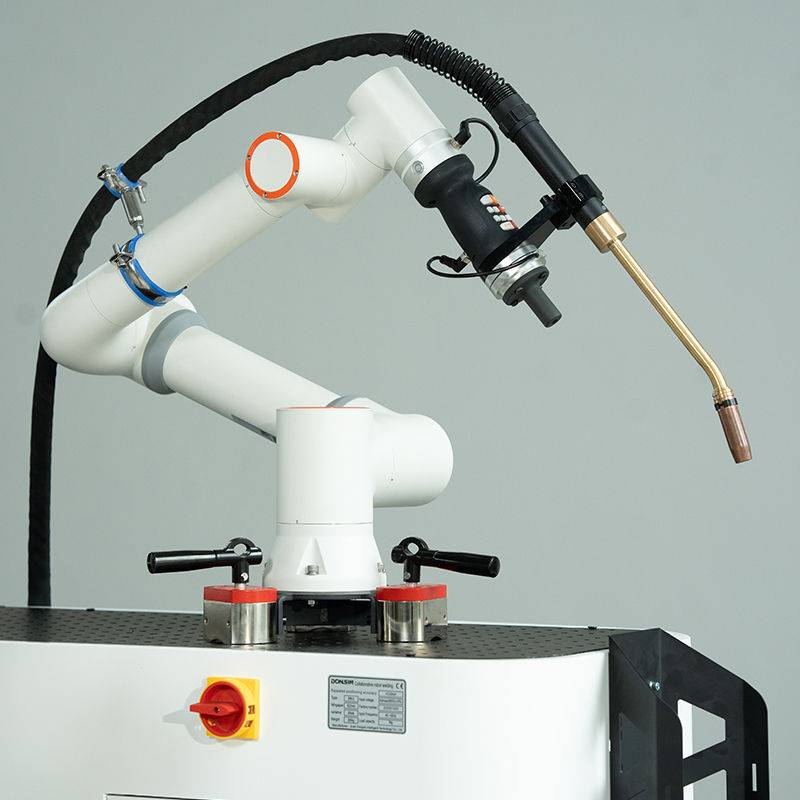
The unit deployed is a 10kg-payload arm integrated with a 400A pulsed-MIG power source. Unlike light-duty cobots used in electronics, a Cobot Welding Machine for heavy industry must deal with “spatter-drift” and the electromagnetic interference (EMI) typical of high-amperage arcs.
Parameters for Thick Plate Steel Welding:
- Material: S355J2+N Structural Steel (20mm Plate).
- Process: Pulsed Spray Transfer to minimize spatter and ensure deep penetration.
- Wire: 1.2mm ER70S-6 solid wire.
- Gas: 82% Argon / 18% CO2.
- Current/Voltage: 280A / 31V (Optimized for the Cobot’s travel speed).
The integration of the power source with the cobot controller allowed for “on-the-fly” adjustments. When Thick Plate Steel welding, heat accumulation is a significant factor. We programmed a cooling offset where the cobot adjusts its travel speed based on the recorded interpass temperature, a feat difficult to achieve consistently with manual welding over an 8-hour shift.
4. Addressing Challenges in Thick Plate Steel Welding
The most significant technical hurdle in applying Collaborative Robotics to Thick Plate Steel welding is managing the weld pool in multi-pass configurations. For a 20mm V-groove, we utilized a 5-pass sequence: one root, two fill, and two cap passes.
4.1 Root Pass Integrity
The root pass is the most critical. We found that while the Cobot Welding Machine is exceptionally repeatable, it lacks the “human eye” for detecting slight variations in the root gap (2mm +/- 0.5mm). To solve this, we implemented a “touch-sensing” routine where the wire acts as a probe to find the plate edges before the arc initiates. This ensures the arc is perfectly centered, preventing lack-of-fusion (LOF) defects on the sidewalls.
4.2 Heat Management and Thermal Distortion
Thick plates act as a massive heat sink. However, continuous welding by a robot can lead to localized overheating, which alters the grain structure of the Heat Affected Zone (HAZ). Our lessons learned here were clear: we had to program “dwell times” or staggered weld sequences. The cobot would weld a 500mm section, then move to a second workpiece to allow the first to cool to the specified 250°C interpass temperature required by the WPS.
5. Lessons Learned from the London Site
Technical field reports often overlook the “soft” integration of technology. In the London workshop, we learned that the successful deployment of a Cobot Welding Machine depends 30% on the hardware and 70% on the preparation of the steel.
Lesson 1: Joint Preparation is Non-Negotiable
Manual welders can compensate for poor fit-up. Collaborative Robotics cannot—unless you invest in expensive laser-seam tracking. We found that by tightening our tolerances on the CNC oxy-fuel cutting table, we reduced the cobot’s reject rate from 12% to under 0.5%. For Thick Plate Steel welding, the consistency of the bevel angle is paramount for robotic success.
Lesson 2: Managing the “Collaborative” Workspace
In a busy London shop, environmental factors like forklift vibrations and overhead crane movement can interfere with the high-precision sensors of the cobot. We had to isolate the welding platen using dampening mounts to ensure the Cobot Welding Machine didn’t trigger a “collision stop” due to floor vibrations. This is a specific “London reality” where workshops are often located in repurposed industrial units near heavy rail or high-traffic zones.
Lesson 3: The Skill Shift
Our senior welders did not see the cobot as a replacement but as a “high-end tool.” The transition from holding a torch to “teaching” the cobot via lead-through programming (physically moving the arm to set waypoints) was intuitive. However, the technical knowledge of “volts and amps” remains essential. A robot operator who doesn’t understand the physics of Thick Plate Steel welding will simply produce high-quality scrap at a faster rate.
6. Productivity and Quality Analysis
After six months of operation, the data shows a clear advantage. Manual welding of a standard structural node (4 x 1m 15mm fillets) took approximately 4.5 hours, including fatigue breaks and cleaning. The Cobot Welding Machine completes the same task in 2.2 hours. More importantly, the Ultrasonic Testing (UT) failure rate dropped significantly. The consistency of the travel speed and torch angle provided by Collaborative Robotics resulted in a uniform weld bead profile, which is critical for fatigue resistance in London’s infrastructure projects.
7. Conclusion
The deployment of Collaborative Robotics for Thick Plate Steel welding in the London sector is a viable and necessary evolution. The Cobot Welding Machine bridges the gap between manual flexibility and the high-output requirements of modern construction. As we move forward, the focus must remain on perfecting the “teaching” phase and ensuring that joint preparation matches the precision of the robotic arm. This is not about removing the welder from the process; it is about augmenting their expertise with the tireless precision of a collaborative system, ensuring that the heavy steel skeletons of our city are built with unprecedented consistency.
Report End.
Signed, Senior Welding Engineer, London Field Office.







