Field Report: Implementing Multi-pass 6-Axis Collaborative Welder Systems in Curitiba
Project Overview and Site Specifics
This report documents the deployment and performance optimization of a 6-axis collaborative welder at a heavy-duty fabrication facility located in the Industrial City of Curitiba (CIC), Paraná, Brazil. The facility specializes in high-pressure vessels for the regional food and beverage industry, necessitating high-specification stainless steel welding. The primary objective was to transition from manual GTAW (Gas Tungsten Arc Welding) to an Automated Welding workflow using collaborative robotics to handle multi-pass sequences on 20mm thick 316L stainless steel plates.
Curitiba’s industrial environment presents specific logistical and environmental variables. High humidity levels during the summer months required stringent management of shielding gas dew points and material storage to prevent hydrogen-induced cracking, though less common in austenitic grades, moisture-driven porosity remains a risk in automated processes where the operator is less likely to compensate on the fly.
The 6-Axis Collaborative Welder: Technical Configuration
The core of the system is a 10kg payload 6-axis collaborative welder integrated with a high-frequency pulsed-MIG power source. Unlike traditional industrial robots, the 6-axis collaborative welder allows for “lead-through” programming. This was critical for the Curitiba team, where the seasoned manual welders transitioned to “Robot Technicians.”
Kinematic Versatility in Multi-pass Scenarios
The six axes of motion provide the necessary degrees of freedom to maintain a constant torch angle (Work Angle and Travel Angle) relative to the groove geometry. In multi-pass stainless steel welding, the torch must often be manipulated to avoid “under-cutting” the sidewalls during the fill passes. The 6-axis configuration allowed us to program precise “weaving” patterns that are synchronized with the travel speed, ensuring that the weld pool wets the edges of the V-groove effectively.
Synergy Between Automated Welding and Collaborative Systems
The term “Automated Welding” often implies a rigid, fixed-automation setup. However, in the context of the Curitiba workshop, the synergy lies in the flexibility of the 6-axis collaborative welder. We integrated an “Automated Welding” logic that utilizes a parametric offset. Once the root pass is taught via the collaborative interface, the software calculates the subsequent fill and cap passes by applying 3D offsets to the original path.
This synergy eliminates the need for a programmer to manually teach every single pass in a 12-pass weld. By defining the groove geometry, the automated welding software calculates the step-over and lift-off for each layer. This reduces downtime between passes by approximately 60% compared to manual recalculation or traditional robotic teaching.
Stainless Steel Welding: Metallurgical and Heat Input Control
Stainless steel welding, particularly 316L, requires precise control over heat input to prevent sensitization (carbide precipitation) and to maintain corrosion resistance. In Curitiba, we encountered challenges with plate warping due to the high coefficient of thermal expansion inherent in stainless steel.
Heat Input Management
The automated welding system allowed us to lock in a Travel Speed (TS) of 350mm/min with a Wire Feed Speed (WFS) of 7.2 m/min. This level of consistency is impossible to maintain manually over a 2-meter seam. By maintaining a constant Heat Input (kJ/mm), we ensured the Heat Affected Zone (HAZ) remained within the qualified limits of the Welding Procedure Specification (WPS). The 6-axis collaborative welder’s ability to maintain a consistent Contact Tip to Work Distance (CTWD) of 15mm was vital in preventing voltage fluctuations that would otherwise destabilize the arc and increase spatter.
Shielding Gas Integrity
We utilized a 98% Argon / 2% CO2 mix. The collaborative welder’s torch was fitted with a specialized trailing shield to provide extended gas coverage over the cooling weld bead. This is essential for stainless steel welding to prevent oxidation of the bead surface, which in Curitiba’s humid conditions can lead to surface contamination if the gas envelope is compromised.
Multi-pass Strategy and Path Planning
The project involved a 60-degree V-groove. The multi-pass sequence was structured as follows:
Root and Hot Pass
The root pass was performed using a pulsed-arc setting to ensure full penetration without burn-through. The collaborative welder used a “touch-sensing” routine to find the exact start point of the plate, accounting for any slight misalignments in the jigging. The hot pass followed immediately, designed to melt out any minor slag inclusions and provide a solid base for the fill passes.
Fill Sequences
We utilized a “split-bead” technique for the fill passes. Instead of a single wide weave, which risks excessive heat input, the 6-axis collaborative welder was programmed to lay two or three narrower beads side-by-side. The automated welding logic handled the lateral displacement (Y-axis) and the vertical increment (Z-axis) automatically. This technique improved the grain structure of the weld metal and reduced the internal stresses within the joint.
The Capping Pass
The final pass required a slight weave to cover the entire width of the groove, which had expanded due to thermal movement. The 6-axis collaborative welder was adjusted in real-time using the “fly-by” correction feature, allowing the operator to tweak the path width while the arc was active—a hallmark of collaborative flexibility.
Lessons Learned from the Curitiba Field Site
1. Thermal Management and Interpass Temperature
A major lesson learned was the necessity of integrating a digital thermometer into the automated welding loop. Stainless steel’s low thermal conductivity means the plate retains heat. We found that if the interpass temperature exceeded 150°C, the weld pool became too fluid, leading to sagging in the 3G (vertical) positions. We implemented a “cooling dwell” in the robotic program, where the 6-axis collaborative welder would signal a wait state until the sensors confirmed the temperature had dropped to acceptable levels.
2. Jigging and Fixturing Rigidity
While the 6-axis collaborative welder can compensate for some variations, automated welding on stainless steel requires robust fixturing. Early in the project, we noticed “ghost” deviations in the path. This was traced back to the plate pulling away from the magnets due to weld shrinkage. We moved to a mechanical clamping system with copper chill bars, which served the dual purpose of heat dissipation and rigid positioning.
3. Local Skill Integration
In Curitiba, there is a strong culture of manual craftsmanship. The transition was most successful when the manual welders were shown how the 6-axis collaborative welder acts as an extension of their skill, not a replacement. Teaching the “Logic of the Weld”—the why behind torch angles and travel speeds—proved more effective than teaching the “Logic of the Robot.”
Technical Performance Analysis
The implementation resulted in a 35% increase in “Arc-on Time.” In manual stainless steel welding, the welder requires frequent breaks due to the intense UV radiation and heat, especially in the enclosed environments often found in Curitiba’s vessel shops. The 6-axis collaborative welder maintained a duty cycle of 85%, stopping only for wire spool changes and interpass temperature checks.
Radiographic testing (RT) of the first ten vessels showed zero rejects. The consistency of the automated welding parameters eliminated the “start-stop” defects commonly found in manual multi-pass welds. The 316L grain structure remained austenitic with minimal delta ferrite formation, as confirmed by ferrite scope testing, ensuring the vessels would meet the corrosion resistance requirements for the Brazilian food industry.
Post-Project Assessment
The deployment in Curitiba confirms that for high-spec stainless steel welding, the 6-axis collaborative welder is no longer an optional luxury but a technical necessity for maintaining competitive quality standards. The synergy between the operator’s situational awareness and the robot’s precision in automated welding creates a hybrid workflow that maximizes both metallurgical integrity and throughput. Future installations should focus on integrating real-time seam tracking to further reduce the reliance on precise jigging and to accommodate the inherent thermal distortions of stainless steel.
-


LT240S tube laser cutting machine
-
LT120S tube laser cutting machine
-
Sale

Tank Fillet Welding Machine
Original price was: $1,000.00.$900.00Current price is: $900.00. -
Sale

MAK100 tube laser cutting machine
Original price was: $5,500.00.$5,000.00Current price is: $5,000.00. -

portable plasma air cutting machine
$1,200.00 -

2in1 fiber laser cutting machine
-

Air cooling Laser welding machine
-

HF h beam laser cutting machine
-

LT240 laser cutting machine
-

Laser welding machine
-


Cobot Welding Station
-

Gantry welding robot solution
-

Tracked Wheeled AGV Welding robot
-

LFH6020 Fiber laser cutting machine
-
LFP6020
-

robotic welidng machine
Advanced Fiber Laser Tube Processing Technology
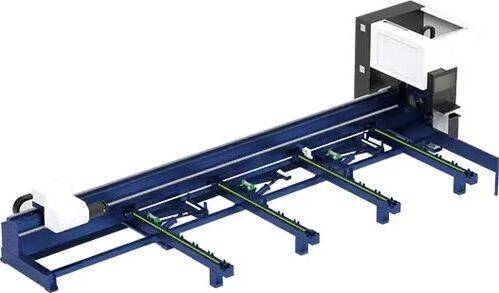
Our CNC Fiber Laser Tube Cutting systems revolutionize metal fabrication by integrating high-precision cutting, punching, and profiling into a single automated workflow. Designed for versatility, this technology handles a wide array of profiles including Round, Square, Rectangular, and Oval tubes, as well as complex L-shaped and U-shaped channels.
- Precision Punching: High-speed hole punching with micron-level accuracy, eliminating the need for mechanical drilling or die-stamping.
- Complex Profiling: Advanced 3D pathing allows for intricate interlocking joints and specialized notch cuts, ideal for structural frames.
- High Material Efficiency: Intelligent nesting software minimizes scrap, reducing raw material costs across large production runs.
- Clean Finish: Delivers oxide-free, burr-free edges that require zero secondary grinding before welding.

Seamlessly processing multiple profiles with consistent precision.
Global Delivery & Logistics



From our high-tech manufacturing facility directly to your global site. PCL WeldCut ensures secure packaging, professional handling, and reliable international logistics to safeguard your equipment throughout the entire journey.