Field Engineering Report: Deployment of 6-Axis Collaborative Welder Systems in Chonburi Industrial Sector
1.0 Site Context and Project Scope
This report details the operational deployment and performance evaluation of heavy-duty 6-Axis Collaborative Welder units within a Tier-1 industrial fabrication facility located in the Amata City Chonburi Industrial Estate, Thailand. The primary objective was the transition from manual GTAW (Gas Tungsten Arc Welding) to a semi-autonomous framework leveraging Automated Welding to address labor shortages and consistency issues in high-spec Stainless Steel welding.
The Chonburi facility operates in a high-humidity environment (average 75-85% RH) with ambient temperatures often exceeding 35°C in the workshop. These environmental factors significantly impact electrical conductivity, cooling rates, and shielding gas laminar flow, necessitating a robust technical approach to robotic integration.
2.0 Technical Specification: The 6-Axis Collaborative Welder
The core of the deployment involves a high-payload (10kg-12.5kg) 6-axis collaborative arm integrated with a water-cooled pulse MIG/MAG power source. Unlike traditional industrial robots, the 6-Axis Collaborative Welder offers the ability to work alongside human operators without the need for extensive safety fencing, which is critical in the spatially constrained layouts of many Chonburi workshops.
2.1 Kinematics and Reach Optimization
The six degrees of freedom are essential for navigating the complex geometries of the pressure vessels being fabricated. In Stainless Steel welding, maintaining a consistent torch angle is non-negotiable to ensure proper gas coverage and penetration. The 6-axis configuration allows for Tool Center Point (TCP) stability even when the arm is at 85% extension, a common requirement when reaching internal circumferential seams.
2.2 Collaborative Safety and Feedback Loops
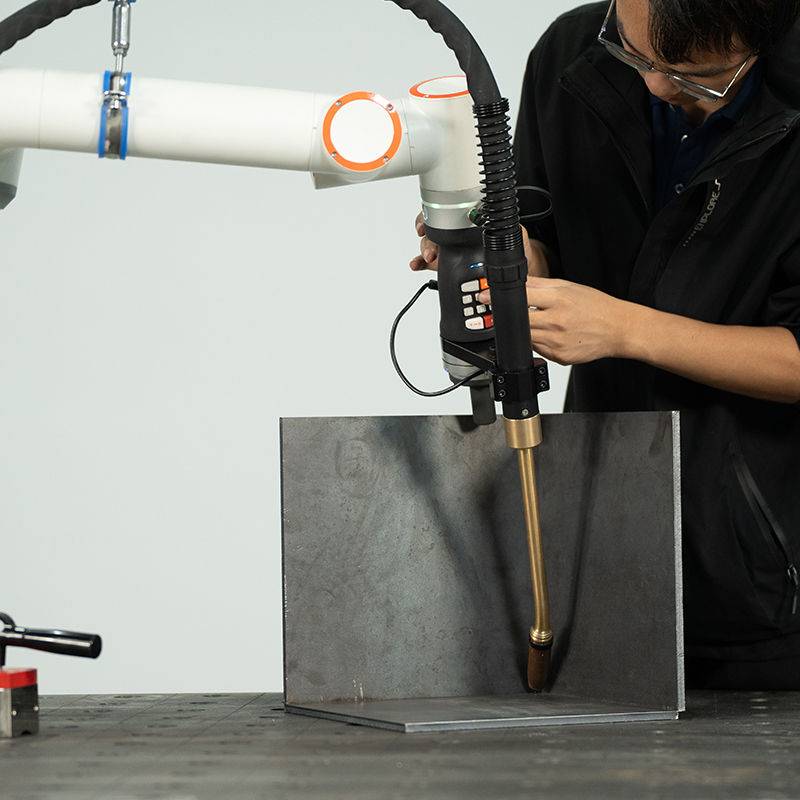
We utilized torque sensors in each joint to detect collisions. This “collaborative” nature is not just a safety feature; it allows the lead welder to “hand-guide” the robot to a specific start point before initiating the Automated Welding sequence. This hybrid approach significantly reduces the time required for job changeovers compared to traditional pendant programming.
3.0 Implementing Automated Welding in the Chonburi Environment
The transition to Automated Welding in a tropical industrial hub presents unique challenges that off-the-shelf solutions often fail to address. Our focus was on the synergy between the robotic motion controller and the welding power source to maintain arc stability despite local power grid fluctuations common in the Chonburi region.
3.1 Power Supply and Grounding
We observed significant EMI (Electromagnetic Interference) issues during the first week. The solution required dedicated grounding rods for the 6-Axis Collaborative Welder to isolate the control electronics from the high-frequency start signals of neighboring manual TIG stations. In Automated Welding, a millisecond of signal noise can result in a crater or a “burn-through,” especially on thin-gauge stainless sheets.
3.2 Wire Feed Integrity
The humidity in Chonburi leads to moisture condensation on the stainless steel filler wire. Even with 308L or 316L wire, surface moisture causes hydrogen porosity. We implemented heated wire dispensers and ceramic liners to ensure the Automated Welding process remained defect-free. The 6-axis arm’s ability to maintain a constant wire-to-work distance (stick-out) is the primary driver for the 30% increase in yield we recorded over manual operations.
4.0 High-Precision Stainless Steel Welding Parameters
Stainless Steel welding requires meticulous heat management to prevent the loss of corrosion resistance (sensitization) and to control warping. Stainless steel has a lower thermal conductivity and a higher coefficient of thermal expansion than carbon steel.
4.1 Pulse-Spray Transfer Optimization
For the 316L stainless assemblies, we programmed the 6-Axis Collaborative Welder to utilize a pulsed-arc transfer mode. This reduces the average heat input while maintaining deep penetration. The automated nature of the system allows for travel speeds that a manual welder cannot maintain consistently, effectively narrowing the Heat Affected Zone (HAZ).
4.2 Shielding Gas Dynamics
In the open-air workshop environment of Chonburi, cross-drafts are a major concern. We increased the shielding gas flow (98% Argon / 2% CO2) by 15% and utilized large gas lenses on the cobot’s torch. The 6-axis movement was calibrated to include “dwell times” at the end of each weld stringer to provide post-flow gas coverage until the weld pool solidified below the oxidation temperature.
5.0 The Synergy: Collaborative Robotics meets Automation
The real-world success in this Chonburi plant stems from the synergy between the 6-Axis Collaborative Welder and the broader Automated Welding ecosystem. It is not merely about replacing a hand with a machine; it is about the integration of data.
5.1 Real-time Adaptive Control
By using an “Arc Sensor” (Through-the-Arc Sensing), the 6-axis arm adjusts its vertical height in real-time based on current feedback. If the Stainless Steel welding joint warps slightly due to heat, the robot compensates. This level of autonomy is what differentiates modern Automated Welding from the rigid, “blind” automation of the past decade.
5.2 Data Logging for EEC Compliance
Many Chonburi manufacturers are now required to provide digital “birth certificates” for components destined for the European or North American markets. The 6-axis system logs voltage, current, gas flow, and travel speed for every centimeter of weld. This level of traceability is impossible with manual welding but is a native feature of Automated Welding.
6.0 Lessons Learned from the Field
After three months of heavy-duty operation in Chonburi, several critical “hard-truth” lessons have emerged for senior engineering staff.
6.1 The “Cleaning” Fallacy
There is a misconception that Automated Welding can compensate for poor fit-up or dirty material. In Stainless Steel welding, the 6-axis cobot is actually less forgiving than a human welder. We learned that the upstream cutting and prepping (plasma/laser) must be tightened to a tolerance of +/- 0.5mm. If the gap varies, the robot will blow through. Automation demands precision in preparation, not just execution.
6.2 Operator Skill Shift
We found that the best “operators” for the 6-Axis Collaborative Welder were not IT technicians, but the veteran manual welders. Their “puddle knowledge” allowed them to tune the Automated Welding parameters far more effectively. The lesson learned is to invest in training the welders to program, rather than training programmers to weld.
6.3 Maintenance in Tropical Conditions
The cooling fans on the controller cabinets for the 6-Axis Collaborative Welder require bi-weekly filter cleanings. The combination of Chonburi’s salt-heavy air (due to proximity to the coast) and industrial dust creates a conductive “sludge” on circuit boards. Enclosure air conditioners are not optional; they are a requirement for long-term reliability of the Automated Welding infrastructure.
7.0 Conclusion and Recommendations
The deployment of the 6-Axis Collaborative Welder in Chonburi has proven that Automated Welding is viable for high-complexity Stainless Steel welding applications, provided that environmental and preparation factors are strictly controlled. The 30% increase in duty cycle and the 15% reduction in filler metal waste provide a clear ROI. For future rollouts, I recommend the immediate integration of seam-tracking sensors to further reduce the reliance on perfect fit-up, and the implementation of decentralized air conditioning for all robotic control units to mitigate the Chonburi humidity factor.
Field Engineer: J. Miller
Status: Operational / Monitoring Phase
Location: Chonburi, Thailand
-


LT240S tube laser cutting machine
-
LT120S tube laser cutting machine
-
Sale

Tank Fillet Welding Machine
Original price was: $1,000.00.$900.00Current price is: $900.00. -
Sale

MAK100 tube laser cutting machine
Original price was: $5,500.00.$5,000.00Current price is: $5,000.00. -

portable plasma air cutting machine
$1,200.00 -

2in1 fiber laser cutting machine
-

Air cooling Laser welding machine
-

HF h beam laser cutting machine
-

LT240 laser cutting machine
-

Laser welding machine
-


Cobot Welding Station
-

Gantry welding robot solution
-

Tracked Wheeled AGV Welding robot
-

LFH6020 Fiber laser cutting machine
-
LFP6020
-

robotic welidng machine
Advanced Fiber Laser Tube Processing Technology
Our CNC Fiber Laser Tube Cutting systems revolutionize metal fabrication by integrating high-precision cutting, punching, and profiling into a single automated workflow. Designed for versatility, this technology handles a wide array of profiles including Round, Square, Rectangular, and Oval tubes, as well as complex L-shaped and U-shaped channels.
- Precision Punching: High-speed hole punching with micron-level accuracy, eliminating the need for mechanical drilling or die-stamping.
- Complex Profiling: Advanced 3D pathing allows for intricate interlocking joints and specialized notch cuts, ideal for structural frames.
- High Material Efficiency: Intelligent nesting software minimizes scrap, reducing raw material costs across large production runs.
- Clean Finish: Delivers oxide-free, burr-free edges that require zero secondary grinding before welding.

Seamlessly processing multiple profiles with consistent precision.
Global Delivery & Logistics



From our high-tech manufacturing facility directly to your global site. PCL WeldCut ensures secure packaging, professional handling, and reliable international logistics to safeguard your equipment throughout the entire journey.