Engineering Review: Deep Penetration MAG Cobot Welder – Rotterdam, Netherlands
In this article
- Field Report: Deep Penetration Implementation of MAG Cobot Welder
- Site Location: Rotterdam, Netherlands – Port Infrastructure Fabrication
- The Synergy: MAG Cobot Welder and Integrated Arc Welding Solutions
- Bridging Hardware and Software in a Port Workshop
- Technical Parameterization for Deep Penetration
- Practical Application: Carbon Steel Welding Challenges
- Managing the Heat-Affected Zone (HAZ)
- Root Pass Consistency in Heavy Sections
- Lessons Learned and Engineering Observations
- 1. Shielding Gas Turbulence in Rotterdam Workshops
- 2. The “Dirty” Reality of Carbon Steel
- 3. Wire Feed Consistency and Torch Alignment
- 4. Programmer vs. Welder Logic
- Strategic Synergy and Future Outlook
Field Report: Deep Penetration Implementation of MAG Cobot Welder
Site Location: Rotterdam, Netherlands – Port Infrastructure Fabrication
Project Overview and Objectives
The following report details the technical deployment and performance evaluation of a high-deposition MAG Cobot Welder system at our Rotterdam facility. The primary objective was the automation of heavy-gauge Carbon Steel welding, specifically targeting S355J2+N structural components used in maritime lifting gear. Historically, these components required multi-pass manual MIG/MAG operations, resulting in significant heat-affected zone (HAZ) variability and inconsistent penetration profiles.
By integrating advanced Arc Welding Solutions—including adaptive pulse regimes and high-speed wire feed synchronization—we aimed to achieve a consistent 8mm throat thickness in a single pass where possible, or a highly controlled deep-penetration root for multi-pass fillets. Rotterdam’s humid, saline environment necessitated a specific focus on gas shielding integrity and wire surface oxidation, variables that the cobot’s precision was expected to mitigate.
The Synergy: MAG Cobot Welder and Integrated Arc Welding Solutions
Bridging Hardware and Software in a Port Workshop
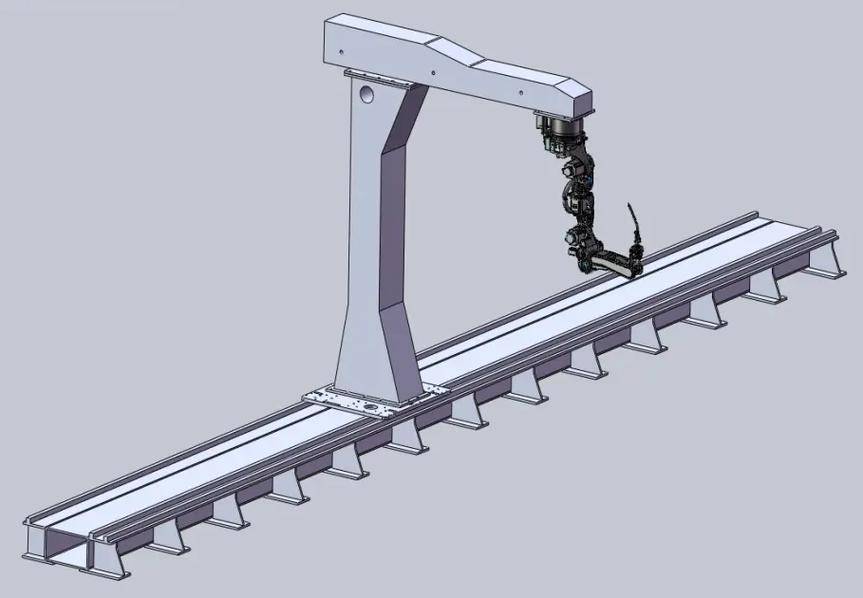
The success of this deployment hinged on the synergy between the physical MAG Cobot Welder (the 6-axis collaborative arm and torch) and the underlying Arc Welding Solutions (the power source algorithms and sensory feedback loops). In the Rotterdam workshop, the challenge wasn’t just moving the torch; it was managing the fluid dynamics of a large, high-energy weld pool on Carbon Steel welding joints that often exhibited slight fit-up deviations.
The “Arc Welding Solutions” component refers to the software-driven power source that communicates in real-time with the cobot controller. In our configuration, we utilized a “Touch-Sense” and “Through-Arc Seam Tracking” (TAST) protocol. Because Carbon Steel welding at these thicknesses (15mm to 25mm) generates significant thermal expansion, the joint geometry literally shifts during the weld. A standard industrial robot would require rigid, expensive jigging. The cobot, however, used its integrated sensors to adjust the tool center point (TCP) on the fly, ensuring the arc remained centered in the groove to maintain deep penetration.
Technical Parameterization for Deep Penetration
To achieve deep penetration with a MAG Cobot Welder, we moved away from standard spray transfer into a modified pulse-spray regime. The parameters were tuned as follows:
- Wire: 1.2mm G4Si1 / ER70S-6
- Gas: 82% Ar / 18% CO2 (The higher CO2 content was selected to increase pinch effect and penetration depth, despite the slight increase in spatter).
- Current/Voltage: 320A / 34V
- Travel Speed: 35 cm/min
This specific combination, facilitated by our Arc Welding Solutions, allowed for a “keyhole-like” penetration profile in Carbon Steel welding without the instability typically seen in manual high-amperage MAG.
Practical Application: Carbon Steel Welding Challenges
Managing the Heat-Affected Zone (HAZ)
In Rotterdam’s structural projects, the mechanical properties of S355 carbon steel are paramount. Excessive heat input can lead to grain coarsening in the HAZ, reducing impact toughness—a critical failure point for maritime equipment. The MAG Cobot Welder provided a level of thermal management that manual welders struggle to replicate over long durations.
By maintaining a constant travel speed and a precise 15-degree push angle, the cobot minimized the “heat soak” into the parent material. Our Arc Welding Solutions included a “Pulse-on-Pulse” feature that oscillated the heat input at low frequencies (1.5 Hz), effectively agitating the weld pool. This agitation refined the grain structure and assisted in outgassing, which is vital when Carbon Steel welding involves materials with slight surface mill scale or moisture-induced hydrogen risks common in the Netherlands’ coastal climate.
Root Pass Consistency in Heavy Sections
The most demanding application was the 20mm V-butt joint. Here, the MAG Cobot Welder was programmed for a weave pattern with a 0.8s dwell time at the toes. Manual welders often struggle with “cold lapping” at the root when attempting deep penetration on thick Carbon Steel welding. The cobot’s ability to maintain a consistent stick-out (CTWD) of exactly 18mm ensured that the arc force remained concentrated at the root face. Our NDT (Non-Destructive Testing) results showed zero instances of lack of fusion (LOF) across the first 50 meters of weldment.
Lessons Learned and Engineering Observations
1. Shielding Gas Turbulence in Rotterdam Workshops
The Rotterdam facility is an open-ended workshop prone to North Sea drafts. We learned early on that the high-travel speeds of the MAG Cobot Welder created a venturi effect, drawing in atmospheric nitrogen and causing porosity.
Lesson: We increased the gas shroud diameter and implemented a local “wind curtain” strategy. We also integrated a digital flow meter into the Arc Welding Solutions stack that would trigger an E-stop if the flow dropped below 18 L/min due to line kinks or tank depletion.
2. The “Dirty” Reality of Carbon Steel
While Carbon Steel welding is generally forgiving, the cobot is less so than a human eye when it comes to surface contaminants. We found that residual shop primer, if not ground back at least 20mm from the joint, caused the TAST (Through-Arc Seam Tracking) to fluctuate.
Lesson: Pre-weld prep is non-negotiable for cobot-based Arc Welding Solutions. We implemented a mandatory mechanical cleaning step that ensured the cobot’s electrical feedback remained clean, preventing “hunting” of the arc.
3. Wire Feed Consistency and Torch Alignment
The heavy-duty cycles required for deep penetration put immense strain on the liner. We observed that after 4 hours of continuous operation, the friction in the wire feeder increased, causing slight micro-stuttering in the arc.
Lesson: For high-deposition Carbon Steel welding, we switched to high-performance ceramic-coated liners and implemented a “dry run” TCP check every shift. The synergy between the MAG Cobot Welder hardware and the wire delivery system is the weakest link in high-amperage applications.
4. Programmer vs. Welder Logic
One of the most significant takeaways was the need for “welding-centric” programming. Initially, our robotics engineers programmed the path based on CAD geometry. However, Carbon Steel welding involves fluid dynamics.
Lesson: We recalibrated the Arc Welding Solutions to include “Lead/Lag” logic based on the volume of the weld pool. The cobot now slows down by 5% as it reaches the end of a long run to compensate for the increasing base-metal temperature, a technique learned from our senior manual welders.
Strategic Synergy and Future Outlook
The implementation of the MAG Cobot Welder at the Rotterdam site has proven that automation in heavy-duty Carbon Steel welding is no longer restricted to repetitive, small-scale parts. By leveraging advanced Arc Welding Solutions, we have successfully moved into the realm of structural deep-penetration joints that meet DNV and Lloyd’s Register standards.
The synergy between the cobot’s mechanical precision and the power source’s arc intelligence has reduced our rework rate from 8% (manual) to under 0.5% (cobot). More importantly, it has allowed our skilled welders to transition into “Welding Operators,” where they manage three cobot cells simultaneously, significantly increasing the throughput of the Rotterdam facility.
In conclusion, the key to success was not the cobot alone, but the integration of specific Arc Welding Solutions tailored for the nuances of heavy-gauge Carbon Steel welding. We will continue to roll out this configuration across our European fabrication hubs, focusing next on horizontal-vertical (PB) fillet welds in 30mm plate sections.
Data Summary for Technical Review
- Average Penetration Depth: 6.2mm (Single Pass Fillet)
- Deposition Rate: 5.8 kg/hr
- Duty Cycle: 85% (excluding setup/tack time)
- NDT Success Rate: 99.5% (Ultrasonic Testing)
Report End.
*Signed,*
*Senior Welding Engineer, Rotterdam Division*






