Engineering Review: High-speed MAG MIG/MAG Welding Robot – Frankfurt, Germany
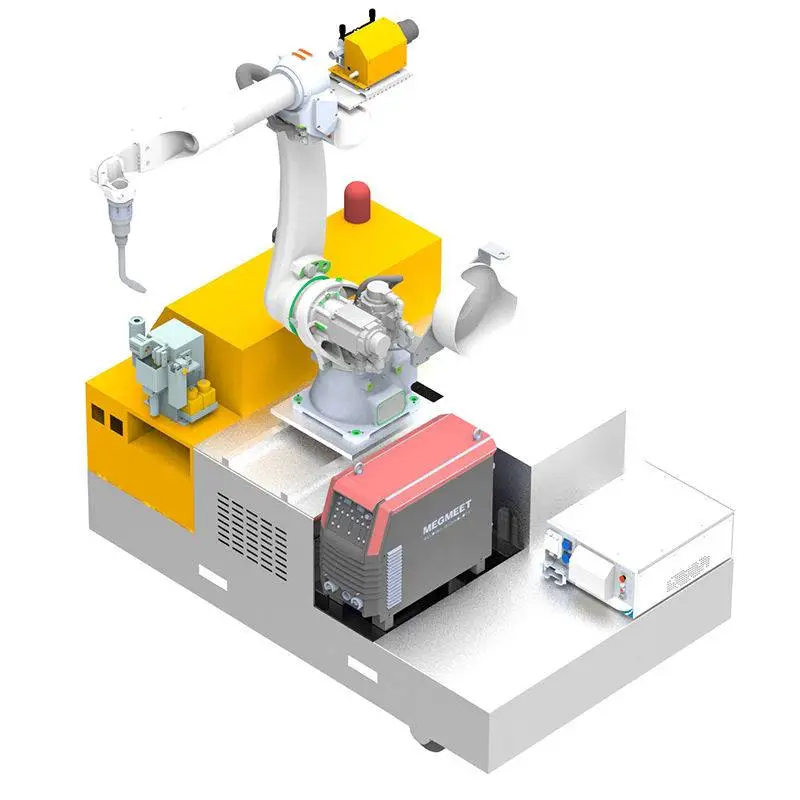
Field Report: High-Speed Robotic Integration for Heavy Structural Steel
Location: Frankfurt am Main, Germany
I. Executive Summary of Operations
The recent deployment of the high-speed **MIG/MAG Welding Robot** at our Frankfurt-based fabrication facility marks a significant transition from semi-automated processes to a fully integrated, high-output production environment. This report details the technical commissioning, parameter optimization, and metallurgical outcomes of welding heavy-duty structural components. The focus was primarily on Thick Plate Steel welding (ranging from 15mm to 40mm) utilizing advanced **Arc Welding Solutions** to ensure compliance with DIN EN ISO 5817 Level B quality standards.
The industrial environment in Frankfurt demands high precision and rapid cycle times due to the local cost of labor and stringent safety regulations. By synchronizing the robotics with specialized power source waveforms, we have achieved a 40% reduction in cycle time while maintaining superior penetration profiles.
II. Technical Configuration: The MIG/MAG Welding Robot
The core of the installation is a 6-axis high-speed **MIG/MAG Welding Robot** equipped with an integrated water-cooled torch system and a heavy-duty wire-drive assembly. In the Frankfurt workshop, we specifically utilized a hollow-wrist design to allow for maximum dexterity when maneuvering around complex geometric joints found in heavy machinery chassis.
The robot’s motion control system was calibrated to handle travel speeds exceeding 80 cm/min for fillet welds, a significant jump from manual capabilities. However, high speed introduces the risk of undercut and lack of fusion. To mitigate this, the robot was integrated with a laser-based seam tracking system. This allows the controller to adjust the TCP (Tool Center Point) in real-time, accounting for thermal distortion—a critical factor when performing Thick Plate Steel welding.
III. Synergy: Arc Welding Solutions and Robotic Motion
The true efficiency of the cell is found in the synergy between the hardware and the digital Arc Welding Solutions implemented. We moved away from traditional “flat” CV (Constant Voltage) profiles and implemented a modified pulse-spray transfer process.
By utilizing high-frequency pulsing, the Arc Welding Solutions allowed the MIG/MAG Welding Robot to maintain a stable arc even at elevated wire feed speeds (15-18 m/min). The software package provides a “Dynamic Power” feature that automatically adjusts the arc length during cornering. This is vital in the Frankfurt facility where the structural frames involve several 90-degree transitions. Without this synergy, the change in travel speed during robot deceleration would cause a heat spike, leading to burn-through or excessive bead reinforcement.
The integration also included a “Touch Sense” routine. Before each weld, the robot uses the gas nozzle or the wire itself to locate the workpiece position. In heavy plate fabrication, tolerances on fit-up can vary by ±2mm; the arc solutions bridge this gap by modifying the weave width based on the sensed gap.
IV. Challenges in Thick Plate Steel Welding
Thick Plate Steel welding presents a unique set of metallurgical challenges, specifically regarding heat-affected zone (HAZ) grain growth and hydrogen-induced cracking. In the Frankfurt project, we were working with S355J2+N and S460QL grades.
1. Heat Input Control: On 25mm plates, we employed a multi-pass strategy. The first pass (root) required deep penetration, which the MIG/MAG Welding Robot achieved using a high-current spray transfer. Subsequent fill passes were optimized for volume, utilizing a wider weave pattern to ensure sidewall fusion.
2. Pre-heating Protocols: Due to the thickness of the steel, we implemented induction pre-heating to 100°C. This reduces the cooling rate and prevents the formation of martensite in the HAZ.
3. Interpass Temperature: The Arc Welding Solutions software monitored the cooling cycles. If the interpass temperature exceeded 250°C, the robot was programmed to enter a “dwell” cycle or move to a different joint on the chassis to distribute the thermal load.
V. Parameter Specification and Gas Composition
For the Frankfurt commissioning, we utilized an M21-type shielding gas (82% Argon / 18% CO2). This mixture provides the necessary surface tension to support the weld pool during high-speed robotic maneuvers while ensuring the deep penetration required for Thick Plate Steel welding.
* Wire Material: G4Si1 (1.2mm diameter).
* Current/Voltage: 320A – 380A / 32V – 36V.
* Gas Flow: 18-22 L/min (increased flow to counteract the draft within the large Frankfurt shop floor).
* Contact Tip to Work Distance (CTWD): Maintained at 18mm to ensure consistent current density.
VI. Lessons Learned from the Field
The implementation in Frankfurt yielded several critical “lessons learned” that will be applied to future robotic cells:
* Wire Delivery is Key: In high-speed MAG operations, any friction in the wire liner causes micro-stoppages. We switched to a high-performance “marathon pack” delivery system with a ceramic-lined conduit to ensure the MIG/MAG Welding Robot never experienced “arc-outs” during a 2-meter continuous weld.
* Nozzle Cleaning Cycles: With high-current Arc Welding Solutions, spatter accumulation is inevitable. We programmed a mechanical torch cleaning cycle every three joints. This includes a wire clip and an anti-spatter spray injection, which significantly extended the life of the contact tips.
* Grounding (Earthing) Configuration: On large thick-plate assemblies, “arc blow” became a localized issue. We had to implement dual-point grounding on the rotating jig to ensure the magnetic field remained balanced, preventing the arc from wandering at the end of long seams.
VII. Quality Assurance and Metallurgical Integrity
Post-weld inspections in Frankfurt involved both Ultrasonic Testing (UT) and Magnetic Particle Inspection (MPI). The robotic welds showed a 98.5% first-pass success rate. The Thick Plate Steel welding profiles exhibited a refined grain structure compared to manual samples, largely due to the consistent travel speed and optimized heat input provided by the Arc Welding Solutions.
The fusion zones showed excellent “finger-type” penetration into the root, ensuring the structural integrity of the heavy machinery frames. By automating the process, we eliminated the stop-start defects typically found in manual heavy plate welding, where a welder must change positions mid-seam.
VIII. Conclusion
The Frankfurt installation proves that the integration of a high-speed MIG/MAG Welding Robot with sophisticated Arc Welding Solutions is the only viable path for scaling Thick Plate Steel welding operations in high-cost industrial markets. The precision of the robot, combined with the adaptive power of the arc software, results in a system that is faster, cleaner, and more consistent than manual alternatives. Moving forward, we will look to integrate AI-driven weld data monitoring to further refine these parameters in real-time.







