Field Engineering Report: Implementation of Air-Cooled MAG Cobot Welder in Rayong Industrial Zone
1. Project Scope and Environmental Context
This report details the operational deployment and performance validation of the MAG Cobot Welder system within a heavy-fabrication facility in Rayong, Thailand. The primary objective was to automate the welding of structural assemblies involving Thick Plate Steel welding (12mm to 25mm thickness) while maintaining the flexibility of a small-footprint cell.
Rayong presents a unique set of challenges for air-cooled systems. With ambient workshop temperatures frequently exceeding 38°C and relative humidity peaking at 85%, the thermal management of the power source and the torch assembly is critical. Unlike traditional dedicated robotic cells, the Arc Welding Solutions implemented here focused on a collaborative approach, allowing human operators to manage fit-up and tacking while the cobot handled the high-arc-time root and fill passes.
2. Hardware Synergy: The MAG Cobot Welder and Integrated Arc Welding Solutions
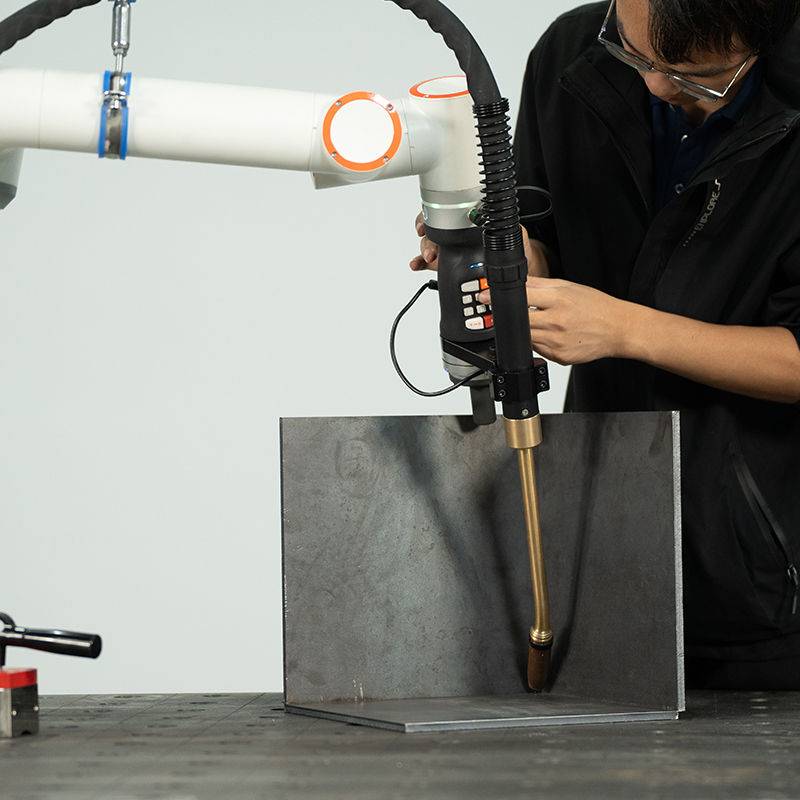
In the Rayong workshop, the synergy between the MAG Cobot Welder and the broader Arc Welding Solutions software suite was the deciding factor in project success. We utilized a 500A inverter power source paired with a high-torque wire feeder integrated directly into the cobot’s sixth axis. This setup is specifically engineered for Metal Active Gas (MAG) processes, where the use of CO2 or Ar/CO2 mixes requires precise voltage control to manage the transition from globular to spray transfer.
The “solution” aspect refers to the interface between the cobot’s teach pendant and the welding database. We utilized “Smart Stitch” and “Weave Pattern” plugins that allow the operator to define weld parameters based on plate thickness rather than raw voltage/amperage numbers. This abstraction is vital in the Rayong labor market, where the gap between a skilled welder and a cobot operator can be bridged more quickly through intuitive software.
3. Technical Deep-Dive: Thick Plate Steel Welding Parameters
When dealing with Thick Plate Steel welding, the primary concern is penetration and heat input control to avoid Lack of Fusion (LOF) and excessive Grain Growth in the Heat Affected Zone (HAZ). For the 20mm V-groove butt joints, we established a multi-pass strategy:
3.1 Root Pass Configuration
The MAG Cobot Welder was programmed with a 1.2mm ER70S-6 solid wire. Using a short-arc transfer mode, we maintained a travel speed of 250mm/min. The cobot’s ability to maintain a consistent 2.0mm stick-out was superior to manual intervention, ensuring a uniform root bead without burn-through, despite the slight variations in the manual tacking performed upstream.
3.2 Fill and Cap Passes
For the fill passes, we transitioned the Arc Welding Solutions profile to a pulsed-spray transfer. This minimized spatter—a significant concern for the air-cooled torch’s nozzle longevity. We utilized a 5Hz weave frequency with a 3mm width to ensure sidewall tie-in. On Thick Plate Steel welding, heat accumulation is significant. Because we were using an air-cooled torch in a 40°C environment, we programmed a “cooling dwell” between passes. The cobot would retract to a safe position, allowing the torch’s internal fans to lower the lead temperature, preventing contact tip fusion.
4. The “Rayong Factor”: Lessons Learned from the Field
Technical specifications often fail to account for site-specific variables. During the first two weeks in Rayong, we identified several critical “field truths” regarding the MAG Cobot Welder deployment.
4.1 Humidity and Wire Feed Integrity
The high humidity in Rayong led to surface oxidation on the welding wire if left in the feeder overnight. This resulted in erratic arc starts and increased liner friction. Lesson Learned: We mandated the use of enclosed wire hoods and implemented a “first-meter purge” protocol every morning. The Arc Welding Solutions software was updated to include a pre-flow gas check of 3 seconds to clear any moisture from the lines.
4.2 Air-Cooled vs. Water-Cooled Trade-offs
While water-cooled torches offer better duty cycles, the MAG Cobot Welder was specified as air-cooled to reduce maintenance complexity in a facility where coolant leaks often lead to floor hazards and contamination. We found that by optimizing the pulsed-arc parameters, we could stay within the 60% duty cycle of the air-cooled torch even on 15mm plates, provided the inter-pass temperature was monitored via infrared sensors integrated into the cobot’s safety circuit.
5. Optimizing Arc Welding Solutions for Local Operators
A significant portion of the commissioning phase involved “localizing” the Arc Welding Solutions. In Rayong, the workforce responds best to visual cues rather than complex alphanumeric menus. We customized the HMI (Human Machine Interface) to show color-coded heat zones. If the operator saw a “Red” status, they knew the Thick Plate Steel welding had exceeded the calculated inter-pass temperature, and the cobot would automatically lock out until the steel cooled to 200°C.
This prevented the common issue of longitudinal cracking in high-stress structural joints, a problem that had plagued the manual welding lines in this specific facility for years.
6. Productivity Metrics and Comparative Analysis
Before the introduction of the MAG Cobot Welder, a standard structural beam assembly required 4.5 man-hours of welding. Post-integration, the metrics showed:
- Arc-on Time: Increased from 35% (manual) to 72% (cobot).
- Rework Rate: Dropped from 8% to less than 0.5% (primarily due to the elimination of stop-start defects in long seams).
- Consumable Efficiency: 15% reduction in gas consumption due to the precise solenoid control offered by the integrated Arc Welding Solutions.
For Thick Plate Steel welding, the consistency of the travel speed meant that the volume of weld metal deposited was exactly according to the theoretical calculation, reducing the “over-welding” habit common in manual welders who tend to compensate for poor fit-up with excessive filler.
7. Maintenance Protocols for the Rayong Environment
To ensure the longevity of the air-cooled MAG Cobot Welder, we established a rigorous preventative maintenance (PM) schedule. In a dusty, tropical industrial hub like Rayong, the fine particulate matter can clog the power source’s heat sinks rapidly.
7.1 Weekly Pneumatic Purge
Every Friday, the power source cabinets must be opened and purged with dry compressed air. We observed a 15°C drop in internal component temperature after implementing this, significantly extending the life of the IGBT modules.
7.2 Nozzle and Contact Tip Management
Because the process involves Thick Plate Steel welding with high current densities, contact tip wear is accelerated. We integrated a “Tip Change Counter” into the Arc Welding Solutions dashboard. After 5,000 meters of wire feed, the system prompts the operator for a tip inspection. This proactive approach prevents the arc-wandering issues that typically ruin high-value assemblies.
8. Conclusion and Future Scaling
The deployment in Rayong confirms that an air-cooled MAG Cobot Welder is not only viable but preferable for mid-tier fabrication shops looking to bridge the automation gap. The success hinges not just on the robotic arm, but on the holistic Arc Welding Solutions that account for the metallurgy of Thick Plate Steel welding and the environmental stressors of the Thai industrial landscape.
Moving forward, we recommend scaling this solution to the sub-assembly line, with a focus on integrating seam-tracking sensors to further reduce the reliance on perfect jigging. The “Rayong Model” of high-heat, high-humidity automation is now a proven template for our EEC operations.
-


LT240S tube laser cutting machine
-
LT120S tube laser cutting machine
-
Sale

Tank Fillet Welding Machine
Original price was: $1,000.00.$900.00Current price is: $900.00. -
Sale

MAK100 tube laser cutting machine
Original price was: $5,500.00.$5,000.00Current price is: $5,000.00. -

portable plasma air cutting machine
$1,200.00 -

2in1 fiber laser cutting machine
-

Air cooling Laser welding machine
-

HF h beam laser cutting machine
-

LT240 laser cutting machine
-

Laser welding machine
-


Cobot Welding Station
-

Gantry welding robot solution
-

Tracked Wheeled AGV Welding robot
-

LFH6020 Fiber laser cutting machine
-
LFP6020
-

robotic welidng machine
Advanced Fiber Laser Tube Processing Technology
Our CNC Fiber Laser Tube Cutting systems revolutionize metal fabrication by integrating high-precision cutting, punching, and profiling into a single automated workflow. Designed for versatility, this technology handles a wide array of profiles including Round, Square, Rectangular, and Oval tubes, as well as complex L-shaped and U-shaped channels.
- Precision Punching: High-speed hole punching with micron-level accuracy, eliminating the need for mechanical drilling or die-stamping.
- Complex Profiling: Advanced 3D pathing allows for intricate interlocking joints and specialized notch cuts, ideal for structural frames.
- High Material Efficiency: Intelligent nesting software minimizes scrap, reducing raw material costs across large production runs.
- Clean Finish: Delivers oxide-free, burr-free edges that require zero secondary grinding before welding.

Seamlessly processing multiple profiles with consistent precision.
Global Delivery & Logistics



From our high-tech manufacturing facility directly to your global site. PCL WeldCut ensures secure packaging, professional handling, and reliable international logistics to safeguard your equipment throughout the entire journey.