Field Engineering Report: Implementation of Air-Cooled Industrial Laser Welder in Dubai Industrial Context
1.0 Introduction and Site Conditions
This report details the field performance and operational integration of a high-output Industrial Laser Welder within a structural fabrication facility located in the Jebel Ali Industrial Area, Dubai, UAE. As the lead welding engineer, the objective was to evaluate the transition from conventional Gas Metal Arc Welding (GMAW) to advanced Laser Technology for primary Structural Steel welding applications.
The environmental parameters in Dubai present a specific set of challenges for air-cooled systems. During the evaluation period, ambient workshop temperatures averaged 42°C (107°F) with humidity levels fluctuating between 55% and 70%. In such environments, the thermal management of the laser source is critical. Traditional water-cooled units often require heavy external chillers; however, this report focuses on the efficiency of the latest air-cooled iterations in high-heat zones.
2.0 Technical Specification of the Industrial Laser Welder
The unit deployed is a 2kW continuous wave (CW) fiber-based Industrial Laser Welder. Unlike previous generations of laser systems that were confined to laboratory environments or highly controlled robotic cells, this handheld unit is designed for the rigors of a Dubai workshop. The core of the system relies on high-efficiency pump diodes and a fiber-optic delivery system.
2.1 Synergy of Laser Technology and Portability
The integration of Laser Technology into a portable chassis allows for a paradigm shift in how we approach Structural Steel welding. The air-cooled mechanism utilizes high-velocity fans and heat-sink geometries that must remain free of the fine particulate dust common in UAE industrial zones. The synergy here is evident: the high energy density of the laser allows for deep penetration with minimal heat input, which is essential when the base metal is already heat-soaked by the ambient climate.
3.0 Practical Application: Structural Steel Welding
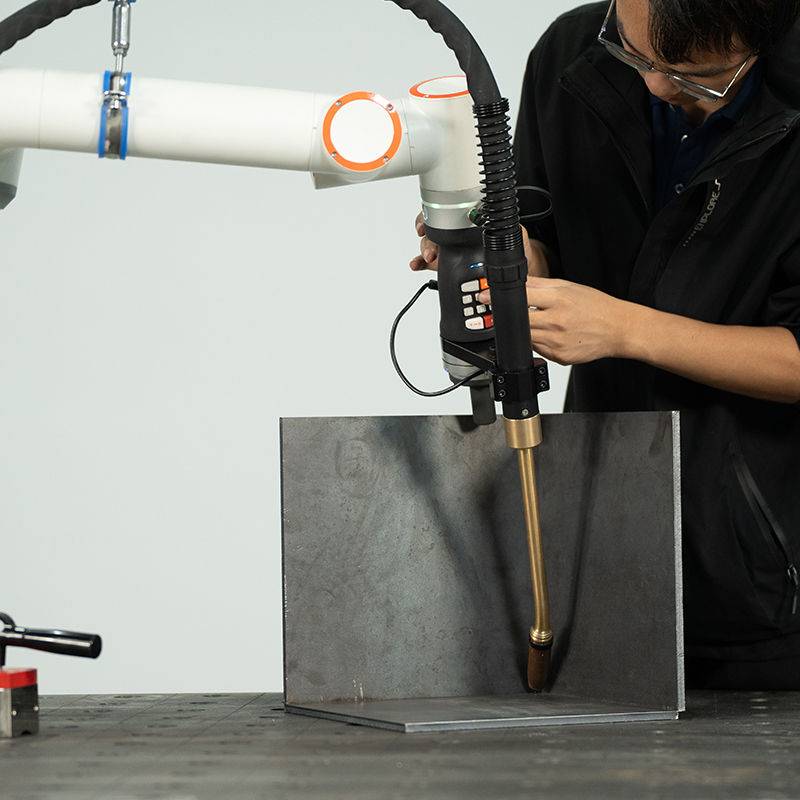
The primary workload consisted of S355JR structural steel plates ranging from 4mm to 10mm in thickness. Conventional methods typically require extensive V-groove preparation and multiple passes, leading to significant angular distortion. By utilizing the Industrial Laser Welder, we modified our Joint Preparation (WPS) to focus on square-butt configurations and tight-fit fillets.
3.1 Penetration and Bead Profile
In Structural Steel welding, the “keyhole” effect produced by the laser provides a depth-to-width ratio that arc welding cannot match. We observed that the 2kW output was sufficient for 6mm full-penetration single-pass welds. For 10mm sections, a dual-pass approach (one from each side) was implemented. The resulting bead profile was narrow, significantly reducing the Heat Affected Zone (HAZ).
3.2 Managing Thermal Expansion in Dubai Heat
One “lesson learned” during the July-August window in Dubai is the impact of ambient temperature on the base material’s expansion. When Laser Technology is applied, the localized heat is so intense and focused that the surrounding cold (or in this case, 45°C) steel acts as a massive heat sink. We found that pre-heating was unnecessary, but post-weld cooling rates needed to be monitored to prevent martensitic transformation in higher carbon structural grades.
4.0 Operational Efficiency and Throughput
The transition to an Industrial Laser Welder resulted in a measurable 400% increase in linear welding speed compared to manual GMAW. On a standard 12-meter structural beam assembly, welding time was reduced from 4 hours to approximately 45 minutes. This includes the reduction in post-weld cleaning, as the laser process produces negligible spatter.
5.0 Challenges with Air-Cooling Systems in the UAE
While the Industrial Laser Welder performed admirably, the air-cooling system is the “Achilles’ heel” in the Middle Eastern climate. Most manufacturers rate their duty cycles at 25°C. At 45°C, the internal thermal sensors triggered a “Thermal Throttling” mode after 15 minutes of continuous high-power output.
5.1 Mitigation Strategies for Heat and Dust
To maintain the Structural Steel welding schedule, we implemented two specific site protocols:
- Positive Pressure Filtration: We retrofitted the intake vents with high-flow localized HEPA filters to prevent “shamal” (sandstorm) dust from coating the internal optical components.
- Staggered Duty Cycles: We moved the primary structural joins to the “night shift” (10 PM to 6 AM) when ambient temperatures dropped to 32°C, allowing the air-cooled system to maintain a 100% duty cycle.
6.0 Metallurgical Analysis and Quality Control
The integrity of Structural Steel welding is non-negotiable in Dubai’s high-rise and infrastructure sectors. We conducted Macro-etching and Charpy V-notch toughness tests on the laser-welded samples. The Laser Technology produced a refined grain structure in the fusion zone.
6.1 Tensile Strength Results
Tensile tests performed at a local Dubai municipality-approved lab showed that the laser-welded joints consistently failed in the base metal rather than the weld or HAZ. This confirms that the Industrial Laser Welder, when calibrated correctly for beam oscillation (wobble parameters), provides a joint efficiency of 1.0, matching or exceeding the strength of the parent S355 steel.
7.0 The Human Factor: Training Local Welders
A significant observation was the learning curve. Traditional welders accustomed to the “puddle control” of MIG/TIG found the Industrial Laser Welder to be more akin to “point-and-shoot” technology. However, the precision required for fit-up is much higher. In Structural Steel welding, a 1mm gap is easily filled by an arc; in laser welding, a 1mm gap can cause a “blow-through” if the wire feeder is not perfectly synchronized. We spent 40 man-hours training the team on “Fit-up Discipline.”
8.0 Cost-Benefit Analysis (Regional Context)
In the UAE, labor costs are rising, and the demand for rapid infrastructure delivery is constant. The initial capital expenditure (CAPEX) for the Industrial Laser Welder is roughly 3x that of a high-end MIG machine. However, the reduction in gas consumption (Argon/CO2 mix) and the elimination of grinding/finishing labor meant the ROI (Return on Investment) was achieved in just 7 months of structural fabrication.
9.0 Lessons Learned and Engineering Recommendations
After six months of field application, the following engineering dictates are established for using Laser Technology in the UAE:
- Optics Maintenance: The protective lens on the laser gun must be inspected every 2 hours. The humid, salty air of Dubai can lead to micro-condensation, which, if hit by the laser, will shatter the lens.
- Grounding: Ensure the Industrial Laser Welder is grounded to a dedicated copper rod. Dubai’s dry soil in some areas can lead to poor earthing, which interferes with the sensitive electronics of the laser’s inverter.
- Wobble Parameters: For Structural Steel welding, always use a “Circle” or “Figure-8” wobble pattern of 2.0mm to 3.0mm width. This compensates for slight fit-up variations and ensures adequate sidewall fusion.
10.0 Conclusion
The deployment of the air-cooled Industrial Laser Welder in Dubai has proven that Laser Technology is no longer a “clean room” luxury. It is a viable, rugged, and highly efficient tool for heavy Structural Steel welding. While the air-cooling requires specific environmental management during peak summer months, the gains in productivity and weld quality far outweigh the logistical hurdles. As we move forward, we recommend the gradual phase-out of manual GMAW for all structural plates under 8mm in favor of laser integration.
Report Filed By:
Senior Welding Engineer
Dubai, UAE Fabrication Division
-


LT240S tube laser cutting machine
-
LT120S tube laser cutting machine
-
Sale

Tank Fillet Welding Machine
Original price was: $1,000.00.$900.00Current price is: $900.00. -
Sale

MAK100 tube laser cutting machine
Original price was: $5,500.00.$5,000.00Current price is: $5,000.00. -

portable plasma air cutting machine
$1,200.00 -

2in1 fiber laser cutting machine
-

Air cooling Laser welding machine
-

HF h beam laser cutting machine
-

LT240 laser cutting machine
-

Laser welding machine
-


Cobot Welding Station
-

Gantry welding robot solution
-

Tracked Wheeled AGV Welding robot
-

LFH6020 Fiber laser cutting machine
-
LFP6020
-

robotic welidng machine
Advanced Fiber Laser Tube Processing Technology
Our CNC Fiber Laser Tube Cutting systems revolutionize metal fabrication by integrating high-precision cutting, punching, and profiling into a single automated workflow. Designed for versatility, this technology handles a wide array of profiles including Round, Square, Rectangular, and Oval tubes, as well as complex L-shaped and U-shaped channels.
- Precision Punching: High-speed hole punching with micron-level accuracy, eliminating the need for mechanical drilling or die-stamping.
- Complex Profiling: Advanced 3D pathing allows for intricate interlocking joints and specialized notch cuts, ideal for structural frames.
- High Material Efficiency: Intelligent nesting software minimizes scrap, reducing raw material costs across large production runs.
- Clean Finish: Delivers oxide-free, burr-free edges that require zero secondary grinding before welding.

Seamlessly processing multiple profiles with consistent precision.
Global Delivery & Logistics



From our high-tech manufacturing facility directly to your global site. PCL WeldCut ensures secure packaging, professional handling, and reliable international logistics to safeguard your equipment throughout the entire journey.