Field Engineering Report: Implementation of Air-Cooled Fiber Laser Cobots in Frankfurt Automotive Prototyping
Site Overview and Equipment Specification
This report details the operational deployment and performance evaluation of an air-cooled 1.5kW Fiber Laser Cobot at a Tier-2 automotive supplier facility located near the Frankfurt-Höchst Industrial Park. The objective was to replace traditional manual TIG (Tungsten Inert Gas) stations for high-volume, thin-gauge Aluminum Alloy welding components.
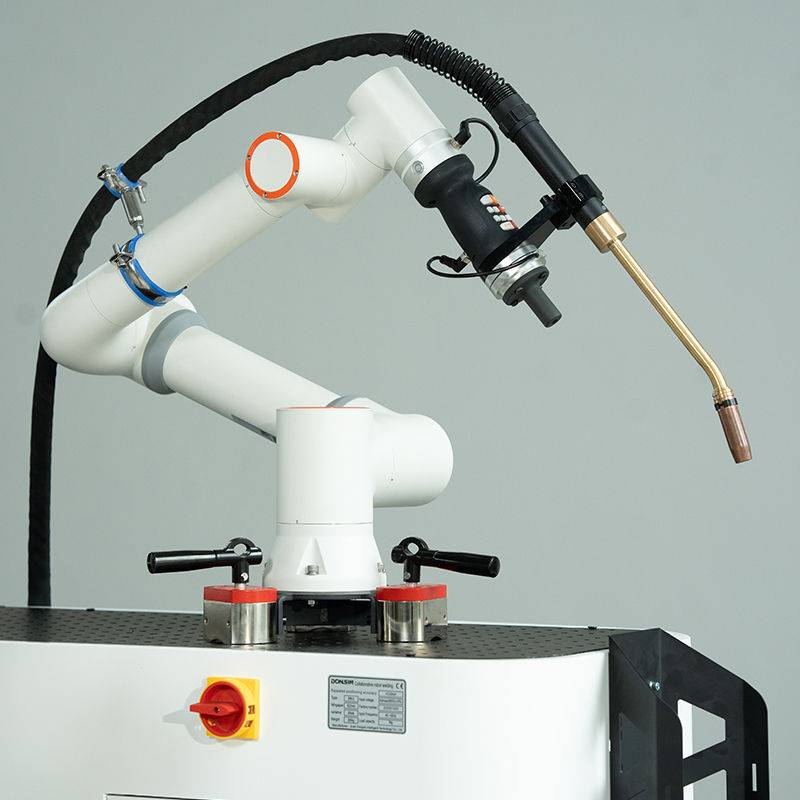
The system under review integrates a continuous wave (CW) fiber laser source with a high-degree-of-freedom collaborative robot. Unlike traditional industrial robots that require massive safety cages, the Fiber Laser Cobot was selected for its footprint-to-output ratio and its ability to work alongside human operators in the condensed floor spaces typical of Frankfurt’s industrial zones. The transition to Laser Technology was driven by the need for reduced thermal distortion and higher travel speeds that manual processes simply cannot achieve in 5000 and 6000 series aluminum.
The Technical Synergy: Fiber Laser Cobot and Laser Technology
The core of this implementation lies in the synergy between the fiber source and the motion control of the cobot. In traditional setups, a laser is often a “dumb” tool attached to a “smart” arm. In our Frankfurt trials, we utilized an integrated software stack where the Laser Technology—specifically the pulse modulation and beam oscillation—was slave-synced to the cobot’s TCP (Tool Center Point) velocity.
The “Air-Cooled” aspect is a significant engineering departure. Most high-kilowatt systems in German workshops rely on bulky water chillers, which introduce failure points like coolant leaks and require significant maintenance. By utilizing high-efficiency air-cooled Laser Technology, we reduced the system’s total energy draw by 30%. In a region like Frankfurt, where industrial electricity prices are a critical KPI, the removal of the chiller unit significantly improves the Return on Investment (ROI) while maintaining a 100% duty cycle at 1500W.
Kinetic Precision and Path Integrity
The Fiber Laser Cobot provides a level of path repeatability (+/- 0.03mm) that manual welding cannot match. This is crucial for Aluminum Alloy welding, where the keyhole must remain stable despite the material’s high thermal conductivity. If the travel speed fluctuates even by 5%, the heat input varies enough to cause either burn-through or lack of penetration. The cobot ensures a constant feed rate, allowing the laser to maintain a consistent molten pool.
Deep Dive: Aluminum Alloy Welding Challenges
Aluminum is notoriously difficult for laser processing due to its high reflectivity and high thermal conductivity. In this Frankfurt facility, we focused on AlMg3 and AlSi1MgMn (6082) alloys. The Laser Technology employed here utilized a 1064nm wavelength, which is absorbed more efficiently by aluminum once the initial melt pool is established.
Mitigating Porosity and Hot Cracking
One of the primary “lessons learned” during the first week of deployment was the management of hydrogen porosity. Aluminum’s oxide layer traps moisture, which leads to gas pores in the weld bead. We addressed this by integrating a dual-gas shielding manifold onto the Fiber Laser Cobot head. High-purity Argon was used as the primary shield, with a trailing shield of Helium-Argon mix to slow the cooling rate slightly, allowing gas to escape before solidification.
Hot cracking in the 6000 series was another hurdle. We utilized the cobot’s precision to implement a “wobble” parameter. By oscillating the beam in a circular pattern at 200Hz with a 1.5mm width, we effectively agitated the weld pool. This refined the grain structure of the Aluminum Alloy welding joint, significantly reducing the localized stress that leads to solidification cracks.
Wire Feed Integration
For structural joints with fit-up gaps exceeding 0.2mm, autogenous welding (no filler) was insufficient. We retrofitted the Fiber Laser Cobot with a synchronized cold wire feeder using AlMg5 (5356) filler wire. The synergy here is vital: the wire must enter the leading edge of the melt pool at a precise 30-degree angle. The cobot’s ability to maintain this orientation across complex 3D geometries is why this technology is superseding manual 5-axis CNC laser cells in modular Frankfurt workshops.
Site-Specific Implementation: The Frankfurt Workshop Environment
Operating in Frankfurt presents unique environmental variables. The facility’s ambient temperature fluctuates with the Rhine-Main climate, which can affect air-cooled electronics. However, the Fiber Laser Cobot remained stable throughout the summer peak, provided the intake filters were cleaned weekly to remove the fine metallic dust prevalent in automotive shops.
Safety and Compliance (DIN EN ISO 11553-1)
A “lesson learned” regarding the Fiber Laser Cobot is that “collaborative” does not mean “unguarded.” While the robot’s motors are force-limited, the laser beam is a Class 4 radiation hazard. We implemented a hybrid safety cell in the Frankfurt plant: laser-rated curtains (OD7+ at 1064nm) surrounding the cobot, with interlocked light curtains at the loading station. This allows the operator to prep the next aluminum assembly while the laser is active, maximizing the “Arc-on” time.
Lessons Learned and Engineering Best Practices
After 600 hours of operation, several technical truths have emerged regarding the application of Laser Technology in a collaborative environment:
1. Cleaning is Non-Negotiable
In Aluminum Alloy welding, any residual cutting oils or oxides will result in immediate weld failure. We found that a stainless steel wire brush pass followed by an acetone wipe, performed no more than 10 minutes prior to the Fiber Laser Cobot cycle, reduced X-ray rejection rates from 12% to less than 0.5%.
2. The Importance of Focal Position
We initially struggled with inconsistent penetration. The “lesson learned” was that the focal point of the Laser Technology must be set 0.5mm below the surface of the aluminum plate to ensure the keyhole is maintained. The cobot’s Z-axis consistency is superior to a human hand, but the initial jigging must be perfect. If the aluminum plate warps during the run, the focus is lost.
3. Beam “Wobble” is a Power Multiplier
Initially, we ran straight stringer beads. However, the Fiber Laser Cobot showed significantly better results using an “Infinity” (figure-8) wobble pattern. This pattern distributed the energy more evenly, allowing us to weld 3mm Aluminum Alloy with only 1.2kW of power, further reducing the thermal load on the air-cooled source.
4. Tooling and Heat Sinking
Aluminum’s thermal conductivity means the heat moves away from the joint rapidly. We redesigned the workholding jigs to include copper backing bars. This acted as a heat sink, preventing the “end-of-bead” melt-back that often occurs when the Fiber Laser Cobot reaches the edge of a component. The precision of the cobot allowed us to program a “crater fill” sequence where the power ramps down over the last 3mm of travel, a standard feature in high-end Laser Technology that is often overlooked in basic setups.
Conclusion: The Future of the Frankfurt “Mittelstand”
The deployment of the Fiber Laser Cobot in Frankfurt proves that high-end Laser Technology is no longer the exclusive domain of massive aerospace firms. For the German “Mittelstand” (small-to-medium enterprises), the ability to perform high-quality Aluminum Alloy welding with an air-cooled, low-maintenance system is a competitive necessity.
The synergy between robotic precision and fiber laser efficiency allows for a “clean” shop floor—no grinding, no heavy spatter, and minimal post-weld heat treatment. As we scale this technology across the Frankfurt site, the focus will shift toward AI-driven vision systems for real-time seam tracking, further reducing the reliance on expensive, high-tolerance fixturing. This field report confirms that for aluminum applications, the air-cooled fiber laser cobot is currently the most viable path toward manufacturing autonomy.
-


LT240S tube laser cutting machine
-
LT120S tube laser cutting machine
-
Sale

Tank Fillet Welding Machine
Original price was: $1,000.00.$900.00Current price is: $900.00. -
Sale

MAK100 tube laser cutting machine
Original price was: $5,500.00.$5,000.00Current price is: $5,000.00. -

portable plasma air cutting machine
$1,200.00 -

2in1 fiber laser cutting machine
-

Air cooling Laser welding machine
-

HF h beam laser cutting machine
-

LT240 laser cutting machine
-

Laser welding machine
-


Cobot Welding Station
-

Gantry welding robot solution
-

Tracked Wheeled AGV Welding robot
-

LFH6020 Fiber laser cutting machine
-
LFP6020
-

robotic welidng machine
Advanced Fiber Laser Tube Processing Technology
Our CNC Fiber Laser Tube Cutting systems revolutionize metal fabrication by integrating high-precision cutting, punching, and profiling into a single automated workflow. Designed for versatility, this technology handles a wide array of profiles including Round, Square, Rectangular, and Oval tubes, as well as complex L-shaped and U-shaped channels.
- Precision Punching: High-speed hole punching with micron-level accuracy, eliminating the need for mechanical drilling or die-stamping.
- Complex Profiling: Advanced 3D pathing allows for intricate interlocking joints and specialized notch cuts, ideal for structural frames.
- High Material Efficiency: Intelligent nesting software minimizes scrap, reducing raw material costs across large production runs.
- Clean Finish: Delivers oxide-free, burr-free edges that require zero secondary grinding before welding.

Seamlessly processing multiple profiles with consistent precision.
Global Delivery & Logistics



From our high-tech manufacturing facility directly to your global site. PCL WeldCut ensures secure packaging, professional handling, and reliable international logistics to safeguard your equipment throughout the entire journey.