Engineering Review: Air-cooled Cobot Welding Machine – Queretaro, Mexico
In this article
- Field Engineering Report: Implementation of Air-Cooled Cobot Welding Systems
- Site Location: Industrial Park, Queretaro, Mexico
- 1. Executive Summary of Field Operations
- 2. Technical Specification of the Cobot Welding Machine
- 2.1. Power Source Integration and Communication
- 2.2. Thermal Management in Air-Cooled Torches
- 3. The Synergy of Collaborative Robotics in the Queretaro Workshop
- 3.1. Lead-Through Programming for Complex Geometries
- 3.2. Safety and Floor Space Optimization
- 4. Application Deep-Dive: Sheet Metal Fabrication Welding
- 4.1. Controlling Heat Input and Distortion
- 4.2. Gap Bridging and Sensorial Feedback
- 5. Lessons Learned and Field Observations
- 6. Conclusion and Future Outlook
Field Engineering Report: Implementation of Air-Cooled Cobot Welding Systems
Site Location: Industrial Park, Queretaro, Mexico
Date: October 24, 2023
1. Executive Summary of Field Operations
This report details the technical assessment and operational integration of an air-cooled Cobot Welding Machine within a high-volume Tier-2 automotive supplier facility in Queretaro, Mexico. The primary objective was to transition a manual Sheet Metal Fabrication welding line to an automated workflow utilizing Collaborative Robotics. Unlike traditional industrial robot cells that require extensive safety fencing and rigid floor mounting, the cobot implementation targeted a high-mix, low-volume production schedule requiring frequent jig changeovers. The following data reflects a three-month observation period focusing on thermal performance, arc stability, and the synergy between human operators and robotic assets.
2. Technical Specification of the Cobot Welding Machine
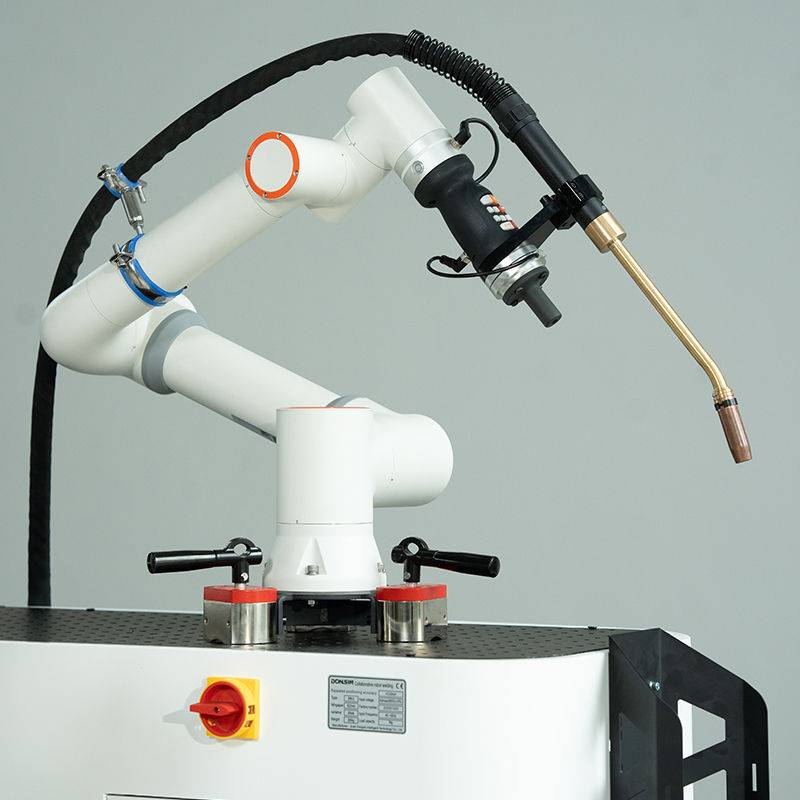
The unit deployed is a 6-axis collaborative arm integrated with a 400A pulsed-MIG power source. We opted for an air-cooled torch configuration to minimize the footprint and maintenance overhead usually associated with water-circulating chillers. In the Queretaro environment—characterized by a semi-arid climate and an elevation of approximately 1,820 meters—heat dissipation presents a unique challenge for air-cooled systems.
2.1. Power Source Integration and Communication
The Cobot Welding Machine utilizes a Modbus/TCP interface to communicate directly with the power source. This allows for real-time adjustment of wire feed speed (WFS) and voltage trim directly from the cobot’s teach pendant. During Sheet Metal Fabrication welding, the ability to modulate the pulse frequency based on the robot’s TCP (Tool Center Point) speed is critical to preventing burn-through on 1.5mm cold-rolled steel components.
2.2. Thermal Management in Air-Cooled Torches
A frequent point of failure in air-cooled systems is the duty cycle limitation. In Queretaro’s ambient afternoon temperatures, which often exceed 30°C in the workshop, we observed a 15% reduction in effective duty cycle compared to sea-level, temperature-controlled environments. We mitigated this by optimizing the “air-cut” paths—the movements the robot makes between welds—to allow for maximum convective cooling of the torch neck. Lessons learned: For air-cooled Collaborative Robotics applications in Mexico’s central highlands, the inter-pass cooling time must be calculated into the cycle time to prevent contact tip deformation.
3. The Synergy of Collaborative Robotics in the Queretaro Workshop
The deployment in Queretaro highlights the practical bridge between traditional manual labor and Industry 4.0. The term “Collaborative” in Collaborative Robotics does not merely refer to the lack of cages; it refers to the workflow synergy where the welder becomes a “Process Controller.”
3.1. Lead-Through Programming for Complex Geometries
One of the primary advantages observed was the “Lead-Through” or “Hand-Guiding” feature. In Sheet Metal Fabrication welding, parts often have slight dimensional variances due to previous stamping or bending processes. A manual welder can adjust for these on the fly; a traditional robot cannot. By using Collaborative Robotics, the Queretaro operators—many of whom have 10+ years of manual experience—were able to “teach” the Cobot Welding Machine the ideal torch angle by physically moving the arm into position. This human-robot synergy reduced the programming time for a new chassis bracket from 6 hours (traditional G-code/TP programming) to 45 minutes.
3.2. Safety and Floor Space Optimization
The industrial park in Queretaro has high real estate costs. Traditional robotic cells require roughly 20 square meters of floor space when safety zones are included. The Cobot Welding Machine setup, utilizing area scanners and torque-sensing joints, reduced this footprint to 6 square meters. This allows the shop to run three collaborative cells in the space previously occupied by one traditional cell, effectively tripling the throughput per square meter of the Sheet Metal Fabrication welding department.
4. Application Deep-Dive: Sheet Metal Fabrication Welding
The technical core of this report focuses on the challenges of welding thin-gauge materials (1.2mm to 2.5mm) using an automated process. Sheet metal is prone to warping, and the precision of the Cobot Welding Machine is the only way to maintain consistent bead profiles without manual rework.
4.1. Controlling Heat Input and Distortion
High-heat input is the enemy of sheet metal. During our field tests, we utilized a “Stitch Welding” program. The Collaborative Robotics software allowed us to synchronize the arc-start with the robot’s movement down to the millisecond. By distributing the heat across the workpiece rather than welding in a single continuous pass, we reduced longitudinal shrinkage by 30%. The air-cooled torch, while having a lower duty cycle than water-cooled counterparts, proved sufficient for these short-burst stitch welds, as the “off-time” between stitches allowed the copper nozzle to shed heat.
4.2. Gap Bridging and Sensorial Feedback
In Sheet Metal Fabrication welding, fit-up is rarely perfect. We integrated a laser-seam tracking sensor onto the cobot’s wrist. The synergy between the sensor’s data and the Collaborative Robotics control loop allowed the arm to shift its path in real-time to compensate for gaps up to 1.0mm. In a manual environment, a welder would slow down and weave to fill this gap. The Cobot Welding Machine was programmed to mimic this “weaving” motion automatically when the sensor detected a wider-than-nominal joint.
5. Lessons Learned and Field Observations
Technical implementation in the Queretaro industrial sector provides several “hard-won” lessons for senior engineers.
Lesson 1: Atmospheric Pressure and Shielding Gas Flow
At Queretaro’s altitude, the density of the shielding gas (90/10 Ar/CO2 mix) is lower. We found that the standard 15 L/min flow rate used at our Detroit facility resulted in porosity here. We had to increase the flow to 18-20 L/min to ensure adequate coverage of the weld pool. This is a critical adjustment for any Cobot Welding Machine being moved from sea-level locations to the Mexican interior.
Lesson 2: The “Operator Buy-In” Factor
The success of Collaborative Robotics depends on the operator not feeling threatened by the machine. In Queretaro, we found that by branding the cobot as a “Power Tool” rather than a “Replacement,” the welders took ownership of the maintenance. They became proficient at cleaning the air-cooled nozzles and monitoring the wire tensioner, which are the two most common points of failure in Sheet Metal Fabrication welding automation.
Lesson 3: Grounding and Electrical Noise
Local power grids in some Queretaro industrial zones can experience voltage fluctuations. We encountered several instances of the cobot’s controller throwing “Emergency Stop” errors due to electrical noise from nearby heavy stamping presses. The solution was the installation of a dedicated isolation transformer and a high-grade grounding stake for the Cobot Welding Machine. Never assume the factory ground is sufficient for the sensitive electronics found in modern Collaborative Robotics.
6. Conclusion and Future Outlook
The integration of the air-cooled Cobot Welding Machine in Queretaro has proven that for Sheet Metal Fabrication welding, the collaborative model is superior to both fully manual and fully caged-robotic systems. The ability to quickly pivot between different part numbers while maintaining a high standard of weld quality has significantly reduced the cost of poor quality (COPQ) for the plant. Moving forward, we recommend the standardization of these units across all Mexican facilities, with specific attention paid to altitude-adjusted gas flow and thermal management for air-cooled hardware.
The synergy between the skilled labor force in Queretaro and the precision of Collaborative Robotics represents the most viable path for scaling fabrication capacity in the region. Engineering teams should focus on refining the “Lead-Through” templates to further reduce the barrier to entry for new operators.
End of Report
Author: Senior Welding Engineer, Global Field Operations







