Engineering Review: 2000W MIG/MAG Welding Robot – Hanoi, Vietnam
In this article
- Field Report: Robotic MIG/MAG Integration and Aluminum Alloy Optimization – Hanoi Sector
- 1. Project Overview and Environmental Constraints
- 2. Hardware Configuration: The 2000W MIG/MAG Welding Robot
- 3. Advanced Arc Welding Solutions for the Hanoi Context
- 4. Technical Deep Dive: Aluminum Alloy Welding Challenges
- 5. Synergy: Integrating the Robot with the Local Ecosystem
- 6. Lessons Learned and Field Observations
- 7. Conclusion
Field Report: Robotic MIG/MAG Integration and Aluminum Alloy Optimization – Hanoi Sector
1. Project Overview and Environmental Constraints
This report details the commissioning and optimization of a 2000W-class digital MIG/MAG Welding Robot system at a Tier-2 automotive supplier facility in Hanoi, Vietnam. The primary objective was the transition from manual Gas Metal Arc Welding (GMAW) to a fully automated cell capable of handling high-volume Aluminum Alloy welding for structural heat exchangers and frame components.
Implementing high-precision Arc Welding Solutions in Northern Vietnam presents unique challenges. During the commissioning phase in March, the ambient humidity in Hanoi averaged 82%, with peak fluctuations during the “Crachin” (drizzling rain) season. For aluminum fabrication, moisture is the primary enemy, leading to severe hydrogen porosity. Our engineering focus was not merely on the robotic motion, but on the synergy between the power source’s waveform control and the environmental management of the consumables.
2. Hardware Configuration: The 2000W MIG/MAG Welding Robot
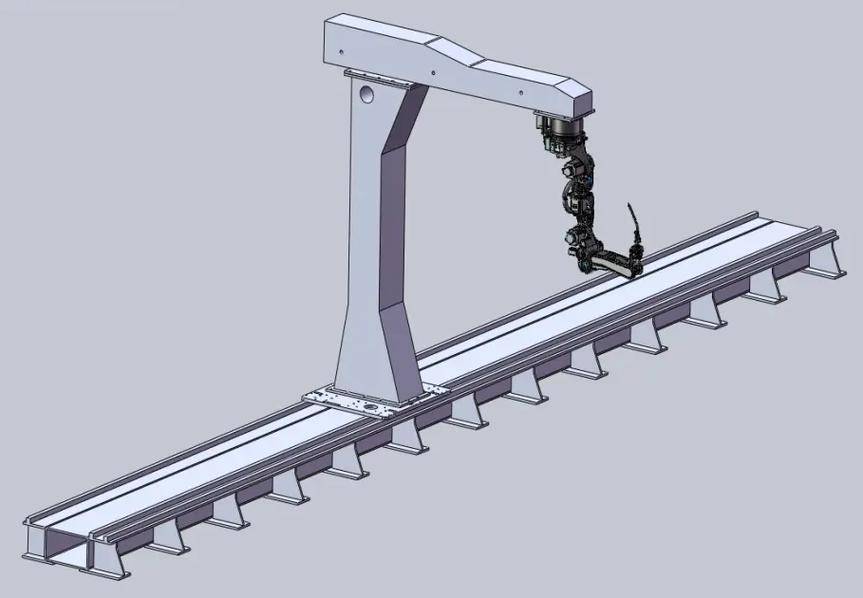
The core of the cell is a 6-axis industrial arm integrated with a 2000W (input-rated) high-speed inverter power source. While “2000W” in a MIG context often refers to the precision-class power draw for light-to-medium gauge work, the output was tuned for 180A–220A continuous duty cycles to penetrate 3mm to 6mm aluminum plates.
2.1 Motion Control and TCP Calibration
The MIG/MAG Welding Robot was calibrated using a five-point Tool Center Point (TCP) method. Given the high thermal conductivity of aluminum, the robot’s travel speed was set significantly higher than steel counterparts (800mm/min to 1200mm/min) to prevent burn-through. We utilized a “Push” torch angle of 15 degrees to ensure the cleaning action of the arc stayed ahead of the weld pool, a critical requirement for removing the tenacious aluminum oxide layer.
2.2 Wire Feed System Integrity
Aluminum wire (ER5356) is notoriously soft. To prevent bird-nesting at the drive rolls, we implemented a four-roll “U-groove” feeder system synchronized with the robot controller. We opted for a push-pull torch configuration. Lessons learned from previous Hanoi installs suggested that standard conduit liners fail in high-humidity environments due to friction increases; we utilized specialized graphite/Teflon liners to maintain a constant wire feed speed (WFS) of 10.5 m/min.
3. Advanced Arc Welding Solutions for the Hanoi Context
In a manual workshop environment, consistency is at the mercy of the operator’s fatigue. By deploying automated Arc Welding Solutions, we shifted the focus from “hand-eye coordination” to “parameter-set optimization.”
3.1 Pulse-on-Pulse Waveform Modulation
To achieve the “stack-of-dimes” aesthetic required by the client without sacrificing structural integrity, we utilized a “Pulse-on-Pulse” (or Double Pulse) waveform. This technology modulates the arc power between two distinct energy levels. In the Hanoi facility, this proved essential for managing the heat sink effect of the large aluminum jigs. The high-energy pulse ensures penetration, while the low-energy pulse allows the puddle to freeze slightly, controlling the weld bead profile.
3.2 Gas Management and Shielding Purity
One of the “lessons learned” during the first week of testing was the inadequacy of standard industrial Argon (99.9%). Due to local supply chain variances in Hanoi, we observed intermittent arc instability. We introduced a secondary gas purification system and switched to an Argon-Helium mix (75/25) for the thicker 6xxx series Aluminum Alloy welding. The addition of Helium increased the arc temperature, allowing for a faster travel speed which further reduced the Heat Affected Zone (HAZ).
4. Technical Deep Dive: Aluminum Alloy Welding Challenges
The shift to Aluminum Alloy welding involves more than just changing the wire. The 6061-T6 alloys used in this project are prone to solidification cracking (hot shortness) if the chemistry of the weld pool is not precisely controlled.
4.1 Mitigating Porosity in High Humidity
Hanoi’s humidity levels can introduce moisture into the shielding gas stream through permeable hoses. We replaced all standard rubber hoses with high-density polyethylene (HDPE) lines to minimize moisture ingress. Furthermore, we implemented a “pre-heat” cycle using an induction coil ahead of the MIG/MAG Welding Robot for any parts that had been stored on the shop floor for more than 4 hours. This drove off surface moisture that the standard cleaning arc could not handle alone.
4.2 Crater Fill and End-of-Weld Logic
Aluminum’s high thermal expansion coefficient often leads to “crater cracks” at the termination of the weld. Our Arc Welding Solutions package included a programmed crater-fill routine where the robot dwells for 0.4 seconds while the current ramps down linearly. This ensures the crater is filled with a convex profile, neutralizing the tensile stresses that lead to radial cracking.
5. Synergy: Integrating the Robot with the Local Ecosystem
The true value of a MIG/MAG Welding Robot in a market like Hanoi is the bridge it builds between high-end engineering and local production capacity. During the integration, we focused on “The Synergy of Three”: the Robot, the Arc Solution, and the Material Science of the Alloy.
5.1 Workforce Upskilling
The local technicians were proficient in manual MIG but lacked experience in “Waveform Troubleshooting.” We developed a localized UI on the robot pendant that translated complex arc parameters (Inductance, Trim, Peak Current) into visual “bead shape” indicators. This empowered the Hanoi team to make real-time adjustments without needing an external consultant for every shift change.
5.2 Data-Driven Quality Assurance
By using the digital backbone of the Arc Welding Solutions, we implemented real-time monitoring of every weld seam. The system logs the voltage and current at 100Hz. In the event of a “burn-back” or a gas shield failure (common during Hanoi’s frequent power fluctuations), the robot automatically halts and flags the specific coordinate for NDT (Non-Destructive Testing). This level of traceability was previously non-existent in the facility.
6. Lessons Learned and Field Observations
After 500 hours of operational runtime, several key takeaways have emerged from the Hanoi deployment:
- Power Stability: The Hanoi industrial grid can experience voltage sags. We found that the MIG/MAG Welding Robot controller required a dedicated Voltage Regulator (AVR) to prevent the logic boards from resetting during heavy arc strikes.
- Wire Storage: Aluminum wire cannot be left on the robot overnight in this climate. We established a protocol where wire spools are returned to a climate-controlled “dry box” (Relative Humidity < 20%) at the end of the second shift.
- Consumable Longevity: The high-reflectivity of the Aluminum Alloy welding process caused accelerated wear on the gas nozzles. Switching to chrome-plated heavy-duty nozzles increased the MTBF (Mean Time Between Failure) by 45%.
7. Conclusion
The integration of the 2000W MIG/MAG Welding Robot in Hanoi has successfully reduced the reject rate from 14% (manual) to less than 0.8% (automated). The success of this project relied heavily on not treating the robot as a “black box” but as a precision instrument that must be tuned to the specific environmental and metallurgical demands of Aluminum Alloy welding. By deploying sophisticated Arc Welding Solutions—specifically double-pulse waveforms and stringent gas management—we have established a new benchmark for automated fabrication in the region. The synergy between high-speed robotic motion and adaptive power source logic remains the only viable path for high-volume aluminum production in tropical industrial zones.
Report Authored By:
Senior Welding Engineer, Field Operations Division
Hanoi Project Office







