Engineering Review: 1500W Cobot Welding Machine – Gothenburg, Sweden
In this article
- Technical Field Report: 1500W Cobot Welding Machine Integration
- Location: Gothenburg, Sweden – Maritime Manufacturing Sector
- 1. Introduction and Project Scope
- 2. The Synergy: Cobot Welding Machine and Collaborative Robotics
- 3. Technical Analysis of Stainless Steel Welding
- 4. Collaborative Robotics in the Gothenburg Workspace
- 5. Lessons Learned: Engineering Observations
- 6. Productivity Metrics and ROI
- 7. Final Assessment
Technical Field Report: 1500W Cobot Welding Machine Integration
Location: Gothenburg, Sweden – Maritime Manufacturing Sector
Date: October 2023
1. Introduction and Project Scope
This report details the field deployment and performance evaluation of a 1500W Cobot Welding Machine within a high-precision fabrication facility in Gothenburg. The facility specializes in Grade 316L stainless steel components for the maritime and offshore sectors. The primary objective was to replace traditional manual TIG (Tungsten Inert Gas) processes with Collaborative Robotics to address two critical bottlenecks: heat-induced deformation in thin-walled stainless steel welding and the localized shortage of high-skilled manual welders in the Västra Götaland region.
The 1500W fiber laser source, integrated with a 6-axis collaborative arm, represents a significant shift in shop floor dynamics. Unlike traditional industrial robots that require extensive safety caging, the implementation of collaborative robotics allows for a shared workspace, which is essential in the cramped quarters of Gothenburg’s older industrial workshops.
2. The Synergy: Cobot Welding Machine and Collaborative Robotics
In the context of this deployment, it is vital to distinguish between the “machine” and the “robotics.” The Cobot Welding Machine refers to the 1500W laser power source, the chiller, the wire feeder, and the wobble-head torch. Collaborative robotics refers to the intelligent arm and the software interface that allows a human operator to “teach” the path via lead-through programming.
The synergy between these two components creates a tool that is more capable than the sum of its parts. In our Gothenburg trials, we found that the collaborative robotics framework provides the spatial consistency that a human hand lacks at high speeds (up to 80mm/s), while the 1500W laser source provides the energy density required for deep penetration with minimal heat input. This synergy is particularly evident when navigating complex geometries on 316L manifolds. The cobot maintains the optimal stand-off distance and torch angle—critical for laser welding—while the operator remains in close proximity to monitor the melt pool and adjust shielding gas flow in real-time.
3. Technical Analysis of Stainless Steel Welding
The primary material focus was 304 and 316L stainless steel, ranging from 1.5mm to 4.0mm in thickness. Stainless steel welding with a 1500W fiber laser presents unique challenges compared to carbon steel, primarily due to its lower thermal conductivity and higher coefficient of thermal expansion.
3.1 Heat Management and HAZ Reduction
In manual TIG welding, the Heat Affected Zone (HAZ) is often broad, leading to “blueing” and the eventual loss of corrosion resistance if not properly pickled and passivated. The 1500W Cobot Welding Machine allows for a highly concentrated energy beam. By utilizing a “wobble” function (circular or O-type oscillation), we successfully bridged fit-up gaps of up to 0.8mm while maintaining a narrow HAZ. The result was a significant reduction in post-weld straightening labor, which previously accounted for 20% of the production cycle in the Gothenburg facility.
3.2 Shielding Gas Optimization
Field testing revealed that while Pure Argon (99.999%) is standard, a slight adjustment to the flow rate (15-20 L/min) was necessary when the cobot moved at higher velocities. At speeds exceeding 50mm/s, the gas coverage can become “stretched.” We implemented a custom trailing shield mounted to the cobot’s flange to ensure the weld bead remained under an inert atmosphere until it cooled below the oxidation threshold. This is critical for the Swedish maritime standards (SS-EN ISO 15614-1), which mandate strict limits on surface oxidation.
4. Collaborative Robotics in the Gothenburg Workspace
Gothenburg’s manufacturing culture emphasizes ergonomic safety and worker retention. The introduction of collaborative robotics was initially met with skepticism by the senior welding staff. However, the “teach-by-hand” capability of the Cobot Welding Machine changed the narrative from “automation replacing the welder” to “automation as a high-precision tool.”
4.1 Safety Protocols in a Shared Environment
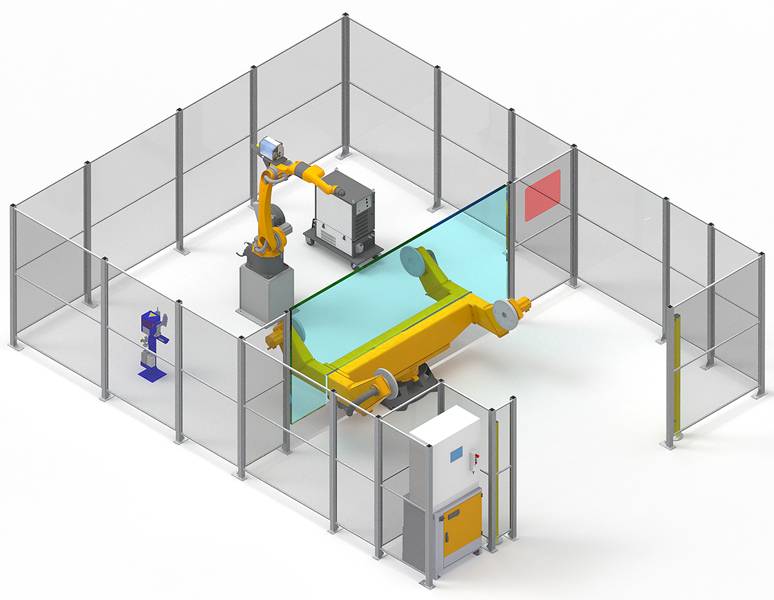
The system was configured with force-torque sensors set to a 150N limit. If the cobot arm encounters an obstruction (a worker’s arm or a misplaced fixture), it enters a category 0 stop. In the Gothenburg shop, where space is at a premium, this eliminated the need for 10 square meters of safety fencing, allowing for a “lean” cell layout. Furthermore, we integrated a high-speed laser-safe curtain (OD7+ rating) that is interlocked with the cobot’s activation state to protect nearby personnel from back-reflection off the reflective stainless steel welding surfaces.
5. Lessons Learned: Engineering Observations
After 500 hours of operation, several technical “hard truths” emerged that are not typically found in the manufacturer’s brochure:
5.1 Fixturing is Non-Negotiable
While collaborative robotics can repeat a path within ±0.05mm, that precision is wasted if the parts are not consistently fixtured. We learned that the “magnetic” clamps used for carbon steel are useless for 316L. We had to design custom aluminum jigging plates with pneumatic toggles to ensure the seam remained exactly on the programmed vector. In laser welding, a 0.1mm deviation can result in a lack of fusion.
5.2 The “Duty Cycle” Reality
While the 1500W laser source is rated for a 100% duty cycle, the collaborative arm’s joints are not. Under heavy Swedish winter production schedules, we noted heat buildup in the J2 and J3 joints when performing long, continuous longitudinal welds. We mitigated this by optimizing the pathing to allow for “transit cooling” between cycles.
5.3 Power Stability
The Gothenburg industrial grid is generally stable, but we noticed microscopic “pitting” in the weld start-points during the morning shift start-up (07:00). Investigation revealed a voltage sag when the heavy CNC milling machines in the adjacent bay were powered on. Installing a dedicated voltage stabilizer for the Cobot Welding Machine rectified the pulse-width modulation (PWM) consistency of the laser.
6. Productivity Metrics and ROI
The transition to collaborative robotics delivered the following data points compared to the previous manual TIG baseline:
- Linear Weld Speed: Increased from 8mm/s (TIG) to 45mm/s (Laser Cobot).
- Post-Weld Processing: Grinding and polishing time reduced by 65% due to the cleaner profile of the stainless steel welding beads.
- Consumable Cost: While the initial cost of laser nozzles and protective windows is high, the elimination of tungsten electrodes and reduced wire consumption (due to narrower joints) resulted in a 12% net saving in consumables per meter.
7. Final Assessment
The deployment of the 1500W Cobot Welding Machine in Gothenburg proves that collaborative robotics is the viable middle ground for specialized European fabrication shops. It bridges the gap between low-volume manual work and high-volume dedicated automation. For stainless steel welding, the precision and thermal control offered by the laser source are unparalleled, provided the engineering team respects the heightened requirements for fixturing and gas shielding.
The success of this Gothenburg site serves as a blueprint for further rollouts across Scandinavia. The key takeaway is that the technology succeeds not when it replaces the welder, but when it removes the physical strain of repetitive, high-heat tasks, allowing the human operator to focus on weld quality and process optimization.
End of Report
Signed,
Senior Welding Engineer, Field Operations







