Field Report: Deployment of 1500W All-in-one Cobot Station
Project Overview and Site Context
This report details the technical commissioning and operational integration of a 1500W All-in-one Cobot Station at a mid-sized sheet metal facility in the industrial district of Budapest, Hungary. The facility primarily services the European automotive and HVAC supply chains, focusing on high-volume, thin-gauge components. The objective was to replace traditional manual TIG (Tungsten Inert Gas) processes with an automated solution to address rising labor costs and a shortage of certified specialty welders in the Hungarian market.
The transition to Collaborative Robotics in this specific workshop was driven by the need for flexibility. Unlike traditional industrial robots that require extensive safety perimeters and fixed light curtains, the “all-in-one” footprint was required to fit within existing floor plans without disrupting the flow of the manual assembly lines. The 1500W fiber laser source was selected as the optimal power point for achieving deep penetration on 3.0mm stainless steel while maintaining a stable arc for 0.8mm aluminum alloys.
The Technical Synergy of the All-in-one Cobot Station
Hardware Integration and Spatial Efficiency
The term All-in-one Cobot Station refers to the physical integration of the fiber laser source, the water chiller, the control PLC, and the collaborative arm into a single, mobile chassis. In the Budapest facility, shop floor real estate is at a premium. Traditional modular systems often result in a “spaghetti” of cabling and external cooling lines that present trip hazards and signal interference.
By utilizing an integrated station, we achieved a footprint of less than 1.5 square meters. This compact nature allowed us to move the station between three different work cells depending on the daily production schedule. The synergy here is clear: the portability of the station complements the inherent flexibility of collaborative robotics. We are not just automating a single part; we are deploying a mobile welding asset that can be “taught” a new path in under ten minutes via lead-through programming.
Collaborative Robotics in the Welding Environment
The deployment focused heavily on the “collaborative” aspect. In sheet metal fabrication welding, the operator often needs to be in close proximity to the workpiece to manage fit-up variations. The cobot’s torque sensors on all six axes allowed the Budapest operators to work alongside the machine. We implemented a “hand-guiding” mode where the welder manually moves the laser head to the start and end points of a seam, recording the path into the software. This bypassed the need for complex G-code programming, which was a significant bottleneck in previous automation attempts.
However, a senior engineer’s note on safety: while the robot is collaborative, the 1500W laser is not. The integration required a Class 4 laser enclosure. The “collaboration” occurs during the setup and programming phases, while the execution phase remains shielded. The synergy lies in the reduction of “non-value-added” time; the operator preps the next fixture while the cobot executes the current weld cycle.
Advanced Sheet Metal Fabrication Welding Applications
Material Specifics and Heat Input Management
The core of our testing in Budapest involved 1.5mm DC01 carbon steel and 2.0mm Grade 304 stainless steel. In sheet metal fabrication welding, the primary enemy is thermal distortion. Traditional MIG or TIG welding inputs massive amounts of heat, leading to “oil-canning” or warping of the panels.
The 1500W All-in-one Cobot Station utilizes a concentrated energy density that allows for high travel speeds (up to 30mm/s in our tests). This high speed significantly narrows the Heat Affected Zone (HAZ). We observed a 65% reduction in post-weld straightening requirements compared to manual TIG. The 1500W power overhead also allowed us to utilize a “wobble” function—a high-frequency oscillation of the laser beam. This is critical for sheet metal where fit-up tolerances are not always perfect. The wobble width was set to 1.5mm, effectively bridging gaps that would otherwise cause burn-through in a static laser setup.
Shielding Gas and Beam Delivery
One lesson learned on the Budapest floor was the critical nature of gas delivery. We moved from a standard Argon setup to a 98% Argon/2% CO2 mix for the carbon steel components to stabilize the plasma plume. The cobot’s ability to maintain a constant 0.5mm stand-off distance ensured that the gas coverage was laminar and consistent. Manual welders often vary this distance by 2-3mm, leading to intermittent porosity. With the All-in-one Cobot Station, the gas flow is synchronized with the laser trigger through the integrated PLC, reducing gas consumption by 30% per meter of weld.
Lessons Learned from the Field
1. The “Zero-Gap” Fallacy
The most significant challenge in sheet metal fabrication welding with lasers is the requirement for tight fit-ups. While the 1500W station is powerful, it cannot create metal where none exists. In Budapest, we found that the existing hydraulic shear was leaving slightly bowed edges on 2-meter sheets. The cobot would follow the programmed line, but the gap would exceed 0.2mm, leading to a concave bead.
Lesson: Automation requires upstream precision. We had to recalibrate the shear and implement toggle clamps on the welding table to ensure a zero-gap fit-up before the cobot was engaged.
2. Programming for Thermal Expansion
During long runs of 3.0mm aluminum, the workpiece would expand toward the laser head. Because collaborative robotics are programmed with specific spatial coordinates, this expansion can change the focal point. We learned to program “tack-weld” sequences into the cobot’s routine. The station would first apply 5mm tacks every 100mm before performing the continuous seam. This kept the geometry stable throughout the cycle.
3. Operator Upskilling
There was initial resistance from the local workforce, fearing replacement. However, the All-in-one Cobot Station actually shifted the welder’s role from “manual labor” to “process technician.” The senior welders in Budapest quickly realized they could oversee three cobot stations simultaneously. The “collaborative” nature of the tech makes it approachable; it looks and feels like a tool rather than a replacement. The lesson here is that the integration is 50% technical and 50% cultural.
Technical Specifications and Performance Metrics
After four weeks of operation, the data from the Budapest site showed the following:
- Cycle Time: Reduced by 4x compared to manual TIG on 1.2mm stainless cabinets.
- Power Consumption: The 1500W fiber source proved more efficient than the old 350A TIG inverters, primarily due to the vastly reduced “arc-on” time required to achieve the same penetration.
- Rejection Rate: Dropped from 4.5% to 0.8%, with most remaining errors attributed to upstream material defects.
Comparison Table: Manual vs. Cobot Station
| Feature | Manual TIG | 1500W Cobot Station |
|---|---|---|
| Avg. Speed (1.5mm Steel) | 5-8 mm/s | 25-35 mm/s |
| HAZ Width | 4.0 mm | 0.6 mm |
| Setup Portability | High | High (All-in-one Chassis) |
| Skill Requirement | High (10+ years) | Moderate (Basic CNC knowledge) |
Conclusion and Future Outlook
The deployment in Budapest confirms that the All-in-one Cobot Station is the logical evolution for European sheet metal fabrication welding. The synergy between the 1500W laser’s precision and the collaborative robotics‘ ease of use solves the two biggest hurdles in automation: space and programming complexity.
For future installations, I recommend a heavy focus on jigging and fixturing. The robot is only as good as the part’s repeatability. As we scale this across the remaining production lines, we will look into integrating vision systems for real-time seam tracking, which would further enhance the station’s ability to handle the minor deviations typical of large-scale sheet metal work. The Budapest facility is now a blueprint for our regional operations.
-


Cantilever Welding Robot solution
-


GF laser cutting machine
-

P3015 plasma cutting machine
-

LFP3015 Fiber Laser Cutter
-

pipe plasma cutting machine
-
LFH 4020 Fiber Laser Cutting Machine
-
LFP4020
-

gantry plasma air cutting machine
-

3D robot cutting machine
-

8 axis plasma cutting machine
-

5 axis plasma cutting machine
-

LT360 tube laser cutting machine
-

robot welding workstation
-

SF6060 fiber laser cutting machine
Advanced Fiber Laser Tube Processing Technology
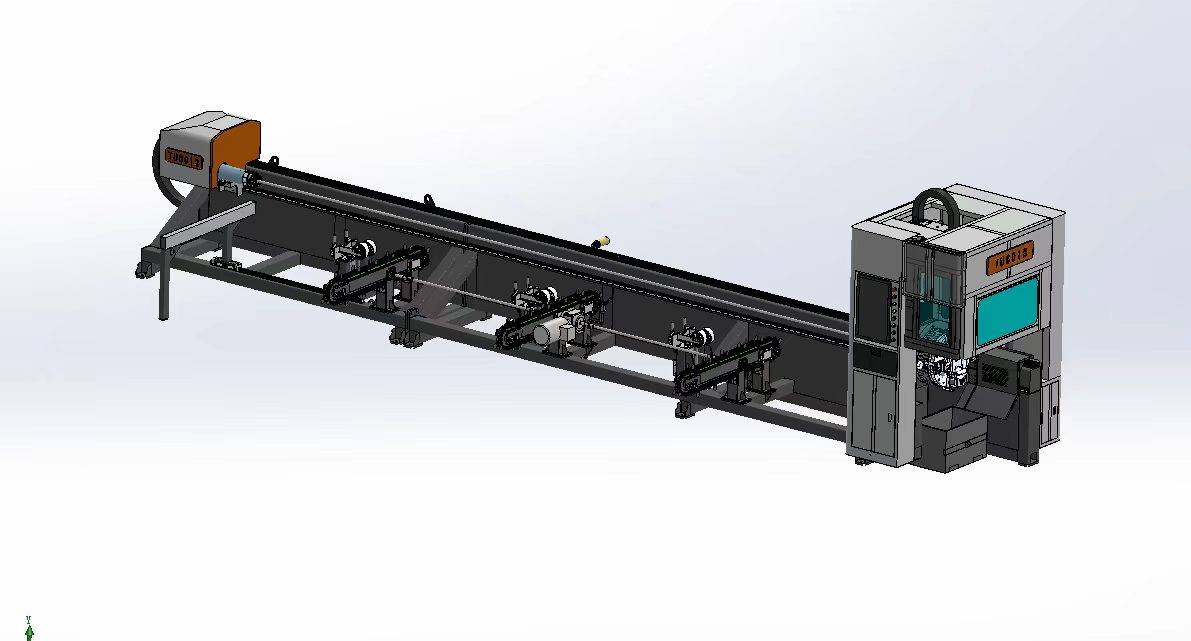
Our CNC Fiber Laser Tube Cutting systems revolutionize metal fabrication by integrating high-precision cutting, punching, and profiling into a single automated workflow. Designed for versatility, this technology handles a wide array of profiles including Round, Square, Rectangular, and Oval tubes, as well as complex L-shaped and U-shaped channels.
- Precision Punching: High-speed hole punching with micron-level accuracy, eliminating the need for mechanical drilling or die-stamping.
- Complex Profiling: Advanced 3D pathing allows for intricate interlocking joints and specialized notch cuts, ideal for structural frames.
- High Material Efficiency: Intelligent nesting software minimizes scrap, reducing raw material costs across large production runs.
- Clean Finish: Delivers oxide-free, burr-free edges that require zero secondary grinding before welding.

Seamlessly processing multiple profiles with consistent precision.
Global Delivery & Logistics



From our high-tech manufacturing facility directly to your global site. PCL WeldCut ensures secure packaging, professional handling, and reliable international logistics to safeguard your equipment throughout the entire journey.