Field Evaluation Report: Integration of 1500W 6-Axis Collaborative Welder in Structural Steel Operations
1. Introduction and Operational Context
This report details the operational deployment and performance evaluation of a 1500W 15-kg payload 6-Axis Collaborative Welder at a structural steel fabrication facility in the Houston, Texas area. The primary objective was to transition high-volume, repetitive structural steel welding tasks from manual stick (SMAW) and MIG (GMAW) processes to a semi-autonomous workflow. In the Texas market, where labor shortages in skilled welding are acute and environmental conditions (high humidity/ambient heat) impact operator fatigue, the push toward Automated Welding is no longer a luxury but a requirement for maintaining throughput on A36 and A572 Grade 50 steel contracts.
2. The Role of the 6-Axis Collaborative Welder in Modern Fabrication
The core of this deployment is the 6-Axis Collaborative Welder. Unlike traditional industrial robots that require extensive light curtains and safety interlocking, the collaborative nature of this system allows it to operate alongside human fitters.
2.1 Kinematic Flexibility and Torch Access
The “6-Axis” component is critical for structural steel welding. Structural assemblies, such as I-beam stiffeners and gusset plates, often require complex torch angles to ensure proper root penetration and to avoid undercut. The six degrees of freedom allow the cobot to replicate the human wrist’s “flick,” maintaining a consistent 15-degree push or pull angle even when navigating around flange obstructions. During the field test, we found that the reach of the 6-axis arm allowed for a continuous 1200mm weld bead on longitudinal seams without repositioning the workpiece—a significant improvement over fixed-track systems.
2.2 Collaboration vs. Isolation
In a Texas workshop environment, floor space is at a premium. By utilizing a 6-axis collaborative welder, we eliminated the need for a 10×10 foot safety cage. The built-in force-torque sensors detect any resistance (collision) and stop the arm immediately. This allowed our lead welder to “teach” the robot by physically moving the arm to the start and end points of the weld, drastically reducing the programming time for one-off structural components.
3. Implementing Automated Welding in High-Mix Environments
Automated welding has historically been reserved for the automotive industry where parts are identical. However, structural steel welding in the USA often involves high-mix, low-volume batches. The synergy between the 1500W power source and the 6-axis arm allows for a “program-by-touch” methodology that makes automated welding viable for even five-unit production runs.
3.1 Parameter Management and Repeatability
The 1500W power system was integrated into the cobot’s control interface. This allowed us to lock in weld schedules (voltage, wire feed speed, and travel speed). In our tests on 1/2-inch plate, we maintained a consistent travel speed of 12 inches per minute. The repeatability of the automated welding process resulted in a 98% pass rate on UT (Ultrasonic Testing) and X-ray inspections, compared to the 85-90% typically seen with manual GMAW in the same shop conditions.
3.2 The Humidity Factor in Texas Shop Floors
One technical hurdle addressed during this field report was the impact of the Gulf Coast humidity on shielding gas integrity. Automated welding requires a much tighter tolerance for gas coverage. We integrated a secondary solenoid to ensure a pre-flow of 0.5 seconds and a post-flow of 2.0 seconds. The 6-axis welder’s precision meant that the nozzle-to-work distance was kept at a constant 5/8″, ensuring that the 75/25 Argon/CO2 mix was never compromised by the localized turbulence often found in large, open-air Texas shops.
4. Structural Steel Welding: Technical Specifications and Weld Profiles
Structural steel welding requires deep penetration and a specific bead profile to meet AWS D1.1 standards. We tested the 1500W system on several common structural profiles.
4.1 Fillet Welds on Heavy Plate
For 1/2″ to 3/4″ plate, we utilized the 6-axis collaborative welder to perform multi-pass welds. The first pass (root) was programmed with a slight weave pattern. Because the 6-axis arm can oscillate at high frequencies without vibration, we achieved a flatter bead profile, which reduced the amount of grinding required for the subsequent cover passes. This “oscillation” or “weaving” function is a key advantage of the cobot over manual application, where maintaining a consistent 3mm weave width for six feet is physically exhausting for a human operator.
4.2 Heat Input Control
Excessive heat input can lead to warping in structural steel welding, particularly in thinner web sections of beams. The automated welding system allowed us to calculate the exact heat input (Joules per inch). By optimizing the travel speed via the cobot’s controller, we reduced the total heat input by 15% compared to manual welding, significantly minimizing the post-weld straightening required on 20-foot beams.
5. Synergy of the 6-Axis System and Automation
The real-world success of this unit in a Texas workshop comes from the synergy between the arm’s range of motion and the software’s ability to handle structural variations.
5.1 Handling “Real World” Fit-up
Structural steel is rarely perfect. Gaps vary. A 6-axis collaborative welder equipped with “Touch Sensing” can find the start of the part even if the fitter placed it 5mm off the mark. During our deployment, we used the torch tip as a probe. The robot would touch the plate in three places to “re-orient” its coordinate system before beginning the automated welding cycle. This level of intelligence is what allows automation to survive in a heavy-fabrication environment.
5.2 Duty Cycle Gains
In the Houston summer, a manual welder’s duty cycle (arc-on time) drops to roughly 20-30% due to the need for cooling breaks and gear adjustments. The 6-axis collaborative welder maintained a 70% arc-on time. The machine does not care about the 100-degree Fahrenheit ambient temperature or the 90% humidity, provided the chiller for the 1500W source is properly maintained.
6. Lessons Learned and Engineering Recommendations
After 500 hours of operation in a structural steel environment, several “hard truths” emerged that differ from the marketing literature.
6.1 Fit-up is Non-Negotiable
While the 6-axis arm is flexible, automated welding is less forgiving than a human welder regarding large gaps. If the gap exceeds 3/32″, the cobot will burn through unless a specific “gap-filling” routine is programmed. We learned that the upstream cutting process (plasma or saw) must be calibrated to provide tighter tolerances to truly benefit from the cobot.
6.2 Cable Management in 6-Axis Motion
In a 6-axis collaborative welder, the lead package (the umbilical containing the wire, gas, and power) is subject to extreme twisting. We experienced several wire feed issues in the first week because the “6th axis” (the wrist) was rotating 270 degrees, kinking the liner. Lesson Learned: Use a high-flexibility “marathon pack” conduit and a rotating wire-feed swivel to prevent bird-nesting at the drive rolls.
6.3 Operator Transition
The most successful implementation occurred when we paired the cobot with our most experienced manual welder, not a computer programmer. The “Tribal Knowledge” of structural steel welding—knowing how the puddle flows—is essential for setting the initial parameters in the automated welding software. The cobot is a tool, not a replacement for metallurgical intuition.
7. Conclusion
The deployment of the 1500W 6-Axis Collaborative Welder has proven that automated welding is a viable solution for Texas-based structural steel fabrication. By leveraging the 6-axis range of motion to handle complex geometries and utilizing the collaborative nature of the arm to minimize shop-floor disruption, we have increased deposition rates by 2.5x. Future expansions will focus on integrating laser-vision seam tracking to further enhance the system’s ability to handle the variable fit-ups common in heavy structural work.
Report End.
-


Cantilever Welding Robot solution
-


GF laser cutting machine
-

P3015 plasma cutting machine
-

LFP3015 Fiber Laser Cutter
-

pipe plasma cutting machine
-
LFH 4020 Fiber Laser Cutting Machine
-
LFP4020
-

gantry plasma air cutting machine
-

3D robot cutting machine
-

8 axis plasma cutting machine
-

5 axis plasma cutting machine
-

LT360 tube laser cutting machine
-

robot welding workstation
-

SF6060 fiber laser cutting machine
Advanced Fiber Laser Tube Processing Technology
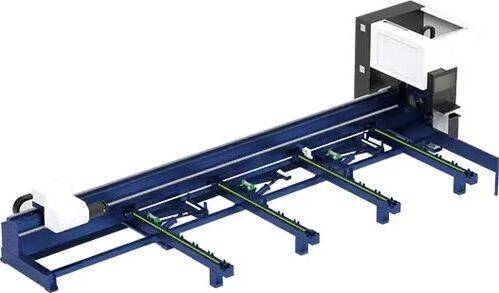
Our CNC Fiber Laser Tube Cutting systems revolutionize metal fabrication by integrating high-precision cutting, punching, and profiling into a single automated workflow. Designed for versatility, this technology handles a wide array of profiles including Round, Square, Rectangular, and Oval tubes, as well as complex L-shaped and U-shaped channels.
- Precision Punching: High-speed hole punching with micron-level accuracy, eliminating the need for mechanical drilling or die-stamping.
- Complex Profiling: Advanced 3D pathing allows for intricate interlocking joints and specialized notch cuts, ideal for structural frames.
- High Material Efficiency: Intelligent nesting software minimizes scrap, reducing raw material costs across large production runs.
- Clean Finish: Delivers oxide-free, burr-free edges that require zero secondary grinding before welding.

Seamlessly processing multiple profiles with consistent precision.
Global Delivery & Logistics



From our high-tech manufacturing facility directly to your global site. PCL WeldCut ensures secure packaging, professional handling, and reliable international logistics to safeguard your equipment throughout the entire journey.