Precision Engineering in C-Channel Processing: The Role of Large Diameter Laser Systems
Structural steel fabrication is undergoing a shift from mechanical punching and sawing to automated laser processing. For C-channel profiles, which are inherently prone to torsion and vibration during movement, the transition to large diameter tube laser cutters provides a significant leap in dimensional accuracy. The integration of high-power fiber lasers with heavy-duty motion control allows for the execution of complex geometries—bolt holes, notches, and miter cuts—in a single pass, eliminating the cumulative error associated with manual layout and multi-machine processing.
Hardware Architecture: Cast Iron Beds and Vibration Damping
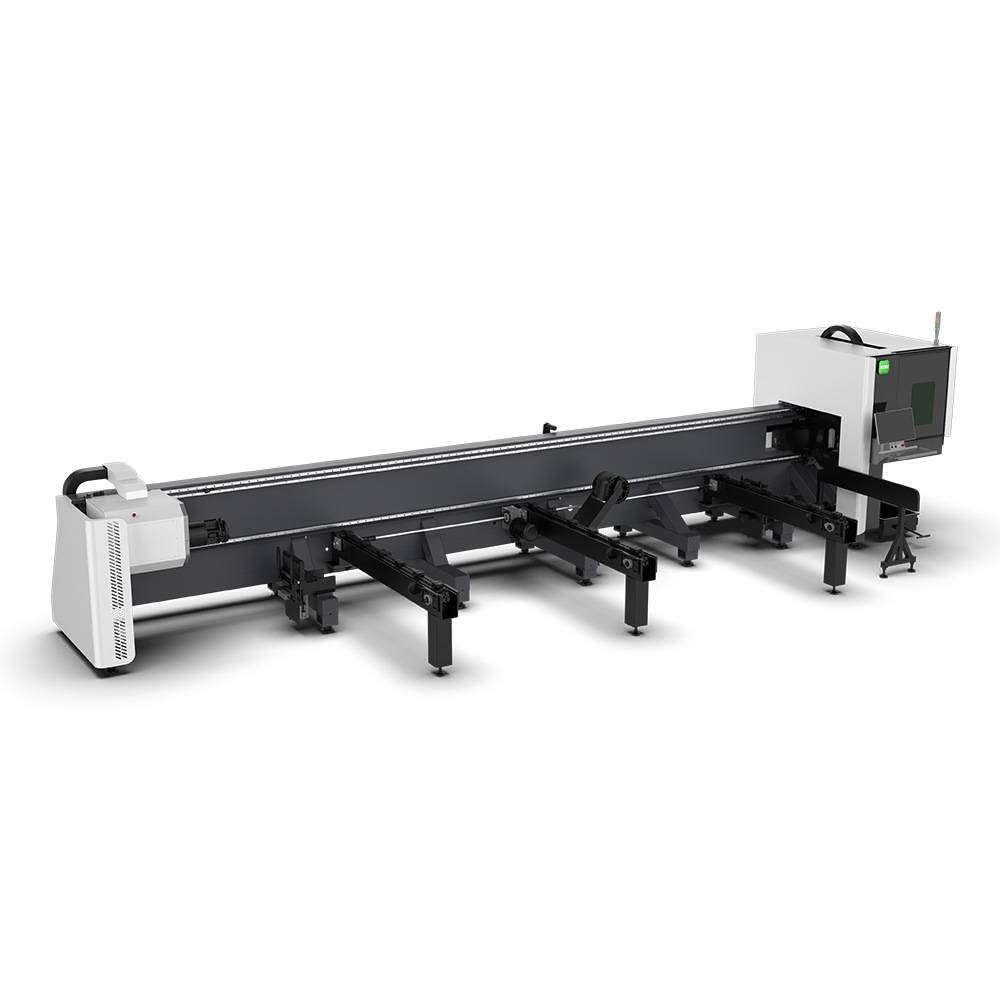
The structural integrity of a laser cutter begins with its base. In structural steel fabrication, the workpiece often weighs several hundred kilograms, creating significant inertia during rapid acceleration and deceleration of the cutting head. While many entry-level machines utilize welded steel frames, industrial-grade large diameter cutters employ a cast iron bed. The graphite flakes within the cast iron provide superior internal friction, which converts kinetic energy into heat, effectively damping high-frequency vibrations that would otherwise lead to striations on the cut surface.
Furthermore, the stability of the workpiece is dictated by the chuck configuration. A 2-chuck system, while sufficient for light tubes, lacks the support required for heavy C-channels. As the material moves forward, the “tailing” or the unsupported end of the profile can sag or whip, causing the laser to lose focus or deviate from the programmed path. A 3-chuck system provides continuous support. The middle chuck acts as a stabilizer that prevents the channel from bowing, while the third chuck allows for “zero-tailing” processing. This ensures that the material is held rigidly at the exact point of laser impingement, maintaining a consistent focal point regardless of the length of the profile.
Comparative Analysis: 2-Chuck vs. 3-Chuck Stability
| Feature | 2-Chuck System | 3-Chuck System (Active Support) |
|---|---|---|
| Vibration Control | Moderate; prone to tail-end whip | High; center-point stabilization |
| Material Waste | 200mm – 300mm tailings | Near-zero tailings (under 50mm) |
| Load Capacity | Standard profiles only | Heavy-duty C-channels and H-beams |
| Processing Accuracy | +/- 0.5mm | +/- 0.1mm |
Intelligence: 95% Material Utilization and Weld Seam Recognition
Beyond the mechanical components, the software ecosystem defines the profitability of the operation. Modern material utilization software uses advanced nesting algorithms specifically designed for asymmetric profiles like C-channels. By interlocking the flanges of the channel in the digital nest, the software can achieve up to 95% material utilization. This is a dramatic improvement over traditional sawing, where each cut results in a kerf loss and significant end-of-bar waste.
Another critical intelligent feature is auto-weld seam recognition. C-channels are often manufactured via hot-rolling or welding, and cutting through a pre-existing weld seam can compromise the structural integrity of the finished part or damage the laser nozzle due to inconsistent material density. Integrated sensors and vision systems identify the location of the weld seam before the cut begins. The software then rotates the profile or adjusts the nesting layout to ensure that holes and critical notches are placed away from the seam, ensuring compliance with structural safety codes without manual inspection.
Workflow Efficiency: Eliminating Secondary Processing
In traditional fabrication, the “cut” is only the first step. Sawing creates heavy burrs, and plasma cutting creates a heat-affected zone (HAZ) with dross that must be ground away before welding or assembly. Three-chuck laser cutting delivers burr-free precision directly from the machine. The high power density of the fiber laser vaporizes the metal instantly, while high-pressure assist gases (typically Nitrogen or Oxygen) blow the molten material out of the kerf, leaving a clean, square edge. This “ready-to-weld” state eliminates the labor cost of secondary grinding, which often accounts for 30% of the total labor time in structural shops.
Efficiency is further amplified through ERP digital nesting integration. Instead of the operator manually entering dimensions, the fabrication requirements are pushed directly from the engineering office to the machine. The ERP system tracks the material batch, the specific parts cut, and the remaining remnant inventory in real-time. This creates a closed-loop manufacturing environment where data flows seamlessly from the 3D model to the shipping dock.
Technical Advantages for Large Diameter Profiles
Large diameter tube lasers are specifically geared toward profiles that exceed 200mm in width. For C-channels of this scale, the thickness of the web and flanges often varies. The laser system’s capacitive height sensing adjusts the nozzle height in milliseconds, maintaining a constant standoff distance even if the channel is slightly warped. This prevents “collisions” and ensures the focal point remains optimal for a clean cut. When combined with cast iron bed vibration damping, the result is a component that meets the strictest tolerances of architectural and industrial engineering.
Conclusion on ROI and Industrial Value
The investment in a large diameter tube laser for C-channel processing is justified through three primary vectors: labor reduction, material savings, and throughput. By removing the need for layout, drilling, and deburring, a single laser operator can replace the output of a four-person traditional fabrication cell. With 95% material utilization, the reduction in scrap costs provides a direct path to a lower cost-per-part, making the facility more competitive in high-volume structural tenders. The precision of the laser ensures that downstream assembly is faster, as parts fit together perfectly without the need for onsite modifications or forced fitment.
-


LT240S tube laser cutting machine
-
LT120S tube laser cutting machine
-
Sale

Tank Fillet Welding Machine
Original price was: $1,000.00.$900.00Current price is: $900.00. -
Sale

MAK100 tube laser cutting machine
Original price was: $5,500.00.$5,000.00Current price is: $5,000.00. -

portable plasma air cutting machine
$1,200.00 -

2in1 fiber laser cutting machine
-

Air cooling Laser welding machine
-

HF h beam laser cutting machine
-

LT240 laser cutting machine
-

Laser welding machine
-


Cobot Welding Station
-

Gantry welding robot solution
-

Tracked Wheeled AGV Welding robot
-

LFH6020 Fiber laser cutting machine
-
LFP6020
-

robotic welidng machine
Advanced Fiber Laser Tube Processing Technology
Our CNC Fiber Laser Tube Cutting systems revolutionize metal fabrication by integrating high-precision cutting, punching, and profiling into a single automated workflow. Designed for versatility, this technology handles a wide array of profiles including Round, Square, Rectangular, and Oval tubes, as well as complex L-shaped and U-shaped channels.
- Precision Punching: High-speed hole punching with micron-level accuracy, eliminating the need for mechanical drilling or die-stamping.
- Complex Profiling: Advanced 3D pathing allows for intricate interlocking joints and specialized notch cuts, ideal for structural frames.
- High Material Efficiency: Intelligent nesting software minimizes scrap, reducing raw material costs across large production runs.
- Clean Finish: Delivers oxide-free, burr-free edges that require zero secondary grinding before welding.

Seamlessly processing multiple profiles with consistent precision.
Global Delivery & Logistics



From our high-tech manufacturing facility directly to your global site. PCL WeldCut ensures secure packaging, professional handling, and reliable international logistics to safeguard your equipment throughout the entire journey.