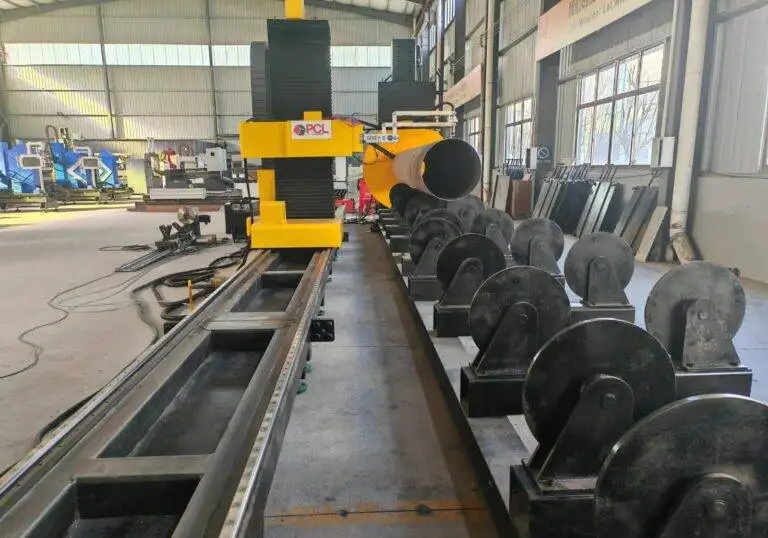
Beam Processing Center with Narrow Gap welding for for Wind Tower fabrication

In this article
- Optimizing Wind Tower Internal Structures via Beam Processing Centers
- High-Definition Plasma Cutting: Mechanical Precision and Intersection Accuracy
- Advanced Beveling for Narrow Gap Welding Preparation
- Maintenance Efficiency in H-Beam Processing
- Eliminating Thermal Distortion and Secondary Operations
- Data Integration and OEE in Wind Tower Fabrication
- Technical Summary of Plasma-Based Beam Lines
Optimizing Wind Tower Internal Structures via Beam Processing Centers
The fabrication of wind towers involves more than just the rolling and welding of large-diameter cylinders. The internal infrastructure—comprising platforms, ladder supports, and secondary structural reinforcements—requires rigorous adherence to geometric tolerances. A specialized beam processing technology is essential for handling the H-beams and channels that form the backbone of these internal systems. Unlike standard structural steel applications, wind tower internals must account for the curvature of the tower shell, demanding high-precision cuts at the points of contact.
The shift toward automated beam processing centers is driven by the need for higher throughput and the reduction of manual rework. By utilizing high-definition plasma systems, manufacturers can execute complex cut patterns, including bolt holes, copes, and notches, in a single pass. This integration is particularly vital when preparing components for narrow gap welding, a process that relies heavily on the consistency of the joint preparation to ensure structural integrity and minimize the volume of filler metal required.
High-Definition Plasma Cutting: Mechanical Precision and Intersection Accuracy
The primary challenge in wind tower beam processing is the intersection accuracy of the beams meeting the inner radius of the tower wall. Manual layout and cutting of these intersections often lead to gaps that exceed allowable welding tolerances, resulting in excessive heat input and potential distortion during assembly. Modern beam processing centers resolve this through multi-axis plasma torch heads capable of 360-degree rotation and significant tilt angles.

These systems use sophisticated sensors to map the actual dimensions of the H-beam, which may deviate slightly from theoretical mill specifications. By measuring the web center and flange squareness before the cut, the plasma system adjusts its trajectory in real-time. This ensures that the intersection profile is mathematically precise, allowing for a “snug fit” against the tower’s interior. The accuracy of these intersections is measured in sub-millimeter increments, which is a prerequisite for the high-fatigue environment inherent in wind energy structures.
Advanced Beveling for Narrow Gap Welding Preparation
The efficiency of the welding stage is dictated by the quality of the edge preparation. Narrow gap welding (NGW) is the preferred method for thick-walled structural sections in wind towers because it reduces the cross-sectional area of the weld joint. However, NGW is highly sensitive to bevel consistency. A beam processing center equipped with a high-definition plasma power source can produce varying bevel angles (V, Y, and K cuts) with exceptional repeatability.
The plasma torch must maintain a constant standoff distance and travel speed to prevent dross accumulation and heat-affected zone (HAZ) expansion. By automating the beveling process, the beam processing center eliminates the variability associated with handheld grinders or semi-automatic tractors. The resulting edges are clean and ready for the narrow gap process, where the groove angle might be as low as 1 to 3 degrees. This level of precision ensures that the weld arc can reach the root of the joint without interference, maintaining the mechanical properties of the steel.
Maintenance Efficiency in H-Beam Processing
Industrial engineers prioritize equipment uptime, and in the context of beam processing, structural beam processing equipment must be rugged enough to withstand the vibrations and dust of a heavy fabrication shop. Plasma systems are inherently robust for these environments. Compared to alternative thermal cutting methods that require sensitive optical alignments, plasma cutting systems utilize a straightforward consumable-based model.
The maintenance of a plasma-based beam line is primarily focused on the gas delivery system and the torch consumables (nozzles, electrodes, and swirl rings). Modern centers feature automated tool changers and diagnostic software that predicts consumable failure before it affects cut quality. For H-beam processing, where the torch must move between the flanges and the web, the mechanical simplicity of the plasma lead-sets reduces the risk of fatigue-related cable failure. This low-maintenance profile ensures that the beam processing center can operate at high duty cycles, matching the production cadence of the tower section rolling lines.
Eliminating Thermal Distortion and Secondary Operations
A critical factor in beam processing for wind towers is the management of thermal input. While plasma is a thermal process, the high speed of modern HD plasma systems minimizes the time the heat source is in contact with the material. This rapid travel speed limits the width of the heat-affected zone and prevents the warping of thin-webbed H-beams.
By achieving a high-quality surface finish directly from the plasma torch, the need for secondary grinding is largely eliminated. In a traditional workflow, a beam would be cut to length, moved to a layout station, manually notched, and then ground to a bevel. An automated processing center compresses these steps into a single station. The elimination of these secondary touches not only reduces labor costs but also significantly lowers the risk of workplace injuries associated with manual material handling and grinding.
Data Integration and OEE in Wind Tower Fabrication
From an engineering management perspective, the beam processing center serves as a data hub. By importing DSTV or IFC files directly from the structural design software, the system ensures that the physical component is a perfect digital twin of the design. This connectivity allows for real-time tracking of production metrics, such as cuts per hour and material utilization rates.
The intersection accuracy achieved through this digital workflow means that the assembly team on the shop floor spends zero time “forcing” fit-ups. In wind tower fabrication, where schedules are tight and liquid damages for delays are high, the reliability and speed of a plasma-based beam line are strategic assets. The system’s ability to handle various beam sizes and shapes without significant retooling makes it a versatile component of the overall manufacturing strategy, providing the flexibility needed for different tower heights and turbine specifications.
Technical Summary of Plasma-Based Beam Lines
The decision to implement a beam processing center with plasma cutting capabilities for wind tower internals is rooted in three technical pillars: geometric precision, preparation quality for narrow gap welding, and operational durability. The 3D movement of the plasma head allows for the complex intersections required for curved surfaces, while the high-definition power sources provide the edge quality necessary for high-integrity welds.
By focusing on these parameters, industrial engineers can optimize the entire secondary steel fabrication process. The result is a streamlined production flow that minimizes waste, reduces manual intervention, and ensures that every structural element meets the rigorous safety and performance standards of the wind energy sector. The low maintenance requirements of plasma systems further solidify their role as the workhorse of the modern beam fabrication facility.