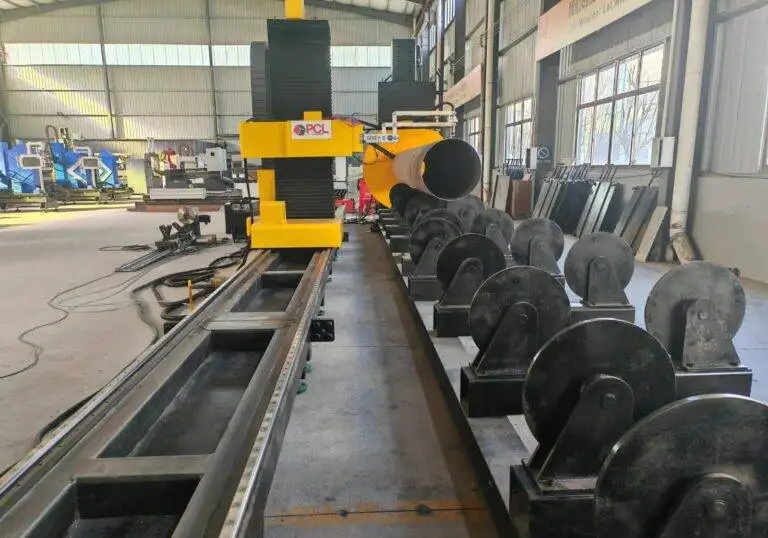
Beam Processing Center with Narrow Gap welding for for Wind Tower fabrication

In this article
- Optimizing Wind Tower Internal Structures via Plasma Beam Processing
- Intersection Accuracy and Geometric Tolerance Management
- H-Beam Processing and Low Maintenance Design Philosophy
- Advanced Beveling for Narrow Gap Preparation
- Thermal Influence and Material Integrity
- Data Integration and Lean Manufacturing Flow
- Summary of Engineering Advantages
Optimizing Wind Tower Internal Structures via Plasma Beam Processing
In the context of utility-scale wind tower fabrication, the efficiency of internal structural components—specifically the platforms, ladders, and reinforcement ribs—is often a bottleneck for total throughput. Modern industrial engineering mandates a shift toward automated Beam Processing Centers that utilize high-definition plasma technology. These systems are engineered to handle the massive cross-sections of H-beams and heavy-wall sections required to withstand dynamic loads. By focusing on the preparation phase, specifically for narrow gap welding applications, the fabrication line can achieve a higher degree of repeatability and structural reliability.
Intersection Accuracy and Geometric Tolerance Management
The core requirement for successful narrow gap preparation is the elimination of fit-up gaps. Traditional manual cutting or standard mechanical sawing fails to provide the complex intersection geometries needed where radial internal supports meet the curved inner wall of the tower shell. An automated plasma beam processing center utilizes multi-axis robotic heads or CNC-controlled gantries to calculate the precise intersection path.
Intersection accuracy in wind tower internals is governed by the ability of the plasma torch to maintain a constant standoff distance while navigating the flange and web transitions of an H-beam. Advanced sensor integration, such as tactile probe sensing or laser vision systems, allows the machine to compensate for material deviations—such as “mill-scale” irregularities or slight beam camber—in real-time. This ensures that the resulting Plasma Cutting path remains within a +/- 0.5mm tolerance threshold. High-precision intersections are critical because narrow gap welding relies on a consistent groove width to maintain arc stability and uniform bead penetration. Any deviation in the cut leads to localized overheating or lack of fusion, necessitating costly rework.
H-Beam Processing and Low Maintenance Design Philosophy
Wind tower production environments are inherently harsh, characterized by high volumes of metallic dust and continuous operation cycles. From an industrial engineering perspective, the uptime of a beam processing center is directly linked to its mechanical simplicity and the robustness of its motion control components. Systems designed for H-beam processing must prioritize low maintenance to ensure a high Return on Investment (ROI).
Low maintenance is achieved through several key design features. First, the use of hardened, rack-and-pinion drive systems instead of ball screws reduces the risk of particulate contamination seizing the motion axis. Second, integrated fume extraction systems that utilize zoned downdraft tables ensure that the dross and slag generated during the plasma process are removed immediately, preventing buildup on sensitive guide rails. Furthermore, the beam processing center utilizes heavy-duty roller conveyors with sensor-based positioning, eliminating the need for manual clamping and reducing wear on the material handling hardware. By minimizing the number of moving parts exposed to the thermal plume of the plasma arc, manufacturers can extend the mean time between failures (MTBF), ensuring that the internal support fabrication keeps pace with the shell rolling and longitudinal welding stations.
Advanced Beveling for Narrow Gap Preparation
The most significant advantage of integrating plasma technology into a beam processing center is the ability to perform complex beveling in a single pass. Narrow gap welding requires specific groove geometries—typically J-preps or steep-angle V-preps—that minimize the volume of weld metal required. Plasma torches mounted on 5-axis or 6-axis robotic arms can execute these bevels across the web and flanges of H-beams with high angular precision.
This automated beveling process replaces secondary grinding operations. When preparing a beam for a narrow gap joint, the beveling accuracy determines the heat input required during the welding phase. A precise plasma bevel ensures that the root face is consistent, which is essential for the high-current, low-voltage parameters used in narrow gap configurations. The ability to switch between a 0-degree straight cut and a 45-degree bevel instantaneously allows for the creation of complex transition zones where internal brackets are welded to primary load-bearing beams. This level of automation reduces the man-hours per ton of steel processed and eliminates the ergonomic hazards associated with manual torch operations and handheld grinding.
Thermal Influence and Material Integrity
A common concern in heavy-duty structural fabrication is the Heat Affected Zone (HAZ) created during the cutting process. Modern high-definition plasma systems mitigate this by utilizing high-velocity gas flows and constricted arcs that concentrate thermal energy into a very narrow area. In wind tower fabrication, where S355 or higher-grade structural steels are common, maintaining the mechanical properties of the H-beam is paramount.
By optimizing the cutting speed and gas mixture (such as Oxygen-Air or Argon-Hydrogen for thicker sections), the beam processing center minimizes the depth of the HAZ. This is particularly important for narrow gap welding, as an excessive HAZ from the cutting stage can lead to grain coarsening in the subsequent weldment, potentially compromising the fatigue strength of the tower internals. Industrial engineers must calibrate the plasma parameters to ensure that the kerf remains narrow and the dross remains “low-speed,” meaning it is easily detached without aggressive mechanical force, thus preserving the base metal’s edge integrity.
Data Integration and Lean Manufacturing Flow
The integration of a beam processing center into a wind tower facility is not merely a hardware upgrade; it is a step toward a digital twin manufacturing model. By importing Tekla or AutoCAD DSTV files directly into the plasma system’s controller, the risk of human error in layout and marking is eliminated. The software automatically calculates the nesting patterns for the H-beams, reducing scrap rates and optimizing material flow.
From a lean manufacturing standpoint, the ability to perform cutting, hole-piercing, and beveling in a single workstation reduces “Work in Progress” (WIP) inventory. In traditional setups, a beam might move from a saw to a drill line and then to a manual beveling station. The automated plasma center consolidates these steps, shortening the lead time for internal assemblies. This synchronized production ensures that as the tower shells move toward the assembly hall, the internal structural kits are ready for immediate fit-up, eliminating delays in the final integration phase.
Summary of Engineering Advantages
Focusing on plasma-based beam processing provides a clear path to scaling wind tower production. The combination of high-precision intersection cutting and automated beveling creates the ideal substrate for narrow gap welding, which is the gold standard for reducing filler material costs and improving weld quality. When these technical capabilities are housed within a low-maintenance mechanical framework, the result is a highly resilient fabrication process capable of meeting the rigorous demands of the global renewable energy sector. The focus remains on maximizing the efficiency of the arc-on time and minimizing the secondary handling of heavy structural sections.