Beam Processing Center with Narrow Gap welding for for Oil & Gas Tanks
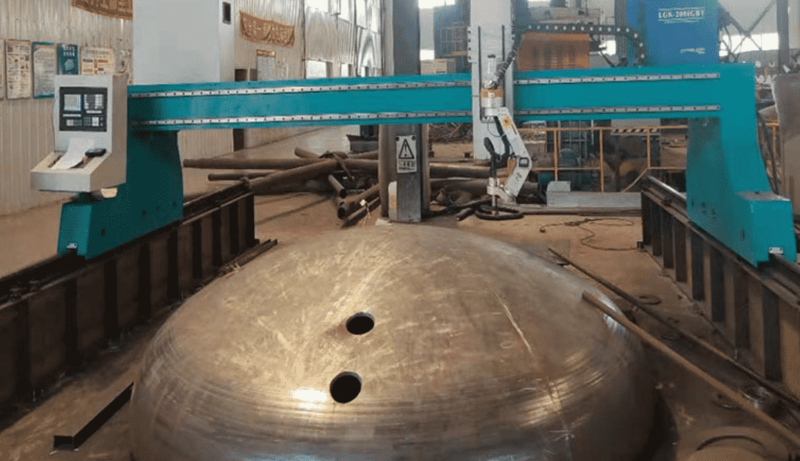
In this article
- Engineering Precision in Heavy-Scale Tank Fabrication
- Plasma Cutting Systems: The Industrial Standard for Thick Sections
- Intersection Accuracy and Structural Fit-up
- Optimizing H-Beam Processing for Low Maintenance
- Mechanical Robustness and Dust Management
- Multi-Axis Beveling for Narrow Gap Welding Preparation
- The Role of Five-Axis Plasma Heads
- Synergy Between Cutting Accuracy and Welding Efficiency
- Reducing Consumable Consumption
- Data-Driven Fabrication and BIM Integration
- Conclusion: The Future of Structural Tank Components
Engineering Precision in Heavy-Scale Tank Fabrication
In the Oil & Gas sector, the structural integrity of storage tank foundations and support frames is non-negotiable. The transition toward automated Beam Processing Center technology has redefined how heavy H-beams and structural profiles are prepared. Unlike traditional manual methods, these centers utilize high-definition plasma systems to execute complex geometries with repeatable precision. The objective is to facilitate Narrow Gap Welding (NGW) by ensuring that every cut, notch, and bevel meets stringent tolerances. This focus on precision at the cutting stage directly impacts the structural reliability and longevity of the vessel supports under extreme hydrostatic loads.
Plasma Cutting Systems: The Industrial Standard for Thick Sections
For the heavy-walled H-beams typically used in Oil & Gas tank platforms, plasma cutting remains the most viable thermal process. Modern plasma power sources provide the necessary energy density to penetrate thick structural steel while maintaining a narrow kerf.
Intersection Accuracy and Structural Fit-up
One of the most significant challenges in beam processing is the accuracy of intersections where cross-members meet main longitudinal supports. In a Beam Processing Center, CNC-controlled plasma heads move across multiple axes to create cope cuts and notches. Intersection accuracy is maintained through advanced material probing and laser measurement systems that account for mill tolerances in the H-beam itself. By measuring the actual flange width and web thickness before the cut, the system compensates for any deviation, ensuring that the finished part fits perfectly against the mating surface. This eliminates the need for manual grinding or gap filling during the assembly of tank support structures.

Optimizing H-Beam Processing for Low Maintenance
From an industrial engineering perspective, the uptime of the fabrication line is as critical as the quality of the cut. Plasma-based beam processors are designed for the rugged environment of a structural steel shop.
Mechanical Robustness and Dust Management
H-beam processing involves significant amounts of metal slag and dust. Unlike more sensitive optical systems, plasma components are inherently robust. The H-beam low maintenance profile is achieved through enclosed rack-and-pinion drives and pressurized bellows that protect the motion system from abrasive particulates. Furthermore, the absence of complex beam delivery optics simplifies the daily calibration routine. For Oil & Gas fabricators operating in high-volume environments, the ability to perform routine maintenance without specialized technicians ensures that production schedules for large-scale tank projects remain on track.
Multi-Axis Beveling for Narrow Gap Welding Preparation
The move toward Narrow Gap Welding (NGW) in tank fabrication requires a fundamental shift in how joints are prepared. NGW utilizes a significantly reduced groove angle, often between 1 to 5 degrees, which requires extreme precision in the beveling process.
The Role of Five-Axis Plasma Heads
A sophisticated plasma cutting center equipped with a five-axis tilt-and-rotate head can create complex bevels (V, Y, K, and X profiles) in a single pass. This is particularly crucial for the heavy web and flange sections of H-beams. By automating the beveling process, the engineer ensures that the root face and the bevel angle are consistent across the entire length of the joint.
Thermal Control and Kerf Compensation
Plasma cutting generates a localized heat-affected zone (HAZ). However, high-speed plasma gas delivery and advanced torch height control (THC) minimize the dwell time of the arc. This prevents excessive thermal distortion of the H-beam flanges. Precise kerf compensation software ensures that the bevel geometry accounts for the width of the plasma arc, resulting in a joint preparation that is optimized for the tight tolerances of NGW torches.
Synergy Between Cutting Accuracy and Welding Efficiency
The primary goal of utilizing high-accuracy plasma cutting in a Beam Processing Center is to facilitate the welding phase. Narrow Gap Welding is highly sensitive to variations in joint geometry. If the gap width fluctuates due to poor cutting accuracy, the NGW process can suffer from lack of fusion or excessive penetration.
Reducing Consumable Consumption
By achieving high intersection accuracy, the volume of weld metal required to fill the joint is minimized. In the context of large Oil & Gas tanks, where hundreds of structural joints are required, the reduction in filler wire consumption and shielding gas is substantial. This not only reduces costs but also decreases the total heat input into the structure, preserving the metallurgical properties of the high-strength steel used in the H-beams.
Data-Driven Fabrication and BIM Integration
Modern beam processing is no longer a standalone operation. It is the physical execution of a digital model. Building Information Modeling (BIM) files are imported directly into the cutting center’s software.
Digital Traceability for Oil & Gas Compliance
In the Oil & Gas industry, traceability is mandatory. Automated plasma centers log every cut, providing data on arc time, material usage, and dimensional accuracy. This digital footprint is essential for quality assurance audits and ensures that every beam used in a tank foundation meets the specified engineering standards. The integration of plasma cutting with CNC software allows for nesting strategies that maximize material yield, reducing scrap in the fabrication of large-scale support grids.
Conclusion: The Future of Structural Tank Components
The integration of high-definition plasma cutting within a dedicated beam processing environment represents the pinnacle of structural engineering efficiency. By focusing on intersection accuracy and specialized beveling for Narrow Gap Welding, fabricators can produce tank supports that are both structurally superior and more cost-effective. The mechanical reliability of plasma systems ensures H-beam low maintenance cycles, allowing for continuous operation in demanding industrial landscapes. As the Oil & Gas industry continues to push for faster project timelines and higher safety margins, the role of automated, high-precision plasma processing will only become more central to the fabrication workflow.






