Engineering Optimization: The Role of AGW in Tank Construction
In the field of petrochemical storage infrastructure, the efficiency of circumferential seam welding dictates the critical path of the entire construction schedule. The Automatic Girth Seam Welder (AGW) represents a specialized robotic solution designed to traverse the top edge of tank shells, providing continuous, high-quality welds in the horizontal position. Unlike manual shielded metal arc welding (SMAW), these systems leverage Metal Active Gas (MAG) processes to deliver consistent penetration and fusion profiles.
The shift toward automation is driven by the need to meet rigorous API 650 and 653 standards while mitigating the variables introduced by human fatigue. An AGW unit operates as a mobile platform, integrating the welding power source, wire feeder, and control system into a single carriage. This allows for a continuous duty cycle that manual operators cannot sustain, particularly in harsh environmental conditions typical of tank farms and refineries.
Zero-Tailing Technology: Precision at the Intersect
One of the most significant advancements in robotic tank welding is the implementation of “Zero-tailing” technology. In traditional automated girth welding, the start and stop points of a circumferential weld often result in “tails” or overlaps that require extensive manual grinding and re-welding to ensure structural integrity and vacuum tightness. Zero-tailing systems utilize advanced encoders and synchronized motion control to manage the arc termination phase with extreme precision.
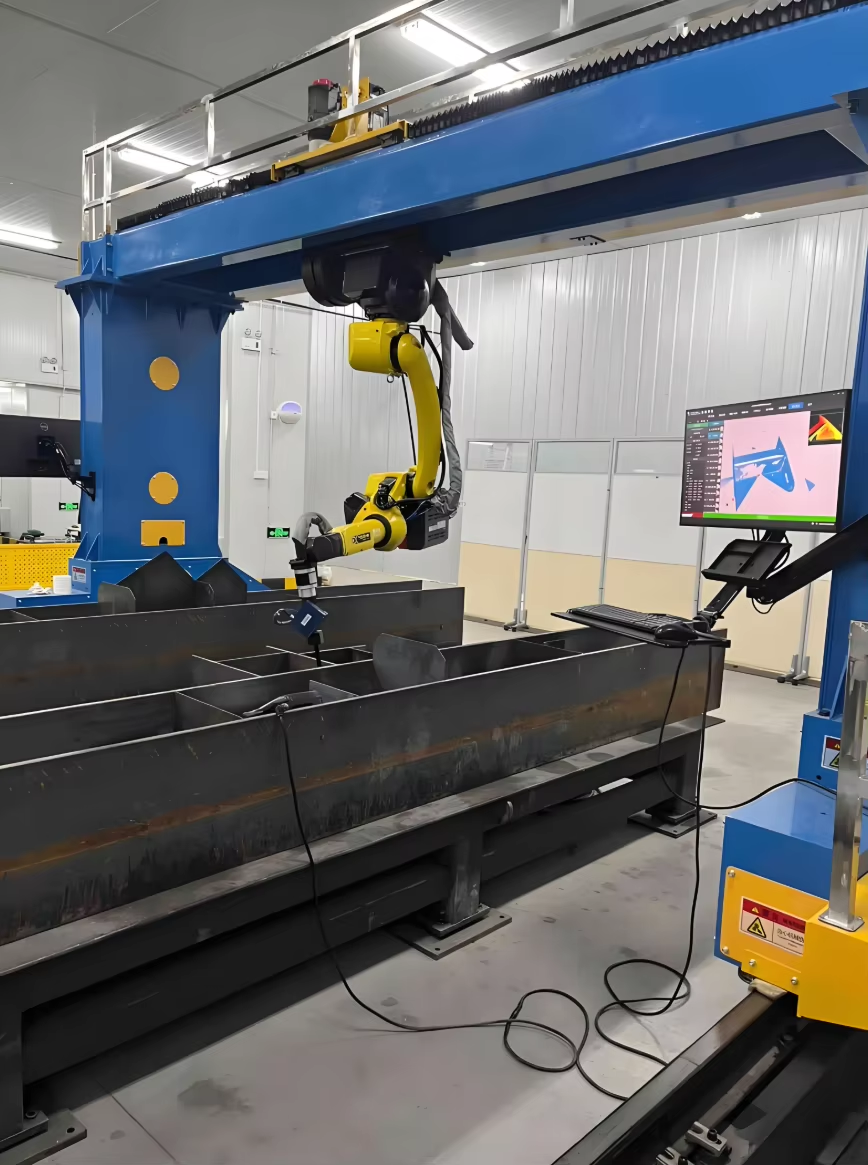
By dynamically adjusting the wire feed speed and travel velocity at the overlap point, the system ensures a seamless transition where the weld bead meets its origin. This eliminates the excess buildup of weld metal, effectively reducing the post-weld processing time. From an industrial engineering perspective, this reduces the “Value-Added” vs. “Non-Value-Added” ratio by cutting down on secondary grinding operations and reducing the risk of slag inclusions or lack of fusion at the tie-in points.
The MAG Process in Robotic Tank Welding
The Robotic Welding systems utilized in AGW configurations primarily employ the MAG process, utilizing a mix of Argon and CO2 shielding gases. This choice is deliberate, as it allows for high deposition rates and deeper penetration compared to Gas Tungsten Arc Welding (GTAW). The use of solid or flux-cored wires in a robotic setup ensures that the chemical composition of the weld metal remains uniform across several hundred linear meters of the tank circumference.
The AGW carriage is equipped with sensors that maintain the torch angle and “stick-out” distance, compensating for minor irregularities in the shell plate alignment. This level of control is vital for managing the heat-affected zone (HAZ), preventing burn-through on thinner upper-course plates while ensuring sufficient fusion on the thicker bottom courses of the tank.
Maintenance Protocols for Automated Welding Systems
To maintain the Labor ROI expected from high-capital equipment, a rigorous preventive maintenance (PM) schedule must be enforced. Unlike manual tools, robotic AGW units are complex electromechanical systems subject to vibration, dust, and thermal stress.
Drive System and Carriage Alignment
The drive wheels and tracking mechanism require weekly inspection. Since the AGW relies on the top edge of the shell plate for guidance, any misalignment in the drive assembly can lead to “wandering,” which compromises the weld root. Operators must ensure that the drive rollers are free of debris and that the tensioning system is calibrated to prevent slippage during vertical transitions or on plates with surface oxidation.
Wire Delivery and Contact Tips
In MAG welding, the stability of the arc is directly tied to the condition of the contact tip and the smoothness of the wire feed. Robotic systems operate at higher wire feed speeds than manual processes; therefore, contact tips should be replaced based on “arc-on” hours rather than failure. Liners must be blown out with compressed air to prevent the accumulation of copper flakes and dust, which can cause bird-nesting in the feeder and lead to costly downtime.
Labor ROI: Quantifying the Shift to Automation
The primary metric for evaluating the success of AGW integration is the return on investment through labor optimization. A traditional manual welding crew for a 50-meter diameter tank might require twelve highly skilled welders to maintain a specific schedule. In contrast, an AGW system can be managed by a single technician and an assistant.
Deposition Rates and Throughput
Manual SMAW typically yields a deposition rate of 1.5 to 2.5 kg per hour, factoring in rod changes and slag removal. A robotic MAG-based AGW system can achieve rates exceeding 5 to 8 kg per hour. When multiplied across the total linear meters of a storage tank, the reduction in man-hours is exponential.
Reduction in Defect Rates
In Oil & Gas construction, the cost of a weld repair is often ten times the cost of the initial weld due to the requirements for carbon-arc gouging, re-welding, and repeated NDT (X-ray or Ultrasonic testing). Zero-tailing technology specifically targets the most common failure point: the tie-in. By automating this transition, the probability of NDT failure is reduced by up to 40%, directly impacting the project’s bottom line by avoiding rework cycles.
Integration with Project Management Workflows
Implementing Automatic Girth Seam Welder units requires a shift in front-end planning. Shell plate fit-up tolerances must be tighter than those for manual welding to prevent excessive gaps that the robot cannot bridge without manual intervention. Industrial engineers must align the plate fabrication precision with the capabilities of the AGW to maximize the “arc-on” time.
When the fit-up is optimized, the AGW can operate at a 75-80% duty cycle, compared to the 30-40% typically seen with manual welders who must pause for repositioning, electrode replacement, and environmental exposure. This increased throughput allows for faster tank completion, enabling faster commission of storage assets and improved cash flow for the facility owner.
Conclusion: The Future of Field Fabrication
The transition to robotic girth welding with Zero-tailing technology is not merely a mechanical upgrade; it is a fundamental shift in the economics of field fabrication. By focusing on the MAG process and high-precision motion control, contractors can deliver tanks that exceed safety standards while significantly lowering the cost per linear meter. As labor markets for skilled welders tighten, the reliance on automated systems that offer high ROI through consistency and maintenance-friendly designs will become the industry standard for oil and gas infrastructure.
-


LT240S tube laser cutting machine
-
LT120S tube laser cutting machine
-
Sale

Tank Fillet Welding Machine
Original price was: $1,000.00.$900.00Current price is: $900.00. -
Sale

MAK100 tube laser cutting machine
Original price was: $5,500.00.$5,000.00Current price is: $5,000.00. -

portable plasma air cutting machine
$1,200.00 -

2in1 fiber laser cutting machine
-

Air cooling Laser welding machine
-

HF h beam laser cutting machine
-

LT240 laser cutting machine
-

Laser welding machine
-


Cobot Welding Station
-

Gantry welding robot solution
-

Tracked Wheeled AGV Welding robot
-

LFH6020 Fiber laser cutting machine
-
LFP6020
-

robotic welidng machine
Advanced Fiber Laser Tube Processing Technology
Our CNC Fiber Laser Tube Cutting systems revolutionize metal fabrication by integrating high-precision cutting, punching, and profiling into a single automated workflow. Designed for versatility, this technology handles a wide array of profiles including Round, Square, Rectangular, and Oval tubes, as well as complex L-shaped and U-shaped channels.
- Precision Punching: High-speed hole punching with micron-level accuracy, eliminating the need for mechanical drilling or die-stamping.
- Complex Profiling: Advanced 3D pathing allows for intricate interlocking joints and specialized notch cuts, ideal for structural frames.
- High Material Efficiency: Intelligent nesting software minimizes scrap, reducing raw material costs across large production runs.
- Clean Finish: Delivers oxide-free, burr-free edges that require zero secondary grinding before welding.

Seamlessly processing multiple profiles with consistent precision.
Global Delivery & Logistics



From our high-tech manufacturing facility directly to your global site. PCL WeldCut ensures secure packaging, professional handling, and reliable international logistics to safeguard your equipment throughout the entire journey.