Optimizing Girth Seam Integrity through Narrow Gap MAG Robotics
In the heavy construction machinery sector, the structural integrity of rotating components—such as hydraulic cylinders, track rollers, and axle housings—is non-negotiable. Traditional welding methods often rely on wide-angle V-grooves that require excessive filler material and prolonged arc-on time. Transitioning to an Automatic Girth Seam Welder utilizing Narrow Gap MAG (Metal Active Gas) technology represents a paradigm shift in industrial efficiency. By narrowing the bevel angle to less than 10 degrees, engineers can drastically reduce the total volume of the weld pool. This approach minimizes heat input, thereby limiting the Heat Affected Zone (HAZ) and reducing thermal distortion in high-tensile steel components.
The engineering challenge in narrow gap applications lies in ensuring consistent root penetration and sidewall fusion. Robotic systems provide the necessary spatial precision to oscillate the torch within tight tolerances, ensuring the arc interacts correctly with both faces of the joint. Unlike manual processes, Robotic Welding systems maintain a constant stick-out length and travel speed, which are critical variables when the clearance for the gas nozzle is restricted. This level of process control is essential for meeting the stringent ultrasonic testing (UT) and X-ray standards required for heavy-duty machinery.
Mechanical Configuration and Process Stability
The architecture of a girth seam welding cell typically involves a synchronized headstock and tailstock or a specialized rotary positioner. The integration of a 6-axis robotic arm or a dedicated linear actuator allows for multi-pass layering within the narrow groove. for Construction Machinery, where plate thicknesses often exceed 20mm, the Narrow Gap MAG process utilizes specific shielding gas mixtures—typically Argon and CO2—to stabilize the arc. This stability is vital to prevent “bridging” or lack of fusion, defects that frequently occur when manual operators struggle with visibility in deep, narrow grooves.
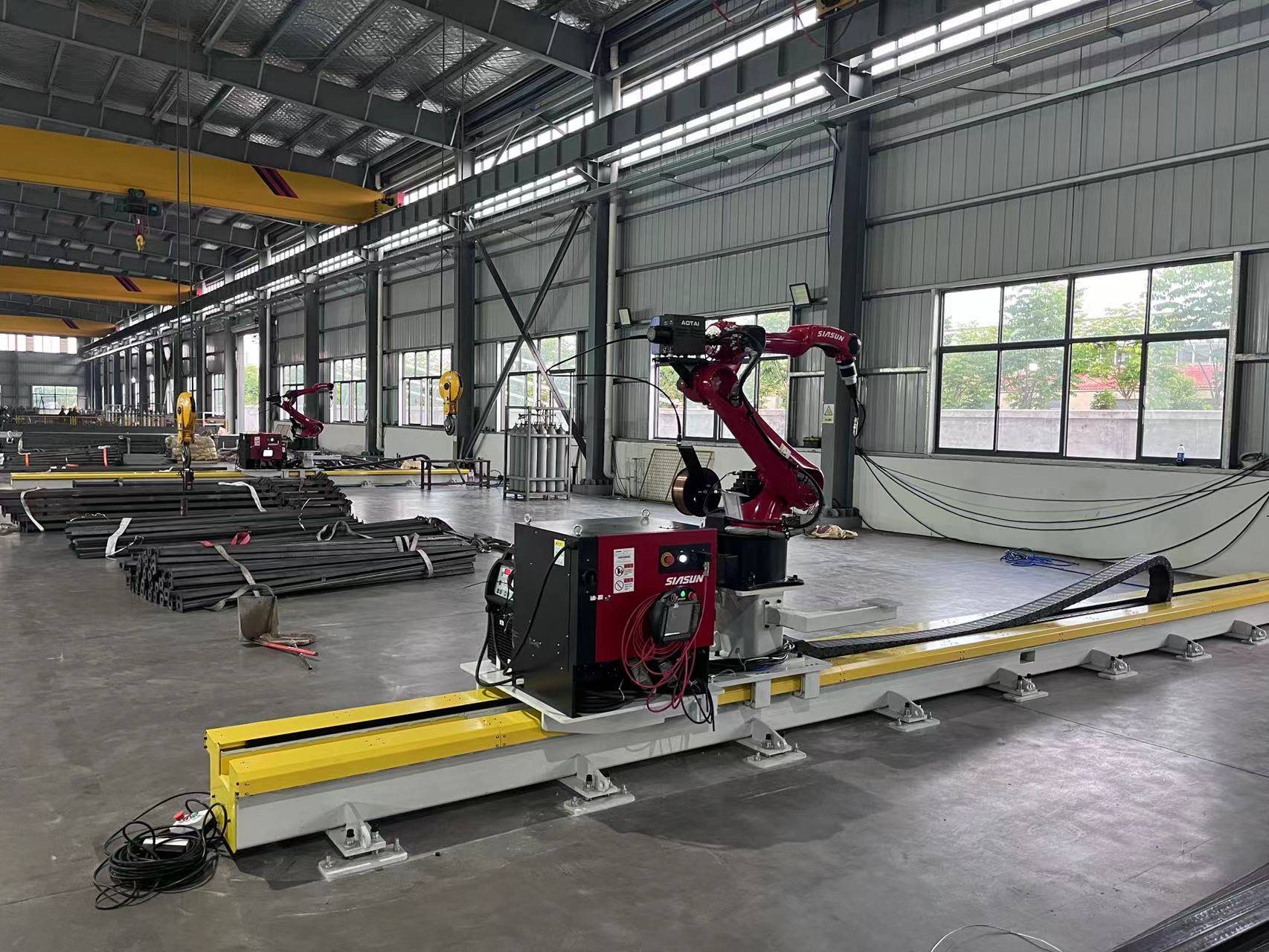
Industrial engineers must focus on the wire feed delivery system as a primary point of failure. In a robotic setup, the use of large-capacity wire drums (250kg to 500kg) minimizes downtime associated with spool changes. However, the increased distance between the wire feeder and the contact tip introduces the risk of “bird-nesting” or friction-induced feed fluctuations. Implementing a high-quality Wire Feed Consistency protocol, including the use of low-friction liners and ceramic guides, ensures that the deposition rate remains constant across an eight-hour shift, directly impacting the final metallurgical properties of the girth seam.
Maintenance Schedules for High-Utilization Robotic Cells
To maintain a high OEE (Overall Equipment Effectiveness), a preventative maintenance strategy is mandatory. Robotic MAG systems in heavy industry are subject to intense thermal cycles and spatter accumulation. The contact tip, a critical consumable, must be monitored for “keyholing”—a condition where the orifice becomes elongated, leading to arc wander. In Narrow Gap MAG welding, even a 0.5mm deviation in arc position can result in a catastrophic lack of sidewall fusion.
Daily maintenance should include the inspection of the robotic torch neck and the automatic nozzle cleaning station. These stations use mechanical reamers to remove spatter and apply anti-spatter compounds, ensuring that the Shielding Gas Flow remains laminar. Blockages in the nozzle can lead to porosity, which is particularly difficult to repair in deep-groove geometries. Weekly inspections should focus on the cable assembly (the “dress pack”). In girth seam welding, the repetitive rotational movement can cause internal fatigue in the power cables and gas lines. Monitoring the electrical resistance of the primary welding circuit helps in identifying fraying cables before they cause voltage drops that compromise weld quality.
Calculating Labor ROI and Throughput Gains
The financial justification for moving to a robotic girth seam welder is anchored in the Labor ROI and the dramatic increase in duty cycles. A manual welder typically operates at an arc-on time of 20% to 30% due to fatigue, repositioning, and the need for frequent starts and stops. In contrast, a robotic system can maintain an arc-on time of 70% to 85%. For a standard 500mm diameter girth seam on a hydraulic cylinder, the reduction in weld volume via narrow gap geometry combined with robotic speed can reduce cycle times by up to 60%.
Furthermore, the scarcity of highly skilled welders capable of performing multi-pass narrow gap welds manually creates a production bottleneck. By automating the process, the role of the human operator shifts from a manual laborer to a Systems Technician. This transition allows one operator to manage multiple welding cells simultaneously, effectively tripling or quadrupling the output per labor hour. When calculating the payback period, engineers must include the reduction in post-weld grinding and rework. Robotic MAG welding produces a significantly cleaner bead profile with minimal spatter, often eliminating the need for secondary finishing processes before painting.
Integration of Seam Tracking and Adaptive Control
While the mechanical precision of the robot is high, the incoming parts in construction machinery manufacturing often have dimensional variances due to upstream processing. To counteract this, Automatic Girth Seam welders are increasingly equipped with “Through-Arc Seam Tracking” (TAST) or laser-based vision sensors. These sensors provide real-time feedback to the robot controller, allowing it to adjust the torch path if the joint centers shift during rotation. This Adaptive Control capability is crucial for narrow gap welding, where the margin for error is significantly smaller than in traditional fillet or V-groove welds.
By leveraging these advanced sensing technologies, the system can compensate for thermal expansion during the welding process. As the component heats up, the metal expands, potentially narrowing the gap further. A smart robotic system will detect changes in the welding current or the physical position of the groove walls and adjust the Deposition Rate and travel speed accordingly. This ensures that every pass, from the root to the cap, meets the specified engineering requirements without manual intervention.
The Strategic Value of Standardized Robotic Output
Ultimately, the move toward robotic narrow gap girth welding is about risk mitigation and scalability. In the production of excavators and loaders, a single weld failure in the field can lead to massive warranty claims and brand damage. Robotic Automation provides a digital record of every weld—tracking parameters such as current, voltage, gas flow, and wire speed. This data logging is essential for quality assurance and continuous improvement initiatives. From an industrial engineering perspective, the transition to Narrow Gap MAG is not merely a tooling upgrade; it is a fundamental optimization of the manufacturing value chain that delivers superior structural performance while maximizing the Labor ROI.
-


LT240S tube laser cutting machine
-
LT120S tube laser cutting machine
-
Sale

Tank Fillet Welding Machine
Original price was: $1,000.00.$900.00Current price is: $900.00. -
Sale

MAK100 tube laser cutting machine
Original price was: $5,500.00.$5,000.00Current price is: $5,000.00. -

portable plasma air cutting machine
$1,200.00 -

2in1 fiber laser cutting machine
-

Air cooling Laser welding machine
-

HF h beam laser cutting machine
-

LT240 laser cutting machine
-

Laser welding machine
-


Cobot Welding Station
-

Gantry welding robot solution
-

Tracked Wheeled AGV Welding robot
-

LFH6020 Fiber laser cutting machine
-
LFP6020
-

robotic welidng machine
Advanced Fiber Laser Tube Processing Technology
Our CNC Fiber Laser Tube Cutting systems revolutionize metal fabrication by integrating high-precision cutting, punching, and profiling into a single automated workflow. Designed for versatility, this technology handles a wide array of profiles including Round, Square, Rectangular, and Oval tubes, as well as complex L-shaped and U-shaped channels.
- Precision Punching: High-speed hole punching with micron-level accuracy, eliminating the need for mechanical drilling or die-stamping.
- Complex Profiling: Advanced 3D pathing allows for intricate interlocking joints and specialized notch cuts, ideal for structural frames.
- High Material Efficiency: Intelligent nesting software minimizes scrap, reducing raw material costs across large production runs.
- Clean Finish: Delivers oxide-free, burr-free edges that require zero secondary grinding before welding.

Seamlessly processing multiple profiles with consistent precision.
Global Delivery & Logistics



From our high-tech manufacturing facility directly to your global site. PCL WeldCut ensures secure packaging, professional handling, and reliable international logistics to safeguard your equipment throughout the entire journey.