Optimizing Heavy-Duty Fabrication via Narrow Gap MAG Integration
In the production of construction machinery, such as hydraulic cylinders, crane booms, and undercarriage components, the girth seam represents a critical structural juncture. Traditional manual welding of these thick-walled sections often requires wide-angle V-grooves, leading to excessive filler metal consumption and prolonged cycle times. The shift toward Narrow Gap Welding using robotic MAG processes addresses these inefficiencies by significantly reducing the total weld volume. From an industrial engineering perspective, the objective is to maximize the deposition rate while minimizing the number of passes required to achieve full penetration and structural integrity.
Technical Foundations of Robotic Narrow Gap MAG
Narrow gap technology utilizes a joint preparation with a groove angle typically ranging from 1 to 5 degrees, or even a parallel-sided gap. This geometry demands extreme precision that manual operators cannot consistently maintain over long production shifts. Robotic systems, equipped with high-resolution encoders and specialized MAG torches, provide the stability necessary to navigate these tight clearances.
MAG Process Parameters in Narrow Grooves
The MAG process (Metal Active Gas) is preferred in construction machinery for its high deposition efficiency and versatility. When applied to narrow gaps, the shielding gas composition—often a mix of Argon and CO2—is optimized to ensure deep penetration without causing sidewall undercut. Industrial engineers must calibrate the pulse parameters to control the arc length precisely. A fluctuating arc in a narrow gap can lead to catastrophic short-circuiting against the sidewalls rather than the root, making robotic consistency a non-negotiable requirement.
Seam Tracking and Adaptive Control
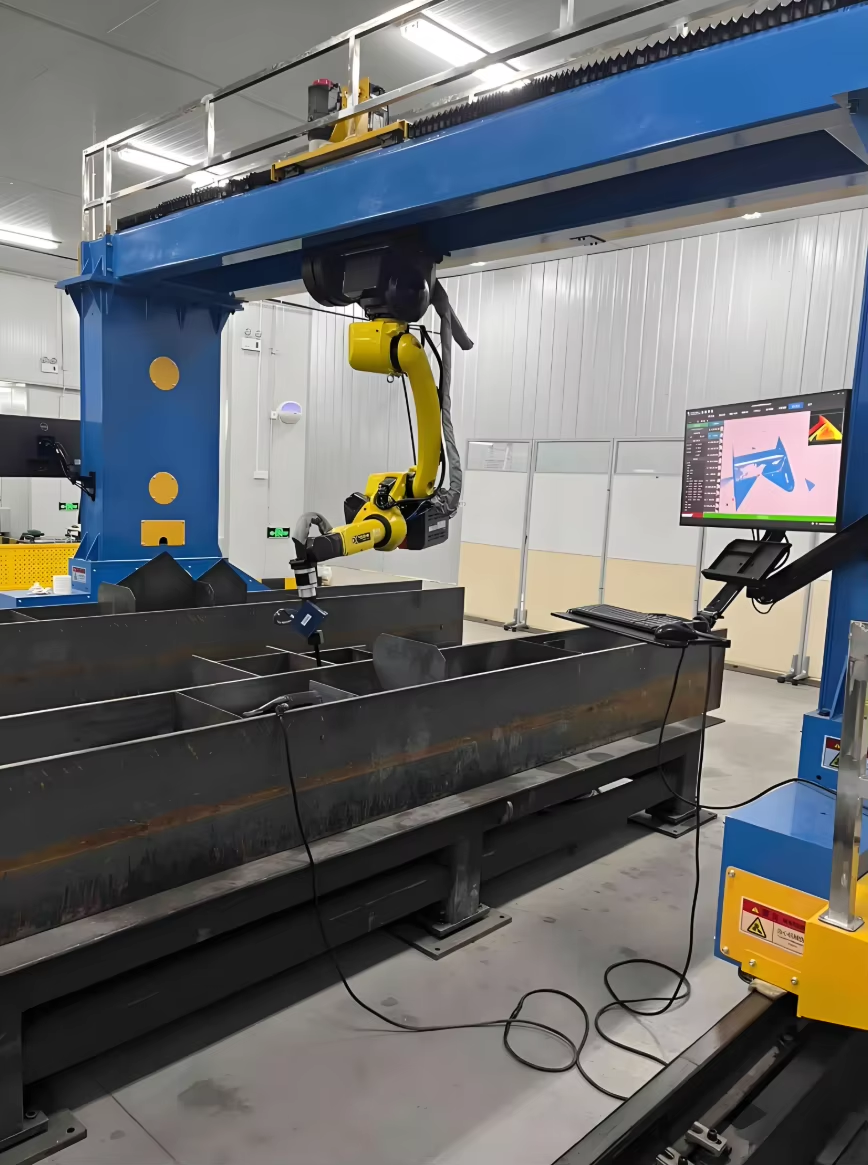
Construction machinery components often exhibit minor dimensional variances due to upstream machining or fit-up tolerances. Robotic girth seam welders utilize “Through-the-Arc” Seam Tracking (TAST) or tactile sensors to adjust the tool center point (TCP) in real-time. This ensures the wire remains centered in the narrow groove, maintaining a consistent heat-affected zone (HAZ) and preventing slag inclusions that typically occur in manual multi-pass girth welds.
The Economic Logic of Labor ROI
The financial justification for investing in an Automatic Girth Seam Welder is rooted in the Labor ROI and the drastic reduction in rework. In manual environments, thick-walled girth seams require highly skilled welders who must manage heat input over several hours. This leads to fatigue and variability in weld quality.
Calculating Throughput Gains
An automated robotic cell can operate at a duty cycle of 85-90%, compared to the 30-40% typically seen in manual heavy-gauge welding. By reducing the groove volume through narrow gap preparation, the amount of required filler wire is reduced by up to 50%. This creates a dual-cost advantage: lower material expenditure and faster cycle times. For a typical excavator boom cylinder, a robotic system can reduce the total welding time from 4 hours to approximately 75 minutes.
Shift in Labor Utilization
Transitioning to Robotic Automation does not necessarily eliminate the need for skilled labor but shifts the focus from manual execution to system supervision. One technician can oversee two or even three robotic girth welding stations simultaneously. The ROI is realized not just through headcount reduction, but through the elimination of the “post-weld inspection and repair” cycle. Robotic MAG produces a repeatable X-ray quality weld, which is essential for components subjected to high fatigue loads in the field.
Maintenance Protocols for High-Uptime Systems
To sustain the ROI of an automatic girth seam welder, a rigorous preventive maintenance (PM) schedule is mandatory. Robotic systems in heavy industrial environments are subject to weld spatter, fine metallic dust, and thermal cycling.
Consumable Management
The contact tip and gas nozzle are the primary points of failure. In narrow gap welding, the nozzle is often elongated to reach deep into the joint. Automated torch cleaning stations (reamers) should be programmed to clean the nozzle every 2-3 cycles. This prevents spatter buildup that could disrupt gas flow or cause wire feeding issues. Industrial engineers should implement “life-cycle tracking” for liners and drive rolls to prevent wire slip, which would otherwise lead to arc instability in the narrow groove.
Robotic Calibration and Axis Alignment
Girth seam welding requires perfect synchronization between the robotic arm and the rotary positioner. If the rotation speed deviates by even 1%, the weld bead profile will change, potentially leading to lack of fusion. Semi-annual calibration of the robot’s axes and the external axis (the rotator) ensures that the surface travel speed remains constant. Maintenance teams must also inspect the ground path; poor grounding in high-amperage MAG welding can lead to bearing damage within the rotary positioner.
Quality Assurance and Structural Integrity
Construction machinery operates under extreme stress. The narrow gap MAG process, when executed by a robot, results in a more refined grain structure due to the controlled, lower total heat input. By using fewer passes to fill the joint, the material undergoes fewer thermal cycles, which preserves the mechanical properties of the base alloy. This is critical for high-strength low-alloy (HSLA) steels frequently used in modern machinery.
Digital Documentation and Traceability
Modern robotic controllers can log every weld parameter—voltage, amperage, wire feed speed, and gas flow—for every girth seam produced. This digital “birth certificate” provides manufacturers with 100% traceability. In the event of a field failure, engineers can review the data logs to confirm that the weld was performed within the specified tolerances, a level of oversight impossible to achieve with manual welding operations.
Conclusion: Scaling the Industrial Advantage
The implementation of an automatic girth seam welder with narrow gap MAG technology is a strategic move for any construction machinery manufacturer looking to remain competitive. The synergy of reduced material consumption, high-speed robotic execution, and data-driven maintenance ensures a rapid return on investment. By focusing on the engineering fundamentals of the weld joint and the precision of robotic movements, facilities can achieve unprecedented levels of throughput and reliability in their heavy-duty fabrication lines.
-


LT240S tube laser cutting machine
-
LT120S tube laser cutting machine
-
Sale

Tank Fillet Welding Machine
Original price was: $1,000.00.$900.00Current price is: $900.00. -
Sale

MAK100 tube laser cutting machine
Original price was: $5,500.00.$5,000.00Current price is: $5,000.00. -

portable plasma air cutting machine
$1,200.00 -

2in1 fiber laser cutting machine
-

Air cooling Laser welding machine
-

HF h beam laser cutting machine
-

LT240 laser cutting machine
-

Laser welding machine
-


Cobot Welding Station
-

Gantry welding robot solution
-

Tracked Wheeled AGV Welding robot
-

LFH6020 Fiber laser cutting machine
-
LFP6020
-

robotic welidng machine
Advanced Fiber Laser Tube Processing Technology
Our CNC Fiber Laser Tube Cutting systems revolutionize metal fabrication by integrating high-precision cutting, punching, and profiling into a single automated workflow. Designed for versatility, this technology handles a wide array of profiles including Round, Square, Rectangular, and Oval tubes, as well as complex L-shaped and U-shaped channels.
- Precision Punching: High-speed hole punching with micron-level accuracy, eliminating the need for mechanical drilling or die-stamping.
- Complex Profiling: Advanced 3D pathing allows for intricate interlocking joints and specialized notch cuts, ideal for structural frames.
- High Material Efficiency: Intelligent nesting software minimizes scrap, reducing raw material costs across large production runs.
- Clean Finish: Delivers oxide-free, burr-free edges that require zero secondary grinding before welding.

Seamlessly processing multiple profiles with consistent precision.
Global Delivery & Logistics



From our high-tech manufacturing facility directly to your global site. PCL WeldCut ensures secure packaging, professional handling, and reliable international logistics to safeguard your equipment throughout the entire journey.