Automatic Girth Seam Welder with Magnetic Crawler for Wind Tower fabrication

In this article
- Advancing Wind Tower Fabrication through Mechanized Girth Seam Welding
- Kinematics and Mechanical Stability of Magnetic Crawlers
- Metal Active Gas (MAG) Process Optimization
- Maintenance Protocols for Robotic Welding Systems
- Economic Impact and Labor ROI Analysis
- Conclusion: The Engineering Standard for Future Fabrications
Advancing Wind Tower Fabrication through Mechanized Girth Seam Welding
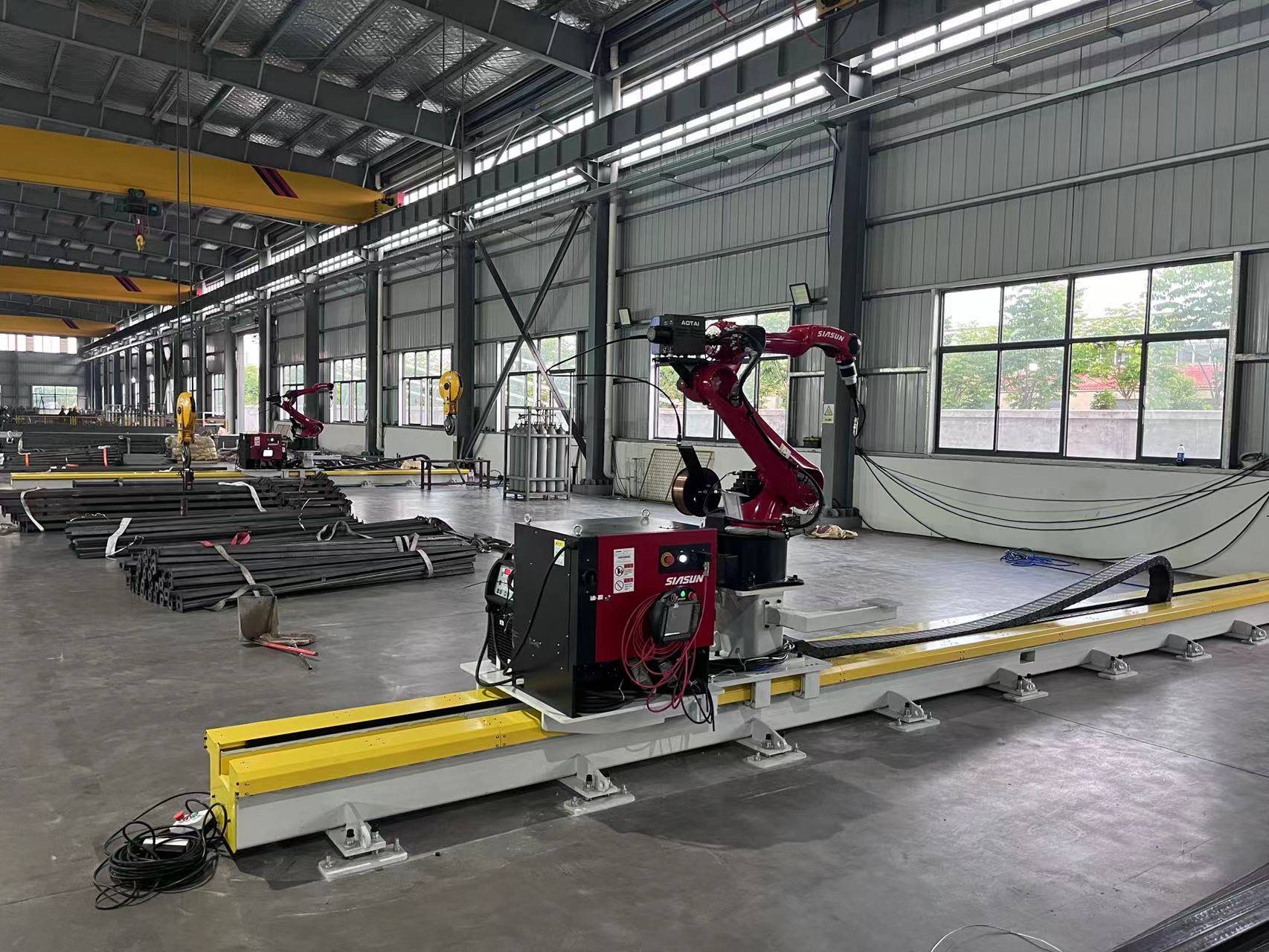
The global demand for utility-scale wind energy necessitates the production of increasingly large tower sections. These sections, often referred to as “cans,” require precise circumferential welds to ensure structural integrity against massive dynamic loads. Traditional manual welding methods are no longer viable for high-volume production due to ergonomic limitations and the high probability of volumetric defects. The introduction of the Automatic Girth Seam Welder, specifically utilizing magnetic crawler integration, represents a paradigm shift in fabrication efficiency. This system adheres directly to the steel wall of the tower, providing a stable platform for high-deposition MAG welding without the need for complex external guidance tracks.
Kinematics and Mechanical Stability of Magnetic Crawlers
Unlike traditional submerged arc welding (SAW) columns that require the workpiece to rotate on heavy-duty rollers, a magnetic crawler moves along the stationary or rotating workpiece with precision. The crawler utilizes high-pull-force permanent magnets or electromagnets to maintain a constant distance from the weld joint. This is critical for maintaining a stable arc length and consistent stick-out. From an industrial engineering perspective, the reduction in material handling—moving the welding head rather than repositioning a 50-ton tower section—drastically reduces the non-value-added time in the production cycle.
The drive system typically incorporates high-resolution encoders that synchronize the travel speed with the wire feed rate. For wind tower sections where wall thicknesses can exceed 50mm, maintaining a consistent travel speed is essential for managing the heat-affected zone (HAZ) and ensuring full penetration during the root pass. The crawler’s ability to navigate slight variations in curvature allows for a more forgiving setup compared to rigid rail systems.
Metal Active Gas (MAG) Process Optimization
The choice of MAG welding for girth seams is driven by its versatility and high deposition rate optimization. In wind tower fabrication, using a gas mixture—typically 80% Argon and 20% CO2—allows for a stable spray transfer mode. This mode is characterized by a fine droplet transfer across the arc, resulting in minimal spatter and deep penetration. When integrated with a magnetic crawler, the MAG process can be pushed to its upper limits of current and voltage, as the mechanical system can handle the heat and speed that a human operator cannot sustain.
Multi-Pass Strategy and Interpass Temperature Control
Heavy-wall girth seams require multiple passes: a root pass, several fill passes, and a cap pass. Automatic crawlers excel here by allowing for “on-the-fly” adjustments. Industrial engineers specify precise parameters for each pass to manage the thermal input. By automating the oscillation width and dwell time at the edges of the weld joint, the crawler ensures that each layer is fused perfectly to the previous one, minimizing the risk of lack-of-fusion defects that are common in manual out-of-position welding.
Maintenance Protocols for Robotic Welding Systems
The reliability of an automated welding cell is only as good as its preventive maintenance (PM) program. For a magnetic crawler system, maintenance is divided into mechanical, electrical, and consumable categories. Failure to adhere to a strict PM schedule results in unplanned downtime, which is particularly costly in the tightly scheduled environment of wind tower assembly lines.
Consumable Management and Wire Delivery
The contact tip and gas nozzle are the most frequently replaced items. In a high-duty-cycle environment, contact tip wear can lead to arc instability and “keyholing” of the tip, which causes wire wandering. Engineers should implement a “hits-based” replacement strategy rather than waiting for failure. Furthermore, the wire conduit or liner must be blown out with compressed air daily to remove copper flaking and dust, ensuring smooth wire delivery from the bulk drum to the torch head.
Magnetic Wheel and Drive Calibration
The magnetic wheels accumulate metallic dust and grinding swarf over time. If not cleaned, this debris can interfere with the magnetic pull force or cause the wheels to slip, leading to inconsistent travel speeds. Monthly calibration of the crawler’s tachometer against a physical measurement of distance is required to ensure the programmed travel speed matches the actual output. This precision is what allows the system to maintain the tight tolerances required by international welding standards such as AWS D1.1.
Economic Impact and Labor ROI Analysis
The primary driver for adopting magnetic crawler technology is the labor ROI analysis. In a manual welding scenario, a welder’s “arc-on” time—or duty cycle—is typically between 20% and 30%. This is due to fatigue, the need for frequent repositioning, and the requirement for PPE adjustments. An automated crawler increases this duty cycle to 70% or 80%. This effectively triples the productivity of a single workstation.
Direct Labor Savings and Skill Level Redistribution
By automating the girth seam, the requirement shifts from needing four highly skilled manual welders to needing one skilled operator and one technician to oversee two or three machines. This addresses the chronic shortage of certified high-pressure welders. The ROI is calculated by comparing the capital expenditure (CAPEX) of the crawler system against the reduction in man-hours per tower. Typically, in a facility producing 100 towers per year, the payback period for a magnetic crawler system is less than 14 months, factoring in both labor savings and the reduction in consumables wasted through spatter and rework.
Quality Costs and Rework Reduction
The cost of rework in wind tower fabrication is astronomical, involving gouging out defective welds, re-prepping the joint, and re-welding—all while the tower occupies valuable floor space. Manual girth welds often suffer from inconsistencies at the 6 o’clock and 12 o’clock positions. The flux-cored arc welding or solid-wire MAG processes used by crawlers provide a uniform bead profile around the entire circumference. Reducing the rework rate from 5% (manual) to less than 1% (automated) provides a significant boost to the bottom line that is often overlooked in initial ROI projections.
Conclusion: The Engineering Standard for Future Fabrications
The integration of magnetic crawlers for girth seam welding is no longer an optional upgrade but an industrial necessity. By focusing on the mechanical precision of the crawler, the metallurgical advantages of the MAG process, and a disciplined approach to maintenance, wind tower manufacturers can achieve unprecedented levels of throughput. The transition from manual labor to automated systems ensures that the structural components of the green energy transition are built with the highest possible standards of efficiency and reliability.






