Automatic Girth Seam Welder with 5-Axis Beveling for Wind Tower fabrication

In this article
Optimizing Wind Tower Girth Seams through 5-Axis Robotic Automation
In the heavy industrial sector, specifically wind energy infrastructure, the structural integrity of a turbine tower is predicated on the quality of its girth seams. As tower heights exceed 100 meters and plate thicknesses increase to support larger turbines, traditional welding methods face diminishing returns. The implementation of an Automatic Girth Seam Welder utilizing 5-axis beveling technology represents a fundamental shift in fabrication throughput. Unlike standard circular welders, a 5-axis system allows for real-time adjustments to the torch angle and orientation, compensating for fit-up discrepancies and ensuring deep penetration across complex weld geometries.
The Technical Advantage of 5-Axis Beveling in Welding Operations
5-axis motion control provides the degrees of freedom necessary to handle the “J” and “V” groove profiles common in wind tower sections. When the robotic system manages the beveling orientation alongside the welding head, it eliminates the variance found in manual torch positioning. For wind towers, where sections can be 4 to 6 meters in diameter, maintaining a consistent torch-to-workpiece distance and angle is physically taxing for human operators. The 5-axis system maintains a constant surface speed and optimal wire stick-out, which is critical for maintaining the heat-affected zone (HAZ) within metallurgical specifications.
This precision is not merely about aesthetics; it is about mechanical properties. By utilizing the additional axes, the system can execute multi-pass welds with variable weave patterns that optimize grain structure during the cooling phase. This reduces the likelihood of porosity or slag inclusions that often lead to costly weld repairs during non-destructive testing (NDT).
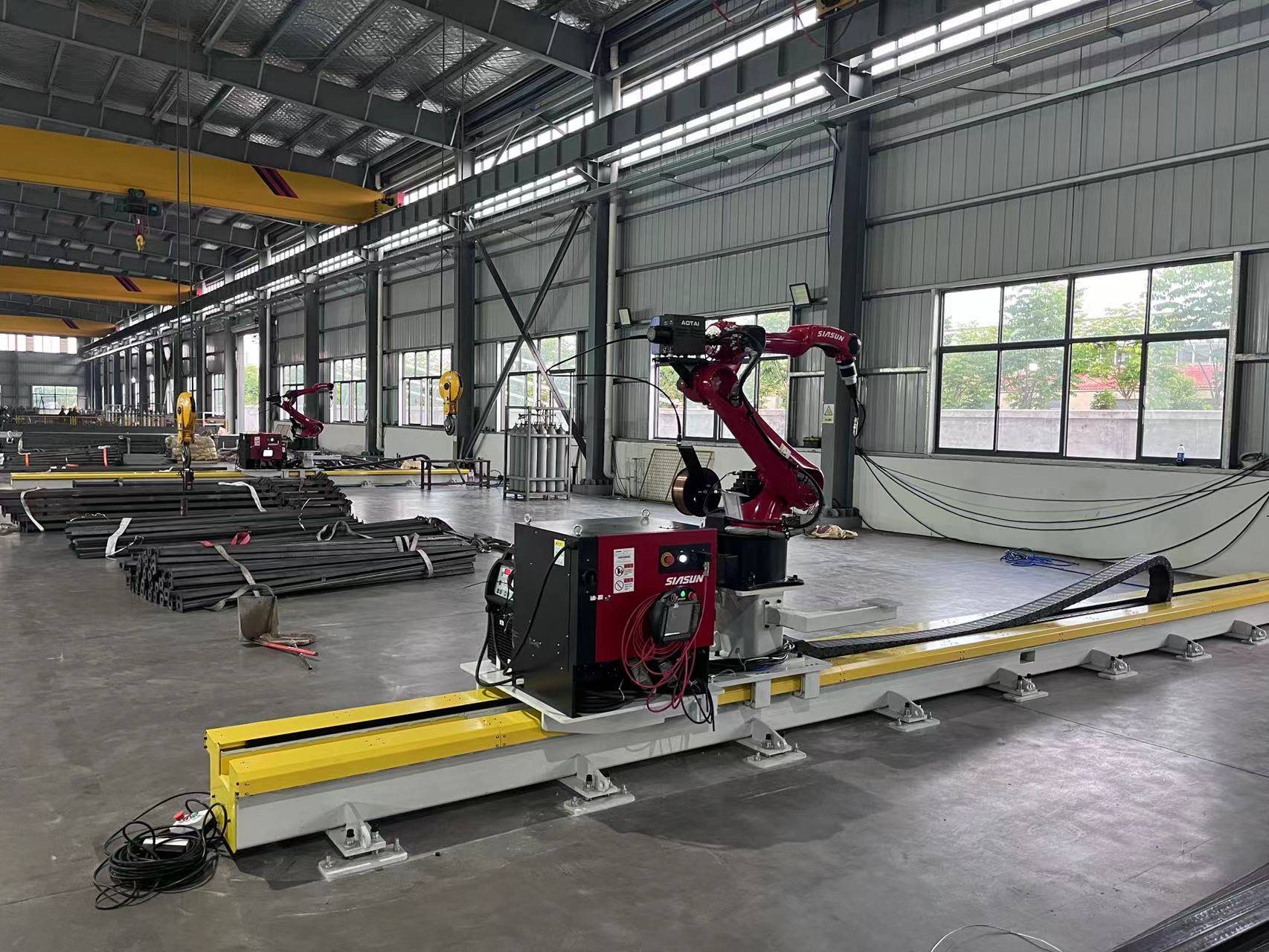
High-Efficiency Metal Active Gas (MAG) Implementation
Robotic MAG Welding is the primary process utilized in these automated cells due to its high deposition rates and adaptability. In wind tower fabrication, using a gas mixture—typically Argon and CO2—allows for a stable arc even at high current densities. The automated system excels in controlling the spray transfer mode, which is essential for the thick sections of tower cans.
The integration of high-amperage power sources with synchronized wire feeders ensures that the deposition rate remains constant. While a manual welder may achieve a deposition rate of 3-4 kg/h, a robotic girth welder can comfortably sustain 8-12 kg/h through tandem wire or high-deposition single-wire configurations. This 300% increase in material deposition significantly shortens the production cycle for each tower section, directly impacting the factory’s annual megawatt capacity.
Predictive Maintenance and Reliability of Robotic Cells
From an industrial engineering perspective, the uptime of the welding cell is as critical as the weld quality. Robotic systems require a structured maintenance regimen focused on the mechanical and electrical components unique to 5-axis movement. Key areas of focus include:
- Torch Calibration: Frequent Tool Center Point (TCP) checks ensure the 5-axis coordinates remain accurate. Automated TCP stations can recalibrate the torch after every weld cycle to account for thermal expansion or minor collisions.
- Consumable Management: The use of automated torch cleaners (rebamers) is mandatory. These systems clear spatter from the gas nozzle and apply anti-spatter fluid, extending the life of the contact tip and ensuring consistent shielding gas flow.
- Wire Delivery Systems: Large-scale wind tower fabrication involves high wire consumption. Maintenance must ensure that the wire conduits and drive rolls are free of debris to prevent “bird-nesting” or erratic feeding, which are the leading causes of robotic downtime.
- Slip Rings and Rotators: Since girth welding involves rotating massive cylindrical sections, the synchronization between the robotic arm and the turning rolls is paramount. Maintenance of the encoder feedback loops and the heavy-duty motors of the rotators is essential for preventing velocity ripples in the weld bead.
Labor ROI and Workforce Transformation
The transition to Wind Tower Fabrication automation often meets resistance due to perceived high capital expenditure. However, the Labor Return on Investment (ROI) is compelling when viewed through the lens of total cost per ton of steel. Manual welding of girth seams requires a highly skilled workforce, a resource that is increasingly scarce and expensive.
In a manual setup, a single girth seam might require four welders working in shifts to manage the heat and physical fatigue. With an automatic 5-axis welder, one technician can oversee two separate welding cells. This does not eliminate the need for skilled labor but shifts the requirement from physical execution to technical oversight and process optimization.
The ROI is calculated by factoring in the reduction of rework. In manual wind tower welding, defect rates can hover between 3% and 5%. Robotic systems, once calibrated, typically bring this down to less than 0.5%. When the cost of gouging, re-welding, and re-testing a 50mm thick girth seam is calculated, the savings often pay for the robotic infrastructure within 18 to 24 months of operation.
Structural Integrity and Duty Cycles
Wind towers are subjected to cyclical loading for 20 to 25 years. The fatigue life of a weld is largely determined by its profile and the absence of undercut. Automatic 5-axis welders produce a consistent weld toe profile that minimizes stress concentrations. Furthermore, these machines operate at a 100% duty cycle. Unlike human operators who require breaks and experience performance degradation toward the end of a shift, the robotic cell maintains peak performance across a 24-hour production schedule.
Conclusion: Scaling Production for the Global Energy Transition
As the demand for renewable energy infrastructure accelerates, the bottleneck in wind tower production is often the welding shop. By deploying 5-Axis Beveling integrated girth seam welders, manufacturers can ensure they meet the rigorous quality standards of the energy sector while maintaining a competitive cost structure. The fusion of MAG welding efficiency with high-precision robotic motion control provides the only viable path for scaling tower production to meet global decarbonization targets. Industrial engineers must prioritize the integration of these systems to optimize throughput, reduce labor-related variability, and enhance the long-term structural reliability of wind turbine assets.






