Automatic Girth Seam Welder with 5-Axis Beveling for Bridge Trusses

In this article
System Architecture for Automatic Girth Seam Welding
In the heavy structural sector, specifically bridge truss fabrication, the girth seam weld represents a critical point of potential failure. Traditional manual methods rely on highly skilled welders to maintain consistent torch angles and travel speeds around large-diameter tubular members. The transition to an Industrial Welding Automation strategy involves the deployment of a specialized 5-axis girth seam welder. This system is engineered to handle the circumferential joints of bridge chords and braces with a level of repeatability that manual processes cannot replicate.
The 5-axis configuration is essential for managing the complex geometries of bridge trusses. Unlike simple 2-axis rotators, a 5-axis system allows for the dynamic adjustment of the torch head in relation to the weld pool. This is particularly vital when dealing with varying wall thicknesses and the inherent deviations found in large-scale structural steel. The system maintains a constant contact-tip-to-work distance (CTWD), ensuring that the voltage and current remain within the specified Welding Procedure Specification (WPS) limits throughout the 360-degree rotation.
Advanced MAG Welding Process Optimization
The core of this automated system is the MAG Welding Process (Metal Active Gas), utilizing a mix of Argon and Carbon Dioxide to stabilize the arc and control penetration depth. for Bridge Trusses, which often utilize high-strength, low-alloy (HSLA) steels, the MAG process is optimized for high deposition rates. In an automated environment, the system can utilize spray transfer modes or pulsed-MAG waveforms to minimize spatter and maximize the duty cycle.
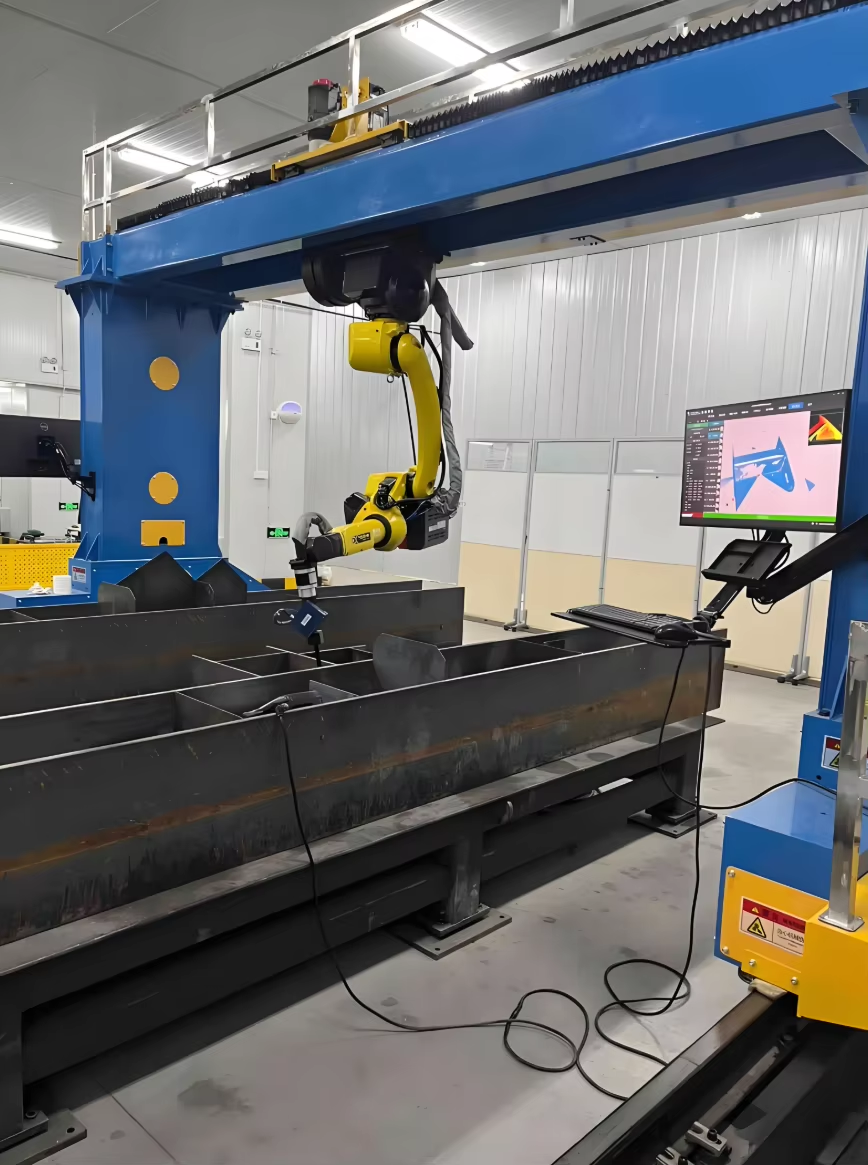
When executing multi-pass welds on thick-walled trusses, the 5-axis capability allows the robot to perform precise “weave” patterns. These patterns ensure adequate sidewall fusion, which is a common failure point in manual girth welding. The automation software calculates the necessary overlap for each pass, compensating for heat build-up and ensuring the interpass temperature remains within engineering tolerances. By automating the MAG process, the heat-affected zone (HAZ) is minimized through consistent travel speeds, which preserves the metallurgical properties of the bridge steel.
Kinematics of 5-Axis Bevel Filling
Bridge truss components are typically pre-beveled to allow for full-penetration welds. The 5-axis robotic welder excels in filling these V-groove or J-groove preparations. The additional axes of motion allow the torch to tilt and rotate, mimicking the dexterity of a human wrist but with mechanical precision. This motion is critical during the root pass, where the fit-up gap may vary. The system’s sensors detect the groove geometry and adjust the torch oscillation in real-time to bridge the gap without burn-through.
As the weld progresses to the fill and cap passes, the 5-axis system manages the weld bead profile to ensure a smooth transition to the base metal. This reduces the need for secondary grinding, which is a significant hidden cost in bridge fabrication. The mechanical consistency ensures that the reinforcement height and toe angles meet stringent AWS D1.5 Bridge Welding Code requirements, significantly increasing the probability of passing ultrasonic (UT) or radiographic (RT) testing on the first attempt.
Maintenance Protocols for High-Throughput Systems
To maintain a high Overall Equipment Effectiveness (OEE) in a bridge truss production line, a rigorous maintenance schedule for the robotic welder is mandatory. Unlike manual equipment, an automated girth welder operates at a duty cycle often exceeding 80%. This places significant thermal and mechanical stress on the torch consumables and the wire delivery system.
The primary maintenance focus is the wire feed consistency. Any friction in the liner can lead to arc instability and weld defects. Engineering standards dictate the replacement of Teflon or steel liners every 500 hours of arc time, or sooner if using flux-cored wires. The contact tips, which facilitate the electrical transfer to the welding wire, must be inspected daily. In high-amperage bridge welding, the orifice of the contact tip can erode, leading to “keyholing” and arc wandering. Automated systems often include a “reamer” station that periodically cleans the gas nozzle of spatter and applies anti-spatter liquid, extending the life of the consumables and ensuring consistent gas shielding.
Preventative Calibration and Mechanical Integrity
The 5-axis drive system requires periodic calibration to maintain its positional accuracy within +/- 0.1mm. This involves checking the backlash in the gearboxes and ensuring the encoders are providing accurate feedback to the controller. For girth seam welders, the alignment between the rotary chuck and the robotic arm is paramount. Misalignment can lead to non-uniform weld beads and increased mechanical wear on the drive motors. Lubrication of the 5-axis gantry and the rotary unit must be performed according to the manufacturer’s MTBF (Mean Time Between Failures) data to prevent unscheduled downtime.
Economic Analysis and Labor ROI
The primary driver for adopting 5-axis girth seam welding is the Labor ROI. In the current manufacturing landscape, finding certified bridge welders capable of manual out-of-position girth welding is increasingly difficult and expensive. An automated system allows a single operator to oversee multiple welding cells, effectively decoupling production capacity from headcount.
When calculating ROI, the engineer must look beyond the initial capital expenditure (CAPEX). A manual welder might achieve a deposition rate of 5 to 7 pounds per hour with a 30% duty cycle. In contrast, an automated MAG system can maintain a deposition rate of 12 to 15 pounds per hour at an 85% duty cycle. This represents a 300% to 400% increase in throughput per shift. Furthermore, the reduction in rework costs is a massive contributor to the ROI. In bridge fabrication, the cost of gouging out a failed weld, re-prepping the joint, and re-welding is often three to five times the cost of the original weld. By achieving a 99% first-pass yield, the automated system pays for itself within 18 to 24 months of operation in a high-volume environment.
Integration into the Production Workflow
Successful implementation of a 5-axis girth seam welder requires a shift in upstream and downstream logic. The fit-up of the bridge trusses must be more precise than what is acceptable for manual welding. If the components are not cut and prepped to tight tolerances, the automated system may require more complex sensing technology, such as laser-based seam tracking, which adds to the cost. Therefore, the engineering team must ensure that the entire Bridge Truss Fabrication process—from the initial tube preparation to the final assembly—is aligned with the requirements of robotic automation.
Ultimately, the move toward 5-axis Robotic Welding for bridge trusses is an evolution driven by the need for structural reliability and economic efficiency. By focusing on the MAG process and the mechanical advantages of multi-axis torch manipulation, fabricators can produce infrastructure components that meet the highest safety standards while optimizing their labor force and increasing their global competitiveness.






