Strategic Integration of 3D Vision in Heavy Structural Welding
In the domain of bridge truss fabrication, the girth seam represents a critical structural junction. Traditional manual welding of these circumferential joints is fraught with ergonomic challenges and consistency issues. The introduction of the Automatic Girth Seam Welder, powered by 3D vision positioning, has redefined the throughput expectations for industrial engineers. Unlike linear seams, girth welds on large-diameter tubular chords or box-section trusses require precise synchronization between the torch movement and the workpiece rotation or the robotic arm’s orbital path.
The primary engineering challenge in bridge trusses is the inherent geometric variance found in heavy-gauge steel. Rolling tolerances and fit-up discrepancies often result in non-uniform gaps and offsets. A static automated system fails in these environments because it cannot adapt to the “as-built” condition of the steel. 3D vision systems solve this by generating a point-cloud map of the joint in real-time. This allows the controller to adjust the wire stick-out, travel speed, and torch angle dynamically, ensuring 100% penetration and consistent bead profile regardless of minor fit-up errors.
The Technical Superiority of Robotic MAG Welding
The MAG welding process (Metal Active Gas) is the preferred modality for structural bridge components due to its high deposition rates and deep penetration characteristics. When integrated into a robotic cell, the MAG process operates at a duty cycle significantly higher than manual stick or semi-automatic MIG welding. Industrial engineers focus on optimizing the shielding gas mixture—typically an Argon/CO2 blend—to balance arc stability with spatter control.
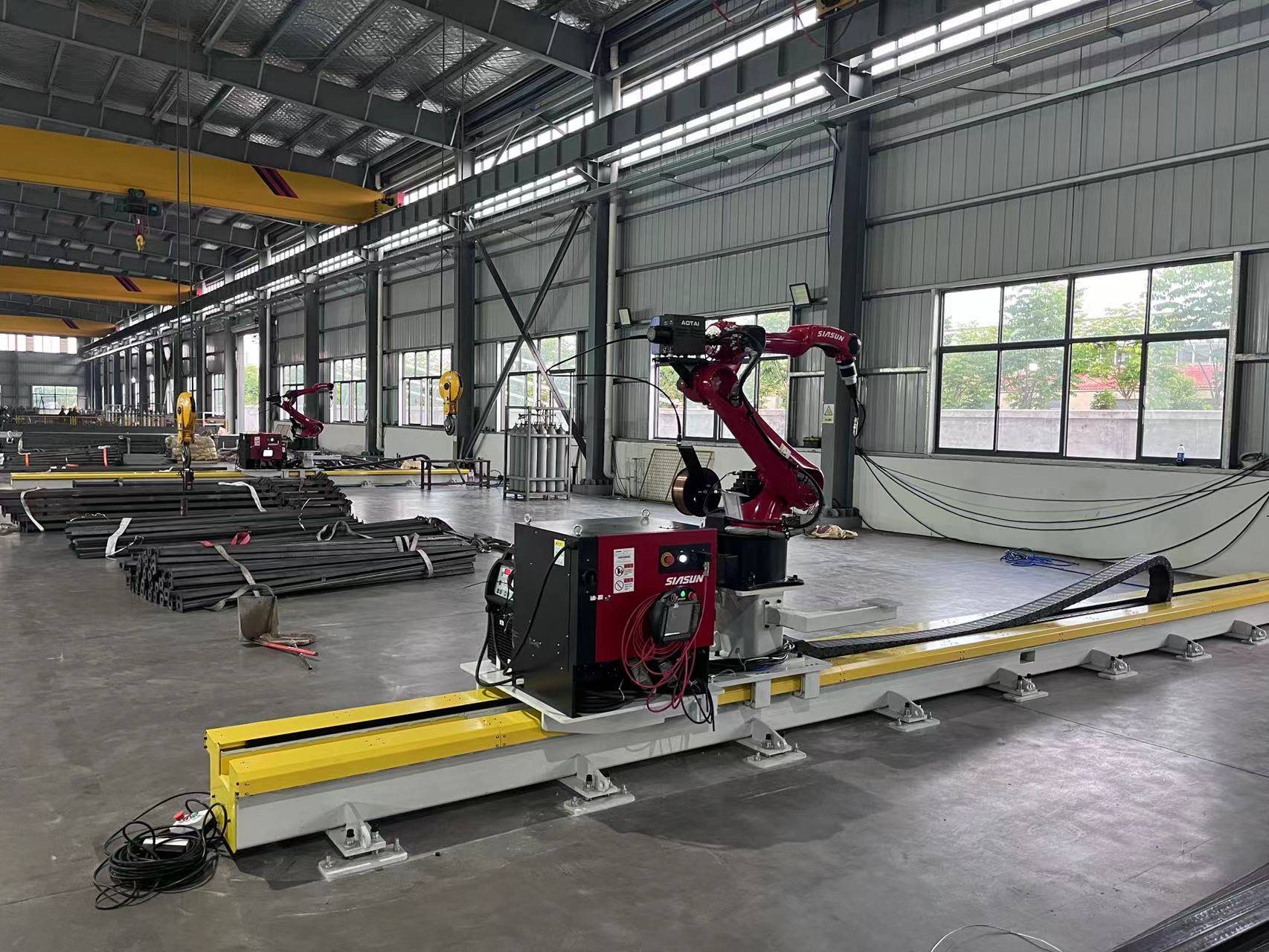
Robotic MAG systems utilize advanced power sources that allow for pulsed-arc or modified short-circuit transfers. In bridge truss applications, where out-of-position welding is common during the girth rotation, these waveforms are essential. The 3D vision system communicates with the power source to adjust parameters on the fly. If the gap widens, the system can increase the weave width and decrease travel speed, maintaining the structural integrity mandated by infrastructure welding codes such as AWS D1.5.
Maintenance Frameworks for High-Uptime Robotic Cells
For an industrial engineer, the reliability of an automated welding system is measured by its Mean Time Between Failures (MTBF). Maintenance in a robotic girth seam environment is not merely about repair; it is about predictive intervention. The high heat and spatter environment of MAG welding necessitate a rigorous maintenance schedule for both the torch assembly and the vision sensors.
The robotic torch requires a dedicated reamer station or “torch cleaner.” This peripheral device automatically clears spatter from the gas nozzle and applies anti-spatter fluid at programmed intervals. Furthermore, the contact tip—the point where electrical current is transferred to the welding wire—must be treated as a high-wear consumable. Industrial engineers implement “contact tip life” counters within the PLC to trigger a change-out before wire-feed instability occurs. Regarding the 3D vision hardware, maintenance focuses on the protective glass and air-knife systems that prevent smoke and spatter from obstructing the laser or camera lens. A clouded sensor leads to pathing errors, which can result in costly weld defects and rework.
Wire Delivery and Feed Consistency
The logistics of welding wire delivery are often overlooked but are critical for large-scale bridge trusses. Because girth seams on thick-walled sections require significant volumes of filler metal, using bulk drums (250kg to 500kg) is standard. The maintenance of the conduit and the drive rolls is paramount. Any friction in the wire delivery path will cause “burn-back” or arc instability, which the 3D vision system cannot compensate for. Regular inspection of the ceramic liners and drive roll tension ensures that the calculated deposition rates are consistently met.
Labor ROI and the Economic Shift
The most compelling argument for the adoption of automatic girth seam welders is the labor ROI. Bridge fabrication has traditionally relied on highly skilled, certified welders who are increasingly difficult to recruit and retain. A manual welder on a bridge truss may have an arc-on time of only 20% to 30%, with the remainder of the shift spent on positioning, cleaning, and rest due to the physical toll of the work.
In contrast, a robotic cell with 3D vision can achieve arc-on times exceeding 75%. The ROI is calculated by comparing the cost of one robotic operator—who does not need to be a certified master welder—against the cost of three manual welders required to match the same output. Furthermore, the reduction in weld defects is a major cost saver. In bridge construction, a single failed X-ray or ultrasonic test on a girth seam can cost thousands of dollars in gouging, re-welding, and re-testing. The precision of 3D vision pathing virtually eliminates the human error associated with “missed seams” or inconsistent penetration depth.
Throughput Scaling and Lifecycle Costs
From an industrial engineering perspective, the capital expenditure (CAPEX) of a robotic girth seam welder is offset by the drastic reduction in operating expenses (OPEX) per foot of weld. By scaling throughput, a fabrication shop can take on more projects without increasing their physical footprint or headcount. The 3D vision system also acts as a data collection tool, recording the parameters of every weld performed. This creates a digital twin of the bridge truss, providing a level of quality assurance and traceability that is impossible to achieve manually.
To maximize the robotic seam tracking investment, engineers must also consider the lifecycle of the software. Updates to the vision algorithms can allow the machine to handle new joint geometries or different material thicknesses without requiring new hardware. This flexibility ensures that the automation remains an asset for decades, matching the long lifecycle of the infrastructure it helps build.
Conclusion: The Engineering Mandate
Transitioning to automatic girth seam welding with 3D vision is no longer an optional upgrade for competitive bridge fabricators; it is a technical necessity. By prioritizing the MAG process for its efficiency and focusing on a robust maintenance culture, industrial engineers can ensure that their operations remain profitable and compliant with stringent safety standards. The shift toward automation represents a strategic move from labor-intensive craftsmanship to high-precision industrial manufacturing, where data, vision, and robotics converge to build the next generation of infrastructure.
-


LT240S tube laser cutting machine
-
LT120S tube laser cutting machine
-
Sale

Tank Fillet Welding Machine
Original price was: $1,000.00.$900.00Current price is: $900.00. -
Sale

MAK100 tube laser cutting machine
Original price was: $5,500.00.$5,000.00Current price is: $5,000.00. -

portable plasma air cutting machine
$1,200.00 -

2in1 fiber laser cutting machine
-

Air cooling Laser welding machine
-

HF h beam laser cutting machine
-

LT240 laser cutting machine
-

Laser welding machine
-


Cobot Welding Station
-

Gantry welding robot solution
-

Tracked Wheeled AGV Welding robot
-

LFH6020 Fiber laser cutting machine
-
LFP6020
-

robotic welidng machine
Advanced Fiber Laser Tube Processing Technology
Our CNC Fiber Laser Tube Cutting systems revolutionize metal fabrication by integrating high-precision cutting, punching, and profiling into a single automated workflow. Designed for versatility, this technology handles a wide array of profiles including Round, Square, Rectangular, and Oval tubes, as well as complex L-shaped and U-shaped channels.
- Precision Punching: High-speed hole punching with micron-level accuracy, eliminating the need for mechanical drilling or die-stamping.
- Complex Profiling: Advanced 3D pathing allows for intricate interlocking joints and specialized notch cuts, ideal for structural frames.
- High Material Efficiency: Intelligent nesting software minimizes scrap, reducing raw material costs across large production runs.
- Clean Finish: Delivers oxide-free, burr-free edges that require zero secondary grinding before welding.

Seamlessly processing multiple profiles with consistent precision.
Global Delivery & Logistics



From our high-tech manufacturing facility directly to your global site. PCL WeldCut ensures secure packaging, professional handling, and reliable international logistics to safeguard your equipment throughout the entire journey.